
Most people spend more time picking a vanity faucet than they do picking a mirror. That’s a mistake. The mirror is the first thing you see when you walk into a bathroom, and the wrong size throws off the entire space — too small and it looks like an afterthought, too wide and the vanity feels ungrounded. Getting the bathroom mirror size right isn’t complicated, but it does require a few specific measurements and a clear understanding of the rules that actually work. This guide walks you through everything, from standard sizes to shape selection to tricks that make even the smallest bathroom feel bigger.
Standard Bathroom Mirror Sizes
Before measuring anything, it helps to know what’s already out there. Most bathroom mirrors are sold in standard widths that align with common vanity sizes. Knowing these ranges narrows your search before you’ve taken a single measurement.
Common widths: 24″, 30″, 36″, 48″, 60″, 72″
Common heights: 28″ to 48″
Single-sink vanities typically fall between 24″ and 48″ wide. Double-sink vanities usually run 60″ to 72″. Mirrors are sized to match — a 36″ vanity pairs with a mirror in the 30″–34″ range, while a 60″ double vanity works with either one wide mirror around 54″–56″ or two separate mirrors at 24″–28″ each.
The most common off-the-shelf mirror size is 24″ × 36″. It fits standard guest bathrooms and most single-sink setups without any customization. Custom sizes become worth considering when your vanity is an unusual width or your ceiling height creates a gap that standard sizes won’t fill cleanly.
Vanity Width vs Recommended Mirror Width
| Vanity Width | Recommended Mirror Width | Notes |
|---|---|---|
| 24″ | 20″–22″ | Compact; single mirror centered above sink |
| 30″ | 26″–28″ | Most common guest bath setup |
| 36″ | 30″–34″ | Standard single-sink primary bath |
| 48″ | 44″–46″ | Works with one mirror or two 20″–22″ mirrors |
| 60″ | 54″–56″ (one) or 24″–28″ (×2) | Double sink; personal preference on one vs. two |
| 72″ | 66″–68″ (one) or 28″–32″ (×2) | Large primary bath; two mirrors recommended |
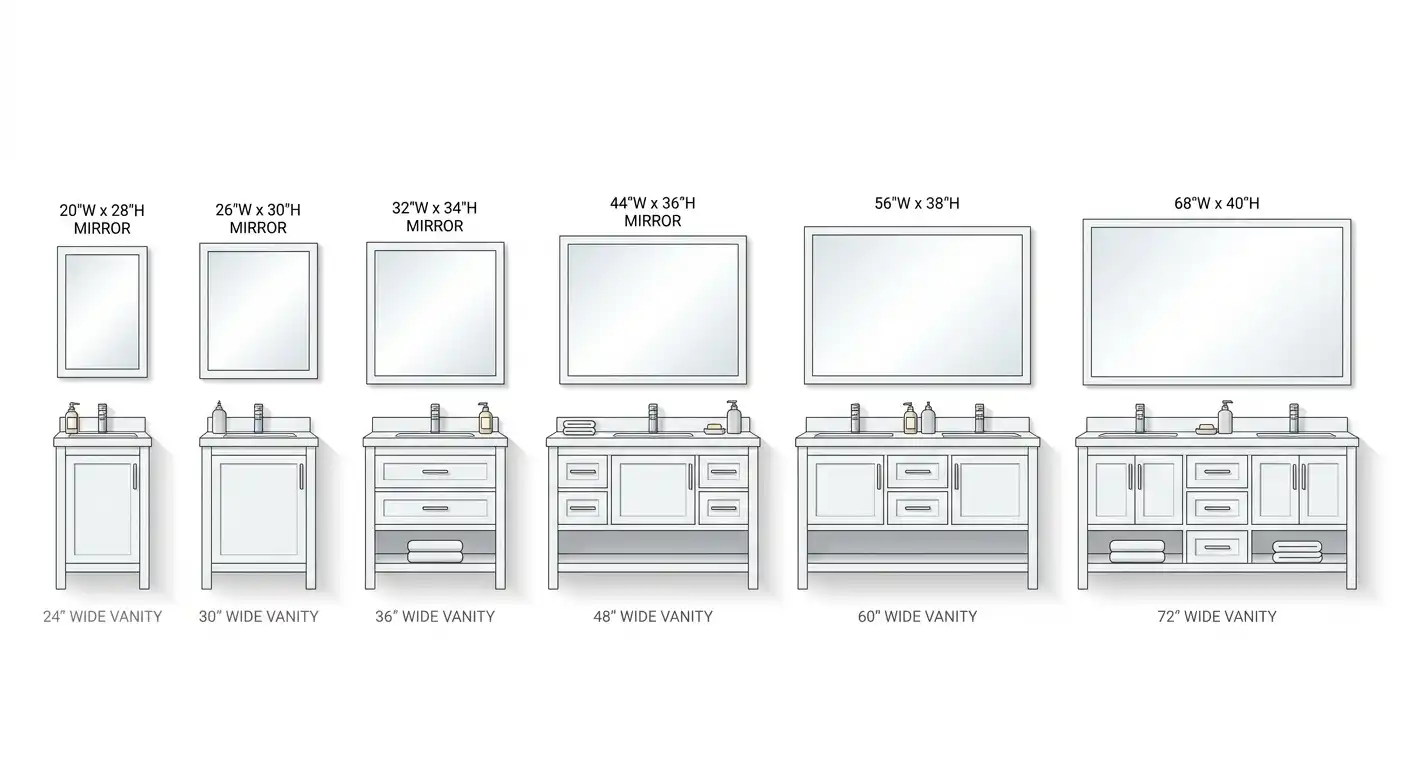
The Core Width Rule
Every sizing guide comes back to the same principle: your mirror should be slightly narrower than your vanity. The most widely used target is 2 to 4 inches narrower on each side, or roughly 70%–80% of the vanity’s total width.
This gap creates what designers call “breathing room.” It visually frames the mirror within the vanity space, keeps the composition grounded, and leaves room for side-mounted sconces if you use them. A mirror that matches the vanity exactly can work with a frameless design, but anything wider than the vanity shifts visual weight upward and makes the wall feel top-heavy.
For single-sink setups: One centered mirror, 2–4″ narrower than the vanity on each side.
For double-sink setups: You have two options. A single wide mirror spanning most of the vanity creates a clean, hotel-style look. Two individual mirrors — each centered above its own sink — offers more flexibility and looks less formal. If you’re planning on round or arched mirrors, two separate mirrors almost always look better than trying to fit one oversized circular shape.
What Happens When You Get It Wrong
- Mirror wider than vanity → looks unbalanced, overwhelms the wall
- Mirror too narrow → looks forgotten, doesn’t reflect enough light
- Two mirrors too close together → creates a crowded, disjointed feel
- Two mirrors spaced too far apart → disrupts the symmetry above the vanity
How to Measure Your Bathroom for a Mirror
Good sizing starts with five measurements. Take them before you buy anything.
What you need to measure:
- Vanity width — measure from left edge to right edge of the cabinet, not the countertop overhang
- Vanity height — from the floor to the top of the countertop surface
- Ceiling height — floor to ceiling
- Faucet height — how high the faucet rises above the countertop
- Available wall width — the distance between any fixed obstructions like side walls, towel bars, or light fixtures
Once you have these numbers, use the formulas below.
Mirror Width Formula
Mirror width = Vanity width − 4″ to 8″ (leaving 2–4″ clearance on each side)
For a 36″ vanity: 36 − 6 = 30″ wide mirror (leaving 3″ on each side)
Mirror Height Formula
Mirror height = Ceiling height − (Vanity height + 12″)
For a standard setup: 96″ ceiling − (35″ vanity + 12″) = 49″ max mirror height
This formula keeps the mirror from running into the ceiling and leaves visual space above it. In practice, most mirrors land between 30″ and 42″ tall for 8-foot ceilings.
The Tape Test
Before drilling, cut strips of painter’s tape to outline the mirror’s exact dimensions on the wall. Live with it for a day. Stand at the vanity, check if your face falls in the center, see how the proportions feel from the bathroom doorway. It takes five minutes and saves a lot of regret.
Bottom edge placement: The mirror should sit 5–10″ above the top of the faucet (or the backsplash if your faucet is recessed). Center the mirror’s midpoint at roughly 57–65″ from the floor for comfortable use by most adults.
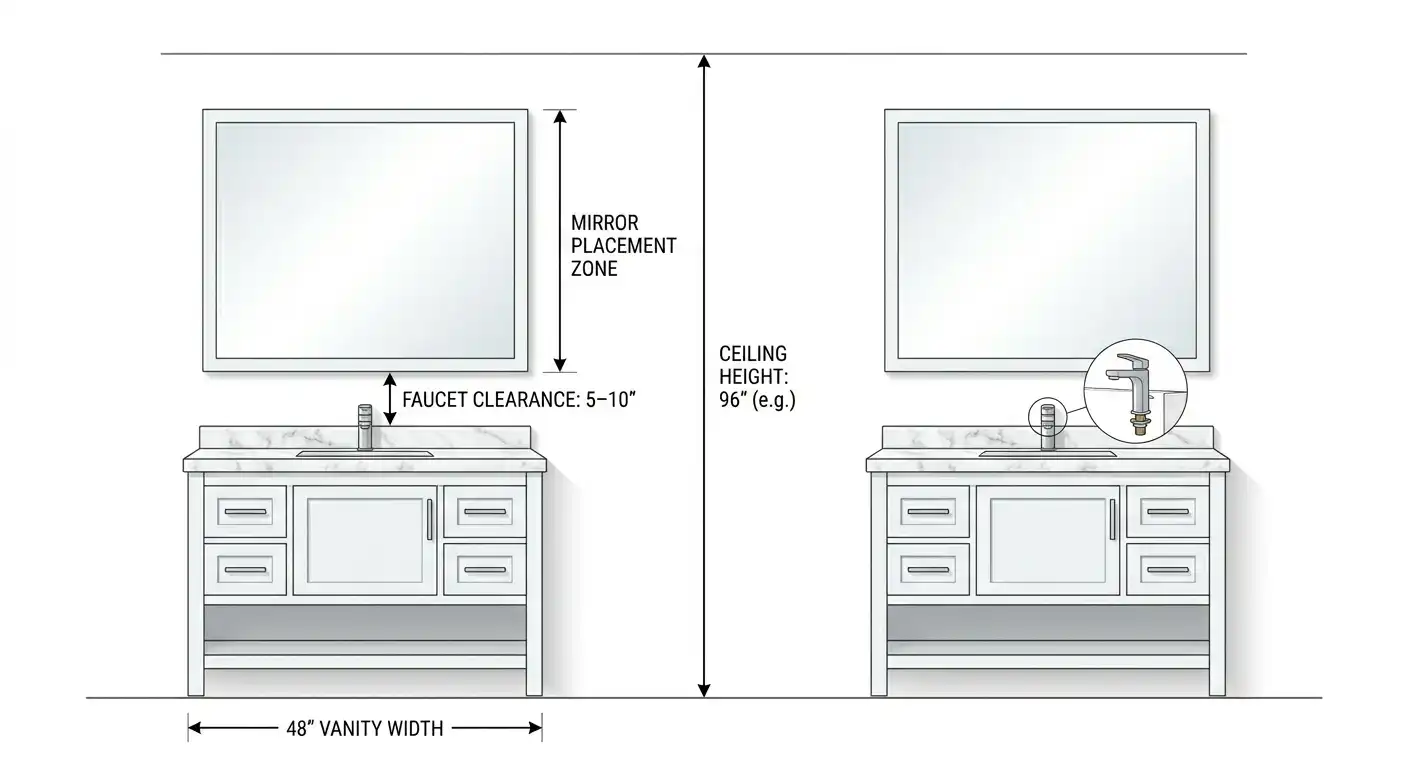
Mirror Shape and What It Does to Your Space
Once you’ve settled on dimensions, shape becomes the next decision — and it does more visual work than most people expect.
Rectangle
The most versatile choice. A rectangular mirror works in almost any bathroom style, scales easily to double vanities, and pairs naturally with overhead or side lighting. Portrait orientation (taller than wide) suits narrow wall spaces and draws the eye upward. Landscape orientation (wider than tall) works well in low-ceiling bathrooms.
Round and Oval
Round mirrors have become a dominant trend, and for good reason. They soften bathrooms full of hard edges — rectangular vanities, angular tiles, square windows. An oval hung vertically adds perceived height to a low-ceilinged space.
For sizing: a round mirror’s diameter should roughly equal the vanity width minus 4″. On a 30″ vanity, a 26″ round mirror works well. For round LED mirrors, the backlit halo effect also adds to the perceived size, so you can often go slightly smaller than you would with a plain mirror.
Arched
Arched mirrors land between rectangular and oval — structured at the bottom, curved at the top. They add a sense of height and work particularly well in traditional, transitional, and farmhouse bathrooms. The arch profile can feel formal, so they’re less common in minimalist or industrial spaces.
How Shape Interacts With Bathroom Style
| Mirror Shape | Best Style Match | Effect on Space |
|---|---|---|
| Rectangle | Modern, contemporary, transitional | Clean structure, neutral visual weight |
| Round | Modern, Scandinavian, eclectic | Softens edges, adds warmth |
| Oval | Traditional, farmhouse, transitional | Adds height, slightly formal |
| Arched | Traditional, Mediterranean, transitional | Adds height, decorative presence |
| Irregular/organic | Eclectic, maximalist, bohemian | Statement piece, high visual impact |
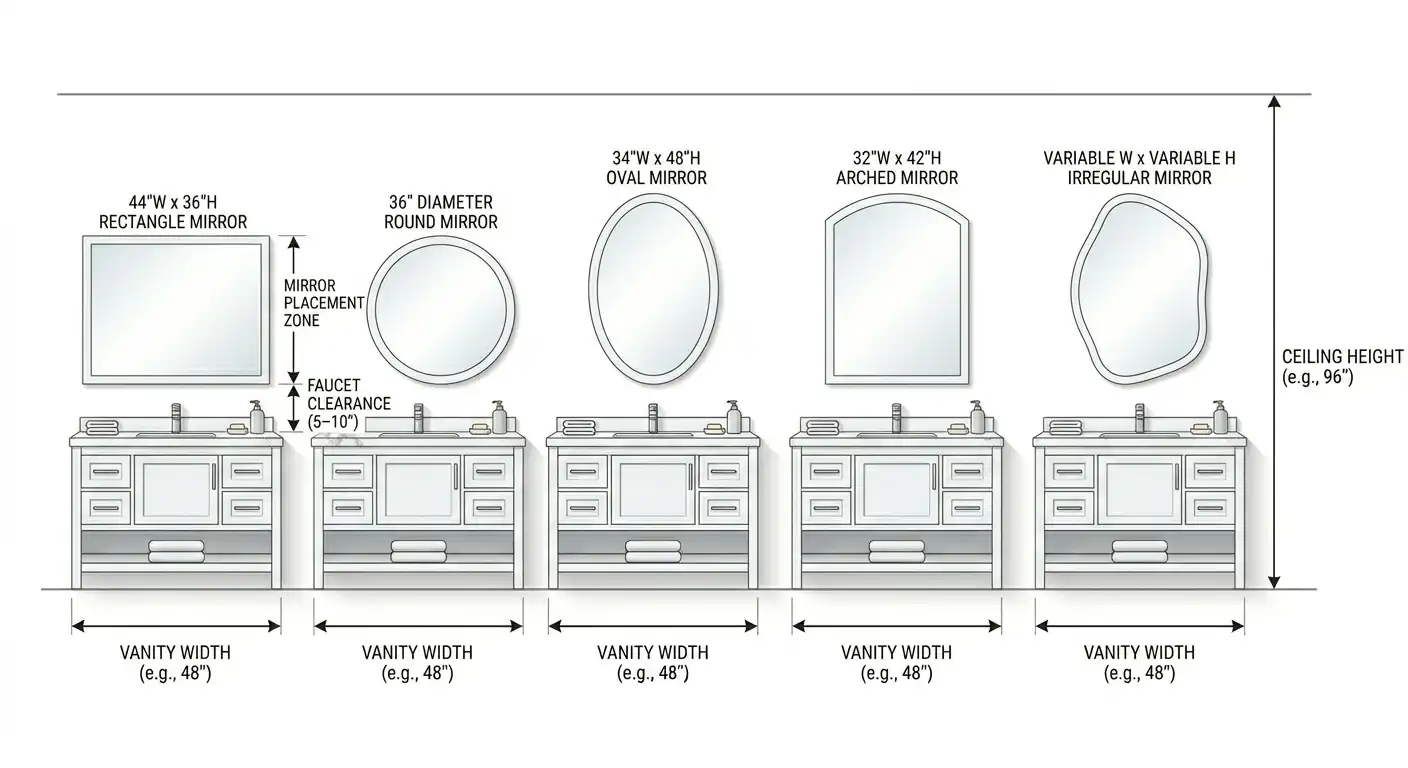
Explore the full range of LED bathroom mirrors to see how different shapes work with integrated lighting in real settings.
Using Mirror Size to Create More Space
In a small bathroom, the mirror is one of the most effective tools you have. The instinct is to go small to avoid overwhelming the space — but that’s usually the wrong call.
Why Bigger Often Works Better
A larger mirror reflects more light, which directly affects how spacious a bathroom feels. In a windowless bathroom or one with limited natural light, a well-sized mirror can brighten the space noticeably. A mirror that’s too small sits like a decorative tile on the wall, contributing very little to the room’s sense of scale.
Techniques That Work
Extend the mirror toward the ceiling. A taller mirror draws the eye upward and makes the ceiling feel higher. Leave only a few inches of clearance above — you don’t need the same breathing room you’d leave in a larger bathroom.
Position the mirror opposite a window. If your layout allows it, a mirror facing a window will reflect daylight into the room and create the impression of a second window. This is one of the oldest and most effective tricks in interior design.
Use a frameless mirror. In a tight space, a frame adds visual weight. A frameless mirror (or a LED bathroom mirror with a slim edge profile) sits more cleanly on the wall and doesn’t add bulk.
For powder rooms specifically: Powder rooms often get statement mirrors — oversized rounds, ornate frames, unusual shapes — precisely because the vanity is small and the space is used briefly. An oversized mirror in a powder room reads as intentional rather than unbalanced.
Small Bathroom Mirror Size Tips at a Glance
- Aim for a mirror at least as wide as the sink, if not the full vanity width
- Height: go taller rather than shorter — ceiling clearance of 3–5″ is fine in small spaces
- Frameless or thin-profile designs keep the wall from feeling cluttered
- Avoid two mirrors in small bathrooms — one well-sized mirror reads better
- Mirrors with built-in LED lighting eliminate the need for separate sconces, freeing up wall space
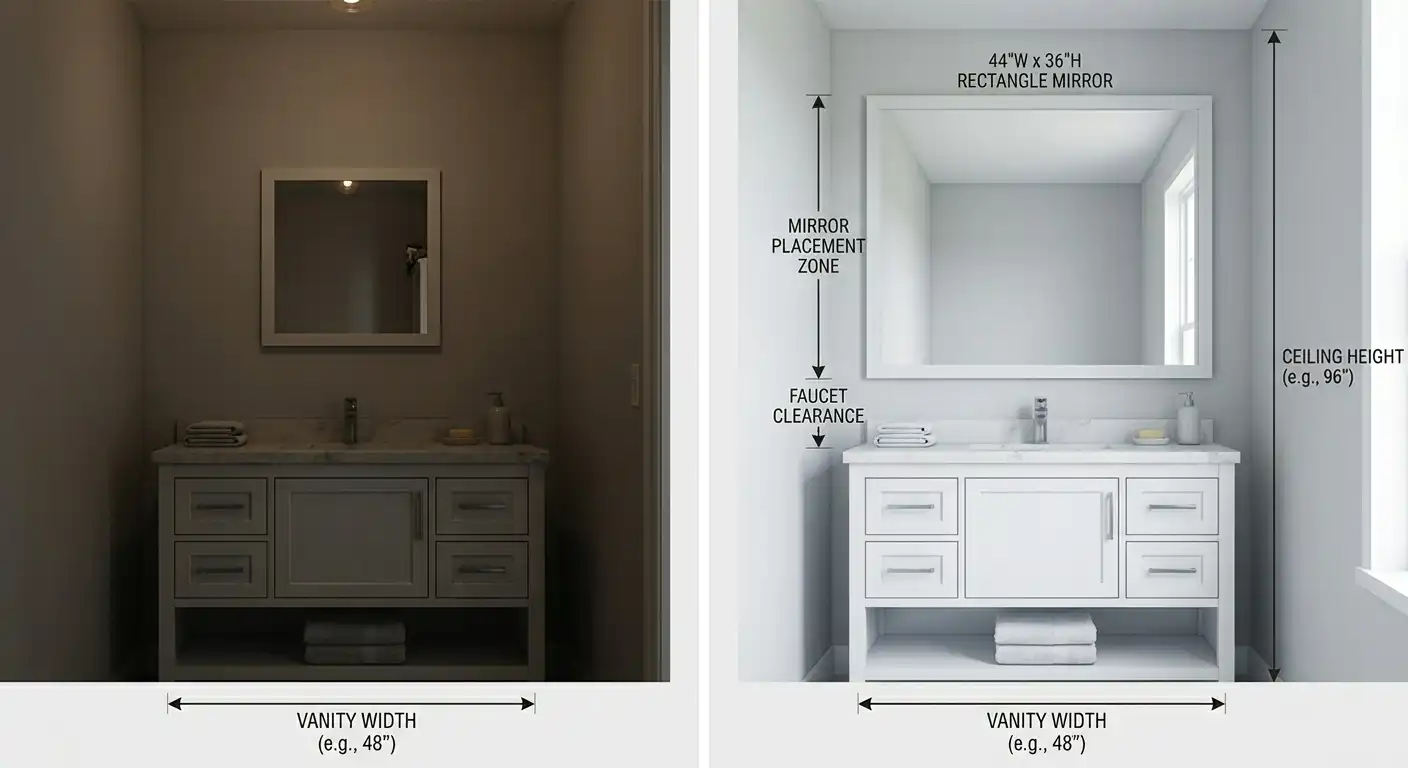
Bathroom Mirror Size Comparison
All the rules above come together at the decision point. Here’s a practical reference that covers the most common scenarios.
By Room Type
| Room Type | Vanity Size | Recommended Mirror | Notes |
|---|---|---|---|
| Primary bathroom | 48″–72″ | 44″–66″ wide, 36″–42″ tall | Consider two mirrors for double sinks |
| Guest bathroom | 30″–36″ | 26″–32″ wide, 30″–36″ tall | One centered mirror, standard sizing |
| Powder room | 18″–24″ | 16″–22″ wide, or oversized statement mirror | Style-forward choices work well here |
| Kids’ bathroom | 30″–36″ | 26″–32″ wide, hang slightly lower | Account for shorter users |
| Small bathroom | Any | Full-width or near-full-width | Prioritize height to open up the space |
Framed vs. Frameless vs. LED: How Each Affects Perceived Size
| Type | Visual Effect | Best For |
|---|---|---|
| Framed | Adds definition, feels heavier | Traditional, farmhouse, maximalist styles |
| Frameless | Clean, minimal, visually lighter | Modern, contemporary, small spaces |
| LED (backlit) | Adds glow, increases perceived size | Any style; especially useful in low-light bathrooms |
| LED (front-lit) | Even face illumination, functional | Grooming-focused bathrooms |
For bathrooms where both style and functionality matter, a LED vanity mirror handles both in one fixture — no separate sconces needed, and the integrated light helps the mirror read larger on the wall.
The Decision Checklist
Before finalizing your mirror choice, run through these:
- Mirror width is 2–4″ narrower than vanity (or 70–80% of vanity width)
- Mirror height fits between faucet clearance and ceiling, with room to breathe
- Bottom edge will sit 5–10″ above faucet or backsplash
- Mirror center will land at roughly 57–65″ from floor
- Shape suits the bathroom’s style and the vanity’s proportions
- Lighting plan accounts for the mirror size (sconces, overhead, or built-in LED)
- For double sinks: decision made on one wide mirror vs. two individual mirrors
Summary
Choosing the right bathroom mirror size comes down to three things: knowing your vanity dimensions, applying the width and height formulas, and matching the shape to both the space and your style. Start with the vanity width, subtract 4–8 inches to get your target mirror width, then use the ceiling-height formula to find the right height. From there, shape and finish are about aesthetics — round mirrors soften angular spaces, rectangular mirrors work almost everywhere, and LED-integrated options handle both proportion and lighting in a single piece. In small bathrooms, resist the instinct to go small; a well-sized mirror reflects light and opens the space in ways nothing else can. Get these basics right, and the mirror won’t just work — it’ll make the whole room look intentional.
Frequently Asked Questions
What size mirror for a 48-inch vanity?
A 44″–46″ wide mirror is the standard recommendation for a 48″ vanity — leaving a 1″–2″ gap on each side. If you’re using two sinks, two mirrors at 20″–22″ each work well too. Height depends on your ceiling and lighting but typically falls between 30″ and 40″.
Should a bathroom mirror be wider than the sink?
Yes — size your mirror to the vanity, not the sink. The vanity is the visual anchor; the sink is just one part of it. A mirror matched to the vanity width (minus 2–4″) will naturally span wider than the sink itself.
What is the best bathroom mirror size for a small bathroom?
In small bathrooms, go as wide as your vanity allows and as tall as your ceiling permits (leaving 3–5″ of clearance). A frameless mirror or a slim-profile LED mirror minimizes visual weight while maximizing the light-reflecting benefit. Avoid going smaller than the vanity width — it tends to make the space feel more cramped, not less.
How high should a bathroom mirror be hung above the vanity?
The bottom edge of the mirror should sit 5–10″ above the faucet or backsplash. The center of the mirror should land at approximately 57–65″ from the floor for comfortable use by most adults. In bathrooms shared by adults and children, err toward the lower end of that range.
What is the standard bathroom mirror size for a double vanity?
For a 60″ double vanity, the most common choice is either one mirror at 54″–56″ wide or two mirrors at 24″–28″ each with a few inches of space between them. For a 72″ vanity, two 28″–32″ mirrors generally look more balanced than a single wide mirror. Round or oval mirrors almost always work better as a pair on double vanities.