
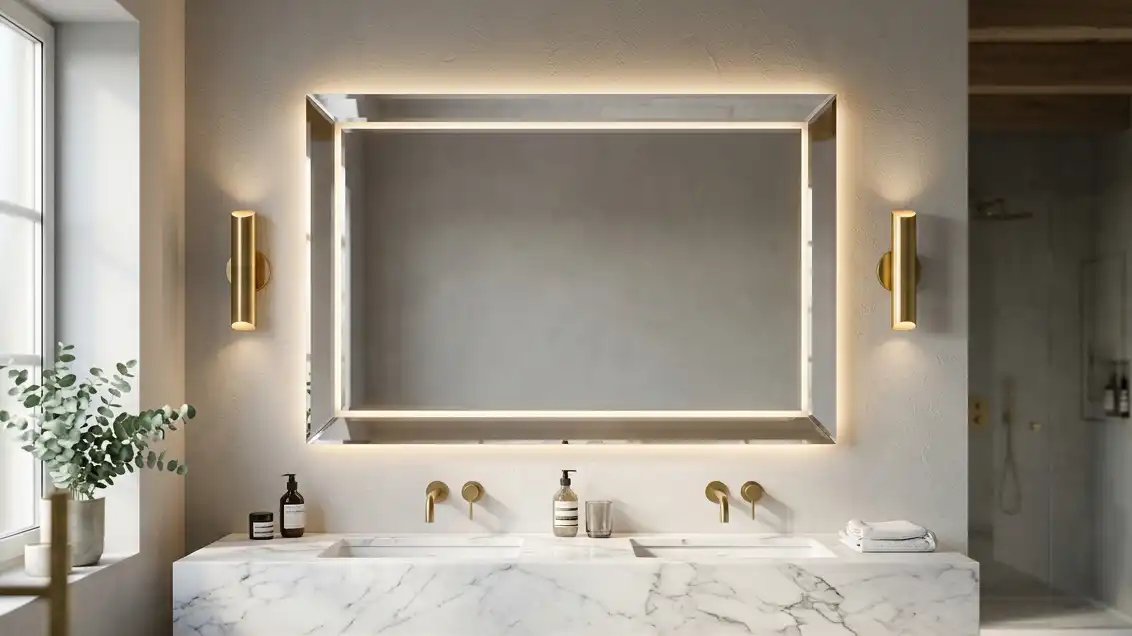
There is a reason a beveled mirror catches your eye before you even notice what it is reflecting. Run a finger along its edge and you will feel the glass slope away under your fingertip, thinning out toward the wall instead of stopping flat. That small angle does something a plain mirror cannot: it bends light along the rim and gives the glass a quiet, dimensional border with no frame at all. The effect has been used in homes for well over a hundred years, and it still shows up in new bathroom renders today, just with LED strips behind it instead of candlelight in front of it.
This guide walks through where the bevel cut came from, what it actually does to light and depth, how it stacks up against other mirror edges, and the practical side — sizing, lighting, and mounting — that decides whether a beveled mirror looks intentional or just expensive.
Where the Bevel Cut Came From
Glass beveling is not a modern decorative trick. Venetian glassmakers were grinding angled edges into mirror glass by hand as early as the 16th century, using stone wheels and pumice to slowly wear down the perimeter of thick glass sheets. The process was slow, the glass was expensive, and a beveled mirror was something only wealthy households could afford.
By the Victorian era, beveled glass had moved beyond mirrors into doors, transoms, and cabinet panels across Britain, France, and the United States. Mirror makers kept the technique because it solved a real problem: thick glass has a visible green-tinted edge, and beveling that edge at an angle makes it look thinner and more refined without changing the actual thickness of the glass.
Machine grinding replaced hand polishing in the 20th century, which is why a beveled mirror today costs more than a flat one but nowhere near what it cost a hundred years ago. The look stuck around because it never really went out of style — it just moved from formal parlors into modern bathrooms and entryways.
What a Beveled Mirror Actually Is
A beveled mirror is a flat mirror with its outer edge cut and polished at an angle instead of left square. The center of the glass stays at full thickness; the angled rim trims down to a much thinner edge, often close to a sharp line. That difference in thickness is what creates the visual “frame” — there is no added material, just glass cut at a slope.
Standard bevel widths run from about 1/4 inch up to 1 1/2 inches, with custom shops able to go wider. A few terms come up often enough to be worth knowing:
- Bevel width — how far the angled section extends from the edge toward the center
- Bevel angle — how steep that slope is; steeper angles catch more light but are pricier to cut
- Single vs. double bevel — most mirrors use one cut per edge; double or triple bevels stack angles for a more ornate look
- Inside corner bevel — a bevel that meets cleanly at an interior corner, used on custom or irregular shapes
None of this changes how the mirror reflects your face. It only changes what happens at the last inch or two of glass.
Why People Choose a Beveled Edge
The appeal comes down to three things, and none of them require a frame.
Light refraction. The angled glass acts like a very shallow prism. Light hitting the bevel splits and bends slightly instead of bouncing straight back, which is why a beveled edge seems to glow or shimmer faintly under bright light.
A frame without a frame. Because the bevel changes the glass thickness near the edge, it reads visually as a border — similar to a metal or wood frame — without adding weight, bulk, or another surface to clean.
Works across styles. A beveled mirror does not commit you to one design direction. It sits comfortably in a farmhouse bathroom, a marble-and-brass primary suite, or a stripped-back minimalist powder room, because the bevel itself is a fairly neutral design move.
The tradeoff is mainly cost and fragility risk during installation — a beveled edge takes longer to fabricate, and the thinned glass at the rim chips slightly more easily than a polished flat edge if it is mishandled before mounting.
Does Bevel Angle Actually Change How Much Light You See?
Yes, though the difference is subtle rather than dramatic, and it depends on the light source as much as the glass.
| Bevel width | Visual effect | Best suited for |
|---|---|---|
| 1/4″ – 1/2″ | Thin highlight line, subtle shimmer, barely visible from a distance | Small mirrors, modern/minimalist rooms, mirrors under 24″ |
| 3/4″ | Noticeable soft glow at the rim under side lighting | Standard vanity mirrors, most mid-size bathrooms |
| 1″ and up | Strong light-catching border, visible “frame” effect even in dim rooms | Statement mirrors, large vanities, traditional or vintage styles |
Under flat overhead lighting, a shallow bevel barely registers — the light source is too direct and too far overhead to catch the angle. Under side lighting, such as wall sconces at eye level, even a 1/2-inch bevel picks up a visible line of brightness along the edge. This is the main reason lighting placement matters more for a beveled mirror than for a plain one: the bevel only earns its keep when light hits it from the side rather than straight on.
Beveled vs Other Mirror Edge Types
A beveled edge is one of several finishing options, and it is worth seeing it next to the alternatives before assuming it is the right call for every room.
| Edge type | Look | Maintenance | Typical cost vs. flat polished |
|---|---|---|---|
| Flat polished | Clean, straight edge, no visible border | Easiest to clean, no groove to trap grime | Baseline |
| Beveled | Angled, light-catching edge with a soft frame effect | Slightly more care — wipe along the angle, avoid pooling liquid in the groove | 15–40% higher |
| Pencil polished | Smooth, gently rounded edge | Same as flat polished | Slightly higher than flat |
| Framed (wood/metal) | Visible decorative border added on top of the glass | Frame can collect dust or, with wood, swell in humidity | Varies widely by material |
| Seamed | Rough, sanded edge meant to be hidden by a frame | Not designed to be seen; needs a frame to look finished | Lowest |
None of these is objectively better. A flat polished edge suits a stripped-down modern look; a beveled edge adds dimension without a frame; a framed mirror adds personality but more upkeep. The choice is mostly about how much visual weight you want the edge to carry on its own.
Lighting a Beveled Mirror
Because the bevel relies on side-angled light to show up, how you light the mirror matters as much as the bevel width itself.
- Side sconces at roughly eye level give the most consistent bevel highlight, since the light hits the angled glass almost horizontally.
- Backlit LED strips mounted behind the mirror create a halo effect on the wall and indirectly light the bevel from the rear edge — a popular pairing for modern vanities. Guides like LuckMirror’s step-by-step backlit LED installation guide cover strip type, color temperature, and waterproof ratings in more depth if you want to add this yourself rather than buy a pre-lit unit.
- Overhead-only lighting is the weakest pairing — light coming straight down barely touches the vertical bevel surface, so the edge effect is mostly lost.
If you would rather skip wiring altogether, ready-made LED bathroom mirrors and LED makeup mirrors already build the light source into the mirror, which removes the side-lighting guesswork.
A quick note on color temperature, since it affects how the bevel reads: warmer light (around 3000K) gives the bevel a softer glow, while cooler light (5000K and up) makes the line sharper and more defined. Neither is wrong — it depends on whether the rest of the room leans warm or cool. The U.S. Department of Energy notes that residential LED lighting uses at least 75 percent less energy than incandescent bulbs and lasts up to 25 times longer, which is one reason most new mirror lighting, beveled or not, has shifted to LED over the past decade.
Choosing the Right Size and Shape
A beveled mirror that is the wrong size will look off no matter how nice the edge is. A few general rules hold up across most bathrooms:
- For a single vanity, aim for a mirror that is 2 to 4 inches narrower than the countertop on each side.
- For a double vanity, choose either one wide mirror spanning most of the counter, or two separate mirrors centered over each sink.
- Round and oval shapes soften a room full of straight lines (tile, cabinetry, counter edges); rectangular mirrors reinforce a more structured, symmetrical look.
- Leave at least 2 to 6 inches of clearance between the bottom of the mirror and the top of the faucet or backsplash.
For mounting height, the U.S. Access Board’s ADA guidance offers a useful baseline even in homes that are not legally required to follow it: a mirror’s reflective surface should sit no higher than 40 inches above the floor when installed above a sink, with the top edge at least 74 inches up so it works for both standing adults and seated users. Most residential vanity mirrors land somewhere in between, centered around eye level for the main household members.
| Mirror placement | Recommended bottom edge height | Source |
|---|---|---|
| Above a lavatory/sink | 40 inches maximum from floor | U.S. Access Board, ADA Standards §603.3 |
| Not above a lavatory | 35 inches maximum from floor | U.S. Access Board, ADA Standards §603.3 |
| Top edge (for shared/multi-height use) | 74 inches minimum from floor | U.S. Access Board, ADA Standards §603.3 |
Installing a Beveled Mirror
Beveled mirrors are heavier at the edges to handle than a flat-cut mirror, so the mounting method matters more than people expect.
- French cleat / Z-bar systems — a metal rail on the wall interlocks with a matching rail on the mirror’s back. This is the most secure option for large or heavy beveled mirrors and keeps the mirror flush against the wall.
- Clips — metal or plastic brackets that hold the mirror’s edges in place. Metal clips with rubber padding hold up better in humid bathrooms than plastic ones, which can become brittle over time.
- Adhesive mounting — mirror-safe mastic glues the mirror directly to the wall. This works for lighter mirrors but is permanent and not ideal as the sole support for anything large.
- Pivot brackets — used for tilting mirrors, often paired with oval or rectangular shapes in more traditional bathrooms.
A few details apply no matter which method you pick: always hit at least one wall stud for anything over a few pounds, use a wall-rated cleaner rather than spraying liquid directly onto the glass, and leave a small gap behind the mirror if it is backlit so the LED glow can diffuse evenly against the wall.
Summary
A beveled mirror earns its place in a bathroom through a small physical detail rather than a big design statement — an angled, polished edge that has been ground into glass since Venetian craftsmen worked it by hand centuries ago. That angle bends light just enough to read as a soft frame, works across nearly every decorating style, and pairs especially well with side or backlit LED lighting, which is exactly what makes it show up the way it is supposed to. Getting the look right comes down to a handful of practical choices: pick a bevel width that matches the mirror’s size and the room’s style, light it from the side rather than only from above, size and place it using the same general rules as any vanity mirror, and mount it with hardware rated for its actual weight. None of these decisions is complicated on its own — they just need to be made together rather than as an afterthought.
FAQs
Is a beveled mirror more expensive than a regular mirror?
Yes, typically 15 to 40 percent more than a flat polished mirror of the same size, since beveling adds a cutting and polishing step that flat edges skip.
Can you add a beveled edge to an existing flat mirror?
Not without professional re-cutting. A glass shop can grind a bevel into an existing mirror’s edge, but it requires specialized equipment and reduces the mirror’s overall size slightly.
What is the standard bevel width for a bathroom vanity mirror?
Most bathroom vanity mirrors use a 3/4-inch bevel, which is wide enough to catch light without overwhelming a mid-size mirror.
Do beveled mirrors crack or chip more easily than flat-edge mirrors?
The thinned edge is somewhat more prone to chipping during handling and installation, though once mounted it is no more fragile day-to-day than a standard mirror.
Are beveled mirrors out of style for modern bathrooms?
No — beveled edges have moved from traditional frames into frameless, minimalist mirrors, and they pair well with LED backlighting in contemporary bathroom designs.