
Most people pick a bathroom magnifying mirror the same way they pick a shower curtain — grab whatever looks fine and move on. Then they spend the next two years squinting at a 3x mirror that’s still too weak for eyeliner, or fighting a 10x mirror that makes their nose look like a planet. The problem isn’t the mirror itself. It’s buying the wrong one because nobody explained what the specs actually mean.
This guide fixes that. Whether you’re replacing a basic mirror or upgrading to a full LED setup, here’s everything you need to know — without the fluff.
Why a Standard Bathroom Mirror Isn’t Enough
Your regular bathroom mirror shows you a true 1x reflection: accurate, life-size, and completely unhelpful the moment you try to apply liquid liner or shape a clean beard edge.
A magnifying mirror solves a simple problem: it brings your face close enough to see the details that actually matter. And when you add proper lighting to that, the difference is night and day — literally.
Here’s what a standard mirror can’t do:
- Show you individual lash placement or fine eyebrow hairs
- Compensate for poor bathroom overhead lighting
- Let you check skincare results up close (pore congestion, redness, dry patches)
- Give men a clear view of beard edges and missed patches
If your grooming routine involves anything more precise than splash-and-go, you need a dedicated magnifying mirror.
The Three Core Use Cases
Before you pick a magnification level, get clear on what you’re actually using the mirror for. These three scenarios have different needs.
Makeup application is the most demanding use case. Foundation blending looks fine from a distance but falls apart under close inspection. Eye makeup — liner, mascara, falsies — requires a magnification of at least 5x to see what you’re doing, and a well-lit mirror makes the difference between getting it right at home and noticing the mistake under natural light outside.
Shaving and beard grooming needs a mirror that’s easy to position, fog-resistant, and large enough to see a decent section of your face at once. Most men are well served by 3x to 5x. Go higher and the distortion makes it harder to see whether your lines are actually straight.
Skincare routines sit somewhere in the middle. Checking for clogged pores or the progress of a breakup requires 5x to 10x, but you don’t need the mirror to be huge — a compact LED makeup mirror with strong spot lighting works well for this.
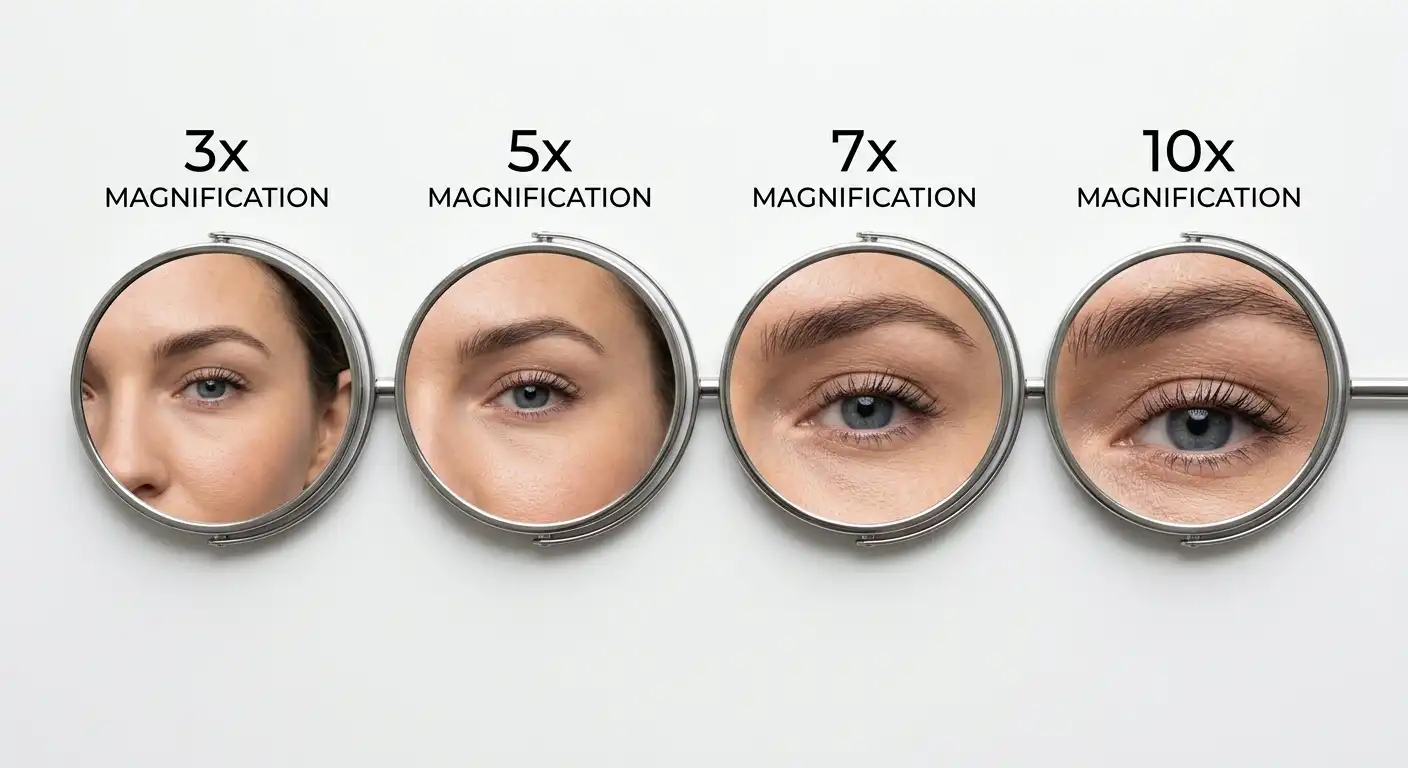
Magnification Levels Explained: 3x, 5x, 7x, and 10x
This is the number most people look at first, and it’s the one most people get wrong. Here’s a plain-English breakdown:
| Magnification | Best For | Viewing Distance | Common Issue |
|---|---|---|---|
| 1x | General use, full face check | Any | No detail |
| 3x | Light touch-ups, basic grooming | 8–12 inches | Underpowered for detailed tasks |
| 5x | Everyday makeup, shaving, skincare | 6–10 inches | Minor distortion at edges |
| 7x | Precise eyeliner, brow shaping | 5–8 inches | Distorts if you move too close |
| 10x | Tweezing, detailed brow work, contact lenses | ~4 inches | Narrow field of view, easy to lose position |
| 15x+ | Specialist use (professional, medical) | ~2–3 inches | Difficult to use, very limited view |
Source: Viewing distance and distortion guidance based on standard concave mirror optics, as outlined by The Magnifying Mirror Store.
The most practical starting point for most people is 5x. It’s precise enough for detailed work but forgiving enough that small movements don’t throw off the image.
A few things worth knowing:
- Higher isn’t always better. At 10x, you’re looking at a tiny section of your face. Many people find it disorienting first thing in the morning — and easy to over-tweeze because you can’t see the full brow shape.
- Double-sided mirrors (1x + 5x or 1x + 10x) are a smart solution if different people in the same household have different needs. You get both views in one unit without cluttering the counter.
- The “20x magnification” mirrors you see in travel sets often use exaggerated marketing claims. The optics involved are rarely comfortable to use at face distance.
Why Lighting Matters as Much as Magnification
You can have the best magnification in the world and still apply foundation in the wrong shade if the lighting around your mirror is poor.
Most bathroom overhead lights cast downward shadows — the worst possible direction for face-level grooming. An LED bathroom mirror solves this by placing the light source at face level, surrounding the reflection evenly.
What to look for in mirror lighting:
- Color temperature — Measured in Kelvin (K). Around 4000K–5000K gives the most neutral, daylight-accurate rendering. 3000K is warm (good for relaxing ambiance, bad for makeup). 6000K is cool white and tends to look clinical.
- Dimmable brightness — Being able to dial the brightness down matters. A mirror blazing at full strength in a dark bathroom at 6 AM isn’t comfortable to use.
- CRI rating — Color Rendering Index. A CRI of 90+ means colors look accurate under the light. Lower CRI mirrors can make skin tones look gray or washed out.
Here’s a quick comparison of lighting types:
| Light Type | Color Accuracy | Lifespan | Energy Use |
|---|---|---|---|
| LED (high CRI) | Excellent | 30,000–50,000 hrs | Low |
| LED (standard) | Good | 25,000+ hrs | Low |
| Incandescent | Warm, low accuracy | 1,000–2,000 hrs | High |
| Fluorescent | Inconsistent | 8,000–15,000 hrs | Medium |
Source: U.S. Department of Energy, Lighting Basics for LEDs; general mirror product specifications.
Anti-Fog (Demister): Useful Feature or Unnecessary Extra?
If you shower before doing your makeup or grooming, you already know the problem: you step out of the shower and the mirror is fogged. You wait, wipe it, wait again.
A built-in demister pad eliminates this. It’s a thin heating element behind the mirror glass that maintains the surface above the dew point, so condensation never forms. On a well-designed mirror, it turns on automatically with the light and uses minimal energy.
When anti-fog is actually worth having:
- You shower and groom in the same bathroom session
- Your bathroom has limited ventilation
- You’re installing a hardwired wall mirror and won’t want to replace it for years
When it’s less important:
- You use a freestanding or countertop mirror that lives outside the steam zone
- You have good bathroom ventilation
One practical note: look for mirrors with at least an IP44 rating if they’re going near a shower or bath area. That rating confirms the electrical components are sealed against water splashes — a basic safety requirement, not a premium feature.
Mirror Shape and Size: What Actually Matters
Shape is mostly about aesthetics, but size has real practical implications.
Shape
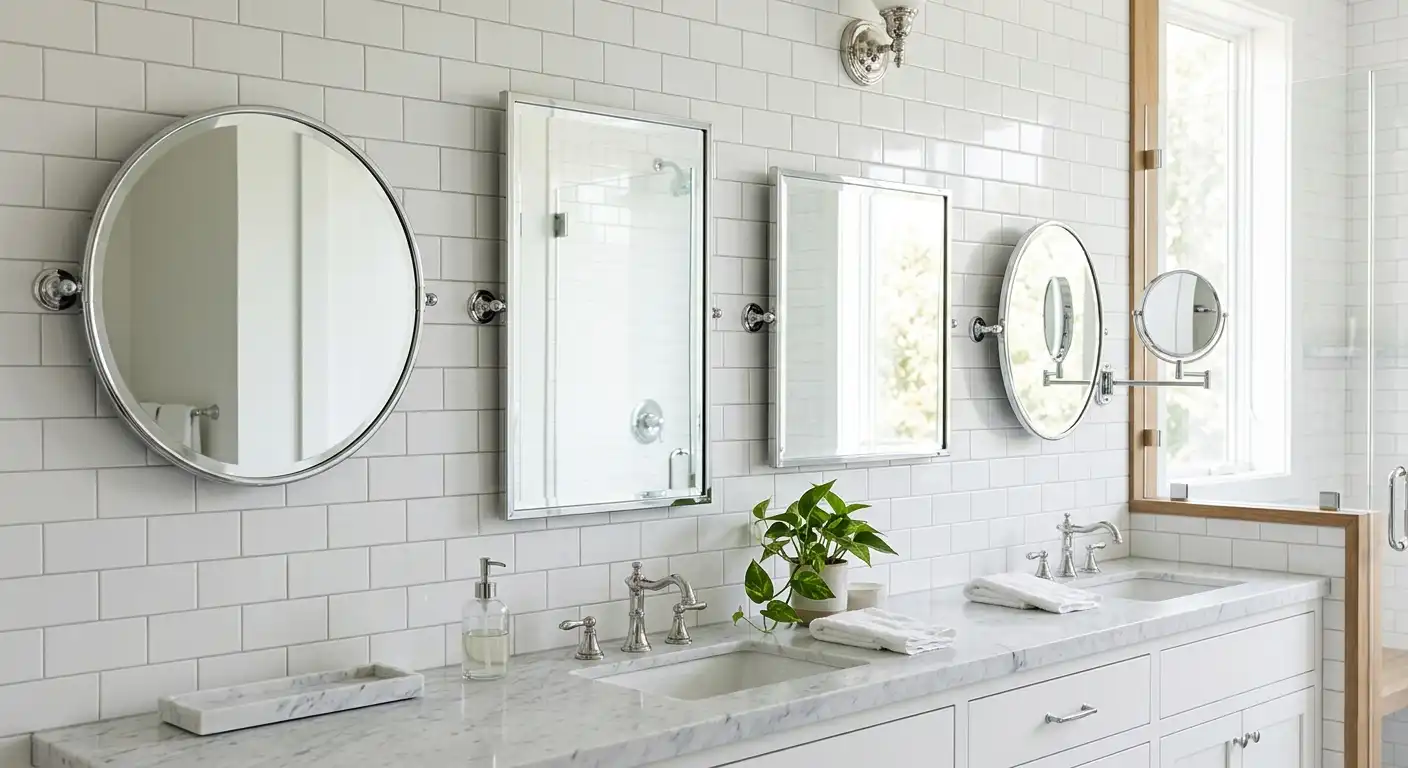
- Round mirrors are the most common shape for magnifying mirrors. They’re compact, easy to mount, and work with almost any bathroom style.
- Rectangular mirrors tend to suit modern, minimalist bathrooms and give more viewing area along the horizontal axis.
- Square mirrors have a similar feel to rectangular but feel more symmetrical — useful in bathrooms with strong geometric tile work.
- Oval mirrors add a softer, slightly traditional feel. Less common in magnifying mirror formats but available in wall-mounted styles.
Size
For a wall-mounted magnifying mirror, the glass diameter typically runs between 6 and 10 inches. Here’s how to think about it:
- 6–7 inches: Good for focused tasks (tweezing, eye makeup). You’ll need to move the mirror if you want to check your full face.
- 8–10 inches: More comfortable for makeup and shaving. You can see most of your face at once at standard viewing distances.
- Larger (12 inches+): Better suited to countertop or freestanding setups where you’re working from a bit further away.
For proper sizing relative to your vanity and bathroom layout, see LuckMirror’s guide on bathroom mirror dimensions.
Anti-Fog, Waterproofing, and IP Ratings
This section is specifically for wall-mounted, electrically powered mirrors.
Bathrooms are wet environments. Any mirror that involves wiring — LED lights, demisters, touch sensors — needs to meet minimum waterproofing standards:
- IP44: Protected against water splashes from any direction. Suitable for most bathroom installations outside the shower zone.
- IP65: Dust-tight and protected against water jets. Better for mirrors that might be near shower enclosures.
Don’t skip this check. An IP rating isn’t just a spec — it’s the manufacturer’s confirmation that the electrical components won’t degrade from humidity over time.
Smart Mirror Features: Worth the Upgrade?
Smart mirrors have been a “coming soon” product category for years, but the practical features are finally catching up.
What’s genuinely useful today:
- Touch sensor controls — Turn the light on/off and adjust brightness without hunting for a switch. Nearly standard on quality mirrors now.
- Memory settings — The mirror remembers your preferred brightness and color temperature. Small convenience, but one you notice daily.
- Built-in clock or date display — Actually useful in a bathroom context. Keeps you on schedule during a rushed morning routine.
What’s getting there but not quite essential:
- Bluetooth speakers — Work well, but the audio quality at reasonable price points is average. Better as a nice-to-have than a core reason to buy.
- Voice control and app integration — Emerging features that still have rough edges. Convenient when they work, frustrating when the connection drops.
For B2B buyers or hotel procurement, smart features add genuine hospitality value. For home use, focus on the fundamentals first.
For a broader look at LED vanity mirrors with smart features, LuckMirror’s product range covers a range of configurations from basic to fully connected setups.
Product Picks by Use Case
You don’t need the most expensive mirror on the market. You need the right one for how you actually use it.
For everyday makeup at home (most people’s starting point): A wall-mounted 5x mirror with built-in LED lighting, adjustable brightness, and a 8–9 inch glass diameter. Chrome or brushed nickel finish for flexibility with bathroom hardware. Look for a swing arm so you can pull it forward and angle it.
For precision work (brows, eyeliner, contact lens users): A 7x or 10x option — either wall-mounted or a countertop unit with strong directional lighting. Keep a 1x mirror nearby; high-magnification mirrors are tools for specific tasks, not a replacement for your main mirror.
For men focused on shaving: 5x is the practical sweet spot. Anti-fog matters here — you want it usable right after a shower. A suction-cup model works if you don’t want to drill into tiles; a proper wall-mounted arm mirror is more stable for daily use.
For a small bathroom with limited counter space: A wall-mounted round LED mirror on a folding arm — it folds flat against the wall when not in use. No counter footprint, no fuss.
For smart home or hotel setups: A hardwired LED mirror with touch sensor, demister, Bluetooth, and adjustable color temperature. Plan the electrical routing before choosing the size.
The Short Version
A bathroom magnifying mirror is a small purchase with a disproportionate daily impact. The core decision is magnification: 5x works for most people, 3x if you just want light assistance, 7x or 10x if you do detailed work. After that, lighting quality matters more than most people expect — a high-CRI LED at 4000K to 5000K is closer to natural daylight than anything a bathroom ceiling fixture will give you. Anti-fog is genuinely useful if you shower and groom in one session; smart features are worth considering if you want the setup to last. Get those three things right and the shape, finish, and brand are secondary.
FAQs
What magnification is best for a bathroom magnifying mirror for everyday use?
5x is the most versatile starting point. It provides enough detail for makeup application, eyebrow grooming, and shaving without the narrow field of view that makes 10x mirrors difficult to work with daily. If you have strong prescriptive glasses and work without them in the bathroom, 7x may be more comfortable.
What is the difference between a lighted magnifying mirror and a regular magnifying mirror?
A regular magnifying mirror relies entirely on your bathroom’s existing light, which is almost always overhead and creates downward shadows on your face. A lighted mirror — especially an LED model — places the light source at face level, eliminating shadows and giving you more accurate color and detail for grooming and makeup tasks.
How do I install a wall-mounted magnifying mirror without drilling into tiles?
Suction-cup models are designed for tiled surfaces and work well on smooth, non-porous tiles or glass. For a more permanent setup without drilling, adhesive mounting strips rated for the mirror’s weight are an option, though wall-anchored arm mounts are more stable for daily use. See LuckMirror’s guide on bathroom mirror height for placement tips.
Do bathroom magnifying mirrors fog up in the shower?
Standard mirrors do. Models with a built-in demister pad heat the glass surface just enough to prevent condensation from forming. Look for mirrors that specifically list anti-fog or demister functionality, and confirm the IP44 or higher waterproof rating if the mirror has electrical components.
What is a good magnifying mirror for someone who wears glasses?
The challenge for glasses wearers is that removing glasses to use the mirror reduces sharpness. A higher magnification (7x or 10x) compensates by enlarging the image enough to offset the reduced visual acuity. A well-lit mirror also helps significantly — strong even lighting reduces the need to rely on sharp focus for grooming tasks.