
For a project spanning more than a handful of units, the vanity and mirror aren’t two separate purchasing decisions — they’re one formula you write once and repeat. Start with the vanity finish and mounting style, let it set the mirror shape through the room’s existing lines, then lock lighting type and adjustability last, since those are the pieces installers actually wire. Get that order backwards and you end up with a beautiful rendering that falls apart the moment unit three needs a slightly different electrical rough-in than unit one.
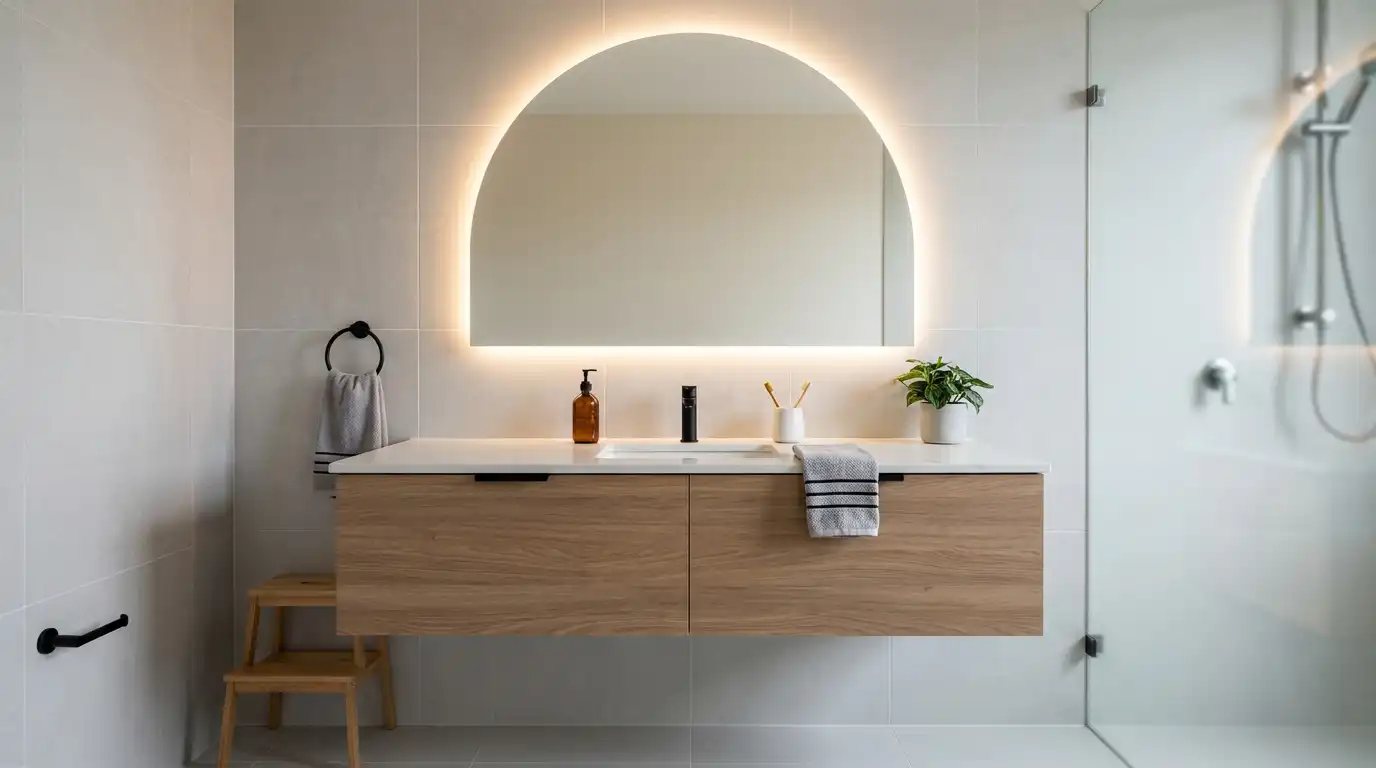
Floating Vanities in Multi-Unit Specs
A wall-mounted, floating vanity does two things a floor-standing cabinet doesn’t: it opens up visible floor space, which reads as larger square footage in listing photos across every unit, and it clears the wall beneath the counter, which matters more than it sounds like it should. Under the 2010 ADA Standards, an accessible lavatory needs knee and toe clearance beneath it — and a floating vanity gets you most of the way there without a redesign, which is worth knowing even on projects where only a percentage of units need to meet that bar. On a market-rate spec, the same floating profile just makes cleaning crews faster, since there’s no toe-kick gap collecting hair and dust.
Dark vs Light Vanity Finish: What Actually Reads Larger on Site
Light vanities bounce ambient light and photograph brighter, which is why they dominate listing photos for compact units. Dark vanities do the opposite job well: they ground a room with tall ceilings or a lot of glass, and they hide daily grime — water spots, toothpaste, fingerprints — far better than a pale finish does under everyday use, which matters more in a rental portfolio than in a single owner-occupied home. Neither reads as “correct.” The practical split we’d suggest: light finishes for units under roughly 40 square feet of bathroom, dark or mixed finishes once the room has enough volume to absorb the visual weight.
Matching the Trim Color to the Vanity
This is really a finish-coordination exercise — vanity color, faucet finish, and mirror trim working as one palette rather than three separate choices — and we’ve already written the full formula, including a coordination-versus-contrast framework and a style-by-style finish table, in our guide to bathroom mirror trim ideas. The short version: repeat two or three finishes deliberately rather than matching everything, and let the vanity (not the mirror) set the reference point.
Letting Existing Fixtures Dictate Mirror Shape
The fastest way to pick a mirror shape for a repeatable spec isn’t to browse inspiration boards — it’s to look at what’s already fixed in the room. A rectangular vanity with sharp counter edges reads as more intentional with a rectangular or arched mirror that echoes the same lines; an oval or vessel sink pulls toward a round or oval mirror instead. Tile pattern matters too: a grid-laid subway tile behind the vanity reinforces a rectangular mirror, while a scalloped or fan-shaped tile treatment makes an arched or organic-shaped mirror feel connected to the room rather than dropped in. For a multi-unit spec, this logic is genuinely useful because it turns “which mirror shape” into a rule you can apply consistently across unit types instead of an aesthetic call made unit by unit. Our bathroom mirror size guide covers how to translate that shape decision into an actual width once the vanity dimensions are set.
Mirror Shape Comparison for Project Specs
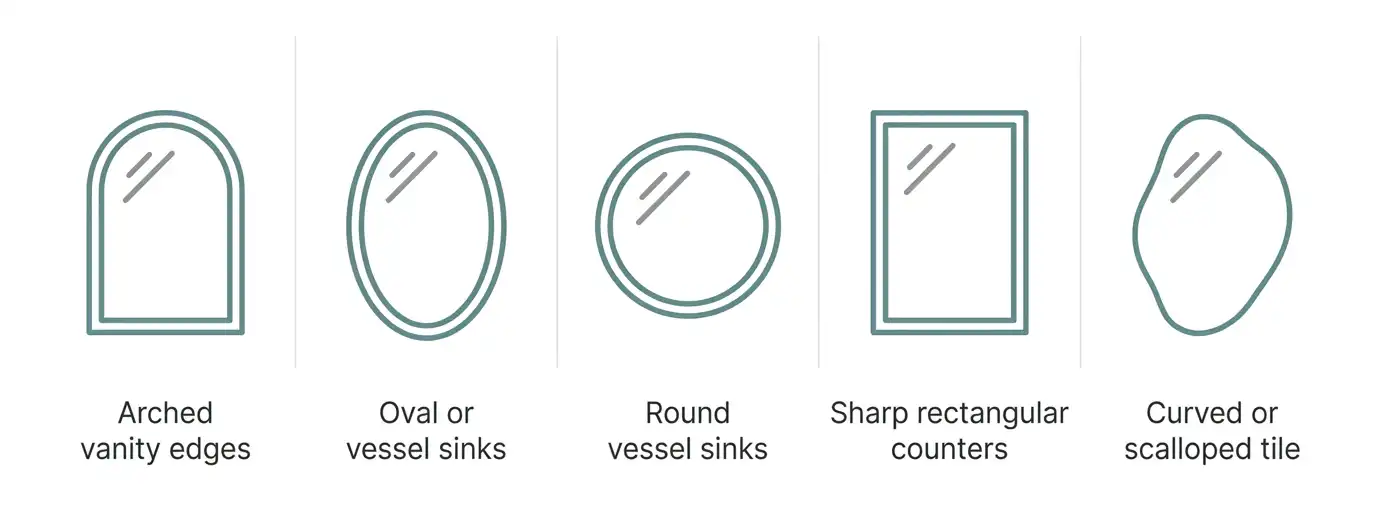
| Shape | Pairs best with | Reads as |
|---|---|---|
| Arched | Rectangular vanity with softened counter edges | Transitional, slightly formal |
| Oval | Oval or vessel sinks, curved fixtures | Soft, residential |
| Round | Round vessel sinks, small powder rooms | Casual, compact-friendly |
| Rectangular | Sharp counter lines, subway tile | Modern, architectural |
| Organic/asymmetrical | Curved or scalloped tile, boutique projects | Distinctive, harder to repeat at scale |
That last row matters for a spec sheet more than it might seem to: organic shapes are the hardest of the five to standardize across dozens of units with consistent sourcing, so they tend to work better as an accent in a handful of premium units than as the base spec for an entire building.
Framed vs Frameless: A Quick Note
Frame material and profile — wood, metal, molding, or none at all — is its own decision tree with real production implications (finish consistency across a large run, moisture resistance, how much visible glass a frame costs you), and we’ve covered that in detail in the trim ideas guide linked above. For this piece, the short answer: frameless keeps the shape decision above clean and unobstructed, which is usually the right default for a repeatable spec unless the project’s design language specifically calls for a framed look.
Layered Mirror Composition: Anchor Plus Accent
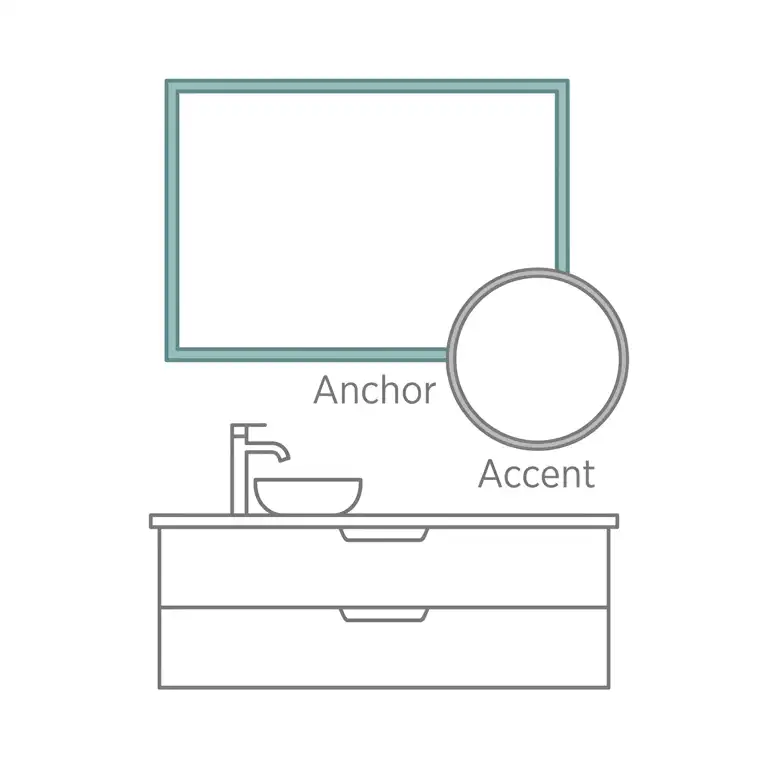
A single large mirror as the anchor, with a smaller mirror doing accent work nearby, reads as more considered than one big mirror alone — but it’s not a technique worth specifying for every unit type. It earns its cost in model units, penthouses, and other spaces where the project budget already supports a bit of extra visual layering; for standard units across a large building, one well-proportioned mirror per vanity is the more defensible default, both for cost and for keeping the punch list shorter.
Backlit LED Mirrors vs Separate Sconces or Pendants
This is less an aesthetic choice than an electrical and installation one. A backlit LED mirror is a single fixture with its own power requirement and, depending on the model, its own dimming and CCT controls built in — one line item on the electrical spec, one point of failure to service. Separate sconces or a pendant give a designer more flexibility to mix fixture styles and light direction, but that flexibility means more electrical rough-ins per unit and more finish decisions to coordinate (sconce style, mounting height, shade material) on top of the mirror itself. For a project rolling out identical bathrooms at scale, backlit integrated lighting usually wins on install simplicity. For a boutique or single flagship unit where the lighting fixtures are meant to be seen and admired on their own, separate fixtures are worth the extra coordination.
Dimmable and Tunable CCT: Why It’s Worth Specifying
A fixed-brightness, fixed-color mirror light works fine in a photo. In daily use, the same light that looks clean and modern at 10 a.m. can feel clinical at 10 p.m., and a unit occupied by a shift worker or an older resident may simply need more or less light than the spec assumed. Dimmable fixtures and tunable color temperature — usually a range roughly between 2700K and 5000K on the mirrors that offer it — solve that without requiring a second fixture. For a multi-unit project, this is one of the few line items where paying slightly more per unit measurably reduces post-occupancy complaints about lighting.
Daylight-Simulating Light for Grooming Tasks
Color temperature gets the attention, but CRI — how accurately a light source renders color compared to natural daylight — is the number that actually determines whether a mirror light is good for shaving or makeup application. According to Westinghouse Lighting’s lighting education material, a CRI in the high 80s to 90s is considered good to excellent, with daylight and incandescent sources sitting near the top of the scale. Pair a CRI of 90 or higher with a color temperature in the 4000K–5000K range and skin tones read close to how they’d look in natural light — the two numbers matter together, not separately.
Pivot and Adjustable Mirrors for Multi-Generational Households
A fixed mirror at standard eye level works for exactly one height range. A pivoting or vertically adjustable mirror serves a household with a wide age spread — a child, a wheelchair user, a tall adult — without requiring three separate mirrors or a compromise height that serves no one particularly well. This isn’t a niche consideration anymore: according to reporting on NAR’s 2026 Home Buyer and Seller Generational Trends data, 14% of home buyers purchased a multigenerational home in 2025, with the share even higher among Gen X buyers. For developments marketing to that buyer, or for any unit type where flexibility across ages is a selling point, a pivot or height-adjustable mirror is worth specifying as a standard feature rather than an upgrade option.
FAQs
Should every unit in a multi-family project use the same mirror shape?
Not necessarily. A consistent shape logic — tied to vanity and fixture lines — works well as the base spec, but premium or model units can reasonably deviate for differentiation as long as the underlying formula still applies.
Are backlit LED mirrors harder to maintain than mirrors with separate lighting?
Not usually, as long as the driver is accessible without removing the mirror from the wall. That’s worth confirming at the spec stage rather than after installation.
What CCT range should a vanity mirror support for grooming tasks?
A range that covers roughly 4000K to 5000K handles most grooming and makeup use well, paired with a CRI of 90 or higher for accurate color and skin tone rendering.
Do floating vanities work for ADA-accessible units specifically?
They help — a floating vanity gets you most of the way to the required knee and toe clearance — but accessible units still need the full clearance and mounting requirements confirmed against the applicable standard, not just a floating profile on its own.
Is a pivot mirror more expensive to spec than a fixed mirror?
Generally yes, since it adds a mechanical hinge point, but the added cost is usually modest compared to the flexibility it adds for multi-generational or adaptable units.
LuckMirror produces LED mirrors across the shapes, finishes, and lighting configurations covered here, with OEM/ODM customization available for projects that need a consistent spec across many units rather than a single custom piece.