
A circle mirror works as wall decor when three things are right: the diameter suits the wall or furniture beneath it, the centre sits near eye level, and the hardware is rated for its weight. For a single room, that is the whole brief. For a hotel floor, a model-unit program or a retail range, a fourth requirement takes over: every mirror has to come out the same diameter, finish and light colour, order after order.
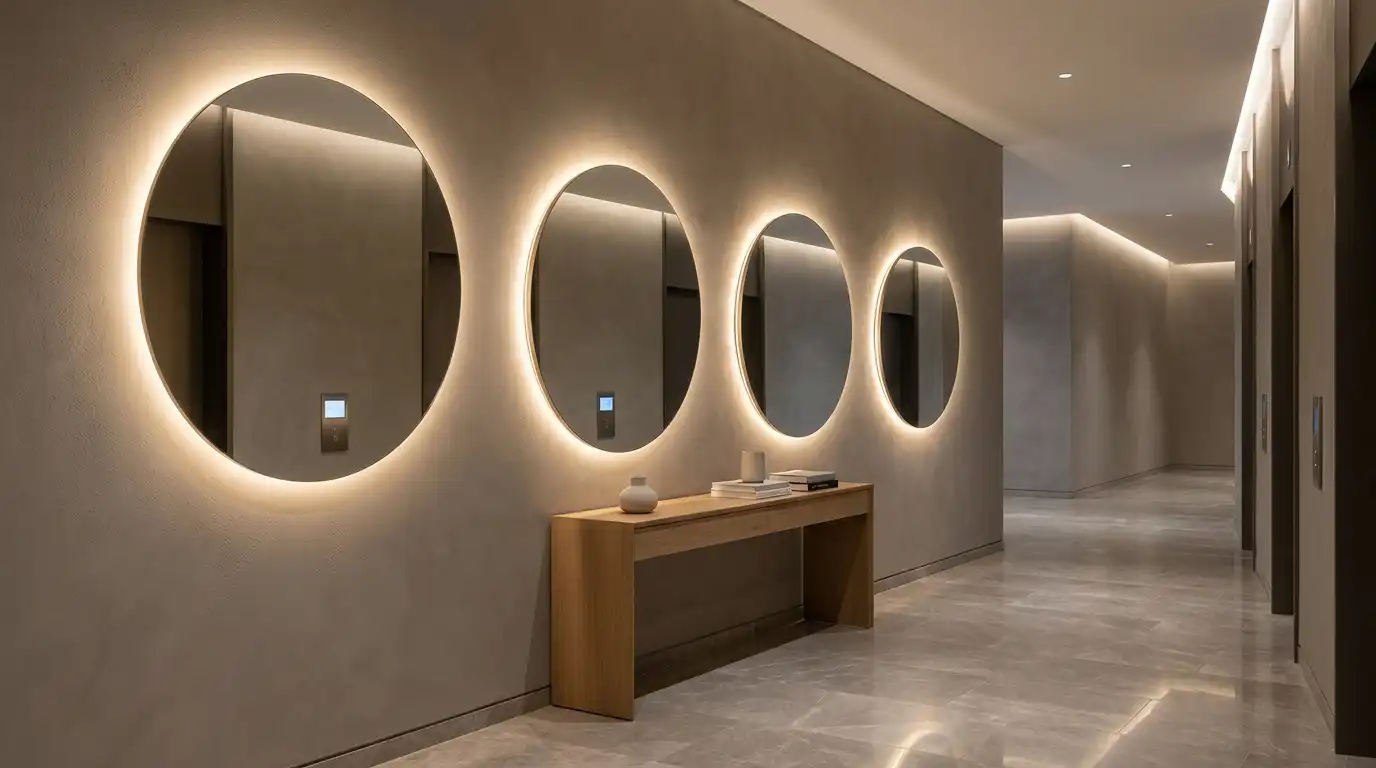
Picture a lift lobby with six round mirrors, each hung a few centimetres higher than the last because two installers worked from two different marks. Nobody notices one mirror. Everyone notices the row. This guide covers how to size, specify, mount and source round decorative mirrors so that a design that works once can be repeated across a project or a product line.
Where Circle Mirrors Earn Their Place in Commercial Interiors
Round mirrors soften rooms built from straight lines: corridors, rectangular vanities, tiled walls and grid ceilings. In project work they tend to appear in a handful of locations, each with a different priority.
| Location | What the mirror does | What to specify first |
|---|---|---|
| Hotel lobby or entry console | Focal point, adds depth and light | Diameter relative to the console, frame finish |
| Corridors and lift lobbies | Breaks up long walls, repeats a motif | Identical diameter and mounting height across units |
| Guest bathroom vanity | Task mirror plus decor | Lighting, moisture resistance, reflective height |
| Model units and show flats | Styling that photographs well | Finish matching the furniture package |
| Restaurants, salons and retail fitting areas | Atmosphere and secondary grooming mirror | Edge safety, secure fixings, cleaning access |
One practical note for vanity use: a circle gives less mirror than a rectangle of the same width. A round mirror has about 79% of the reflective area of a square with the same width (π ÷ 4), and its full height is available only at the centre. Where guests actually groom, choose a larger diameter than the vanity width alone would suggest, or treat the round mirror as the decor piece and add task lighting.
Sizing a Circle Mirror to the Wall
There is no standard for decorative mirror sizes, but designers work from a few consistent conventions:
- Over furniture: a diameter of about two-thirds of the furniture width keeps the mirror visually anchored. Over a bathroom vanity, a wider ratio of roughly 70–80% of the vanity width is common, as covered in our bathroom mirror size guide.
- Gap above furniture: leave a clear space between the console top and the bottom of the mirror so the two read as one composition rather than touching.
- Centre height on an open wall: galleries commonly hang art with its centre at about 57–60 in (1450–1525 mm) above the floor. The same convention works for a decorative round mirror with no furniture beneath it.
- Groups: clusters of several round mirrors usually look more deliberate with consistent spacing between them than with consistent alignment of their tops.
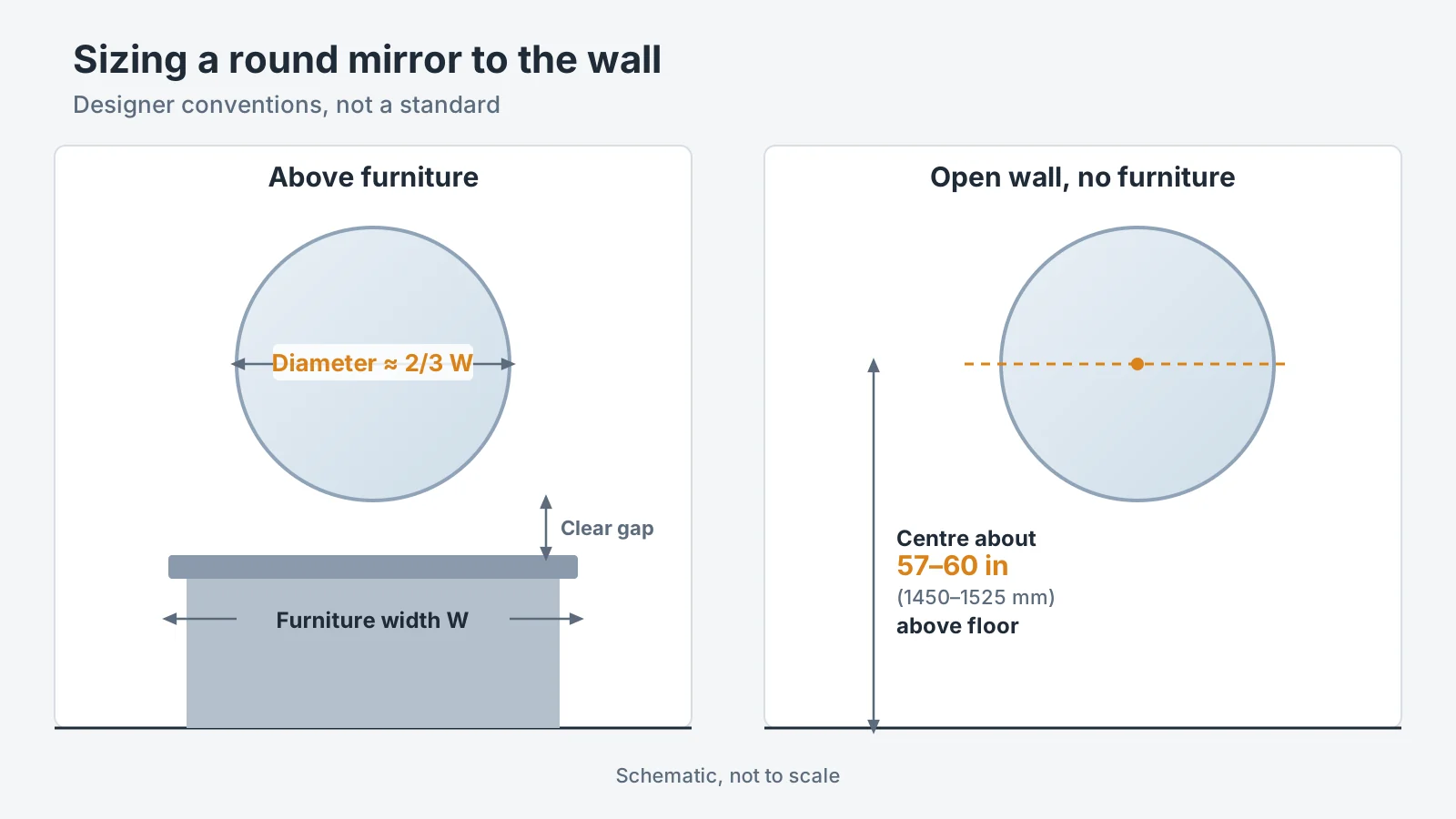
Applying the two-thirds convention gives a quick starting point:
| Furniture width | Suggested mirror diameter |
|---|---|
| 36 in (915 mm) | about 24 in (610 mm) |
| 48 in (1220 mm) | about 32 in (815 mm) |
| 60 in (1525 mm) | about 40 in (1015 mm) |
| 72 in (1830 mm) | about 48 in (1220 mm) |
In public restrooms and accessible guest rooms, accessibility rules take priority over decor conventions. Under the 2010 ADA Standards for Accessible Design, the bottom edge of the reflecting surface of a mirror above a lavatory or countertop may be no higher than 40 in above the floor. With a round mirror, that bottom edge is a single point at the base of the circle, so the mirror’s centre ends up lower than many designers expect. Our ADA bathroom mirror specification guide covers the full requirements.
Glass, Edges and Frames
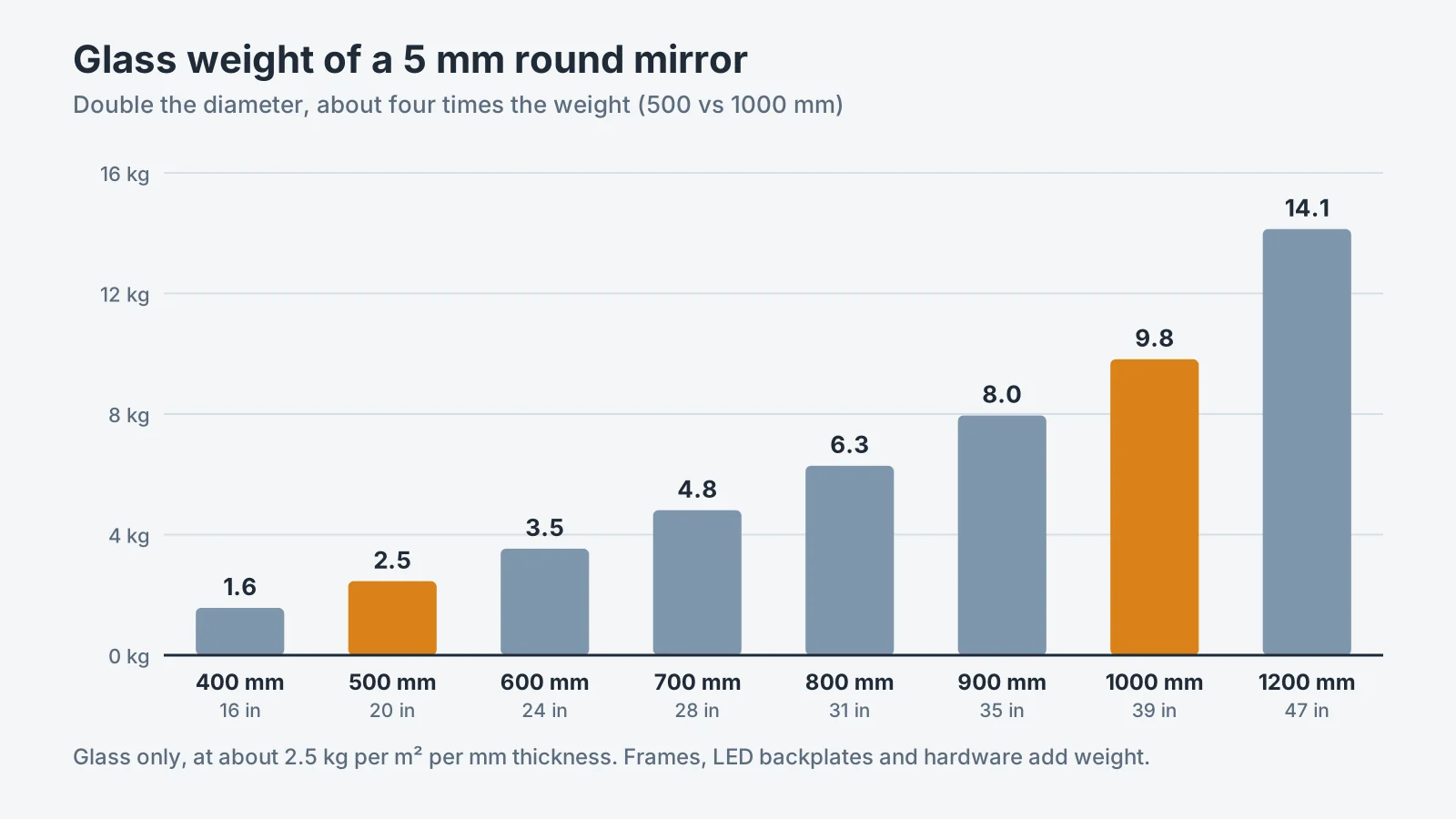
Glass thickness and weight. Decorative and bathroom mirrors are commonly made from 4–6 mm silvered glass. Float glass weighs about 2.5 kg per square metre for each millimetre of thickness, so weight rises with the square of the diameter: doubling the diameter roughly quadruples the glass weight. The chart below shows the glass alone at 5 mm; frames, LED backplates and hardware add to it.
Edge finish. A frameless circle shows its edge, so the edge finish is part of the design:
- Polished edge: clean and minimal; the default for frameless decor.
- Bevelled edge: catches light at the perimeter and suits traditional or transitional schemes.
- Frosted or etched light band: used on backlit and front-lit LED mirrors to diffuse the light.
Frame material by location. Aluminium and stainless steel frames tolerate bathroom humidity. Wood, rattan and other natural materials suit lobbies, corridors and bedrooms but are a poor fit near showers. For trim and finish combinations across a project, see our guide to bathroom mirror trim ideas.
Moisture and the silver backing. In bathrooms and spas, the cut edge of any mirror is its weak point. Copper-free silver glass, a sealed backing and a frame that covers the edge all help. Cleaning practice matters as much as construction; our mirror cleaning protocol for housekeeping teams explains why.
Lit or Unlit: Choosing the Right Round Mirror
A plain round mirror reflects the room’s light. An LED round mirror adds its own, and the lighting layout changes what the mirror is for.
| Configuration | Light effect | Best use |
|---|---|---|
| Plain, polished edge | None; reflects ambient light | Corridors, lobbies, bedrooms |
| Framed (metal, wood, rattan) | None; frame carries the design | Statement walls, model units, retail displays |
| Backlit LED (halo) | Soft glow on the wall behind | Decor lighting in bathrooms, corridors and suites |
| Front-lit or front-and-back lit LED | Light directed toward the user | Guest bathroom vanities, salons |
A backlit halo looks good on a corridor wall but puts little light on a face. Front lighting does the grooming work. For a project with many identical rooms, specify a single colour temperature across the order. Adjustable mirrors in the 3000–6000 K range let the operator choose, but units that power up at different default settings will look mismatched down a corridor.
For lit mirrors in decor locations away from a sink, plan the power feed early. A hardwired connection behind the mirror keeps cords off a feature wall, which means the electrician needs the mirror’s mounting height and wire entry point before the wall is closed.
Mounting Round Mirrors Securely
A round mirror has no straight top edge to rest on a ledge, so the fixing method matters more than with a rectangle.
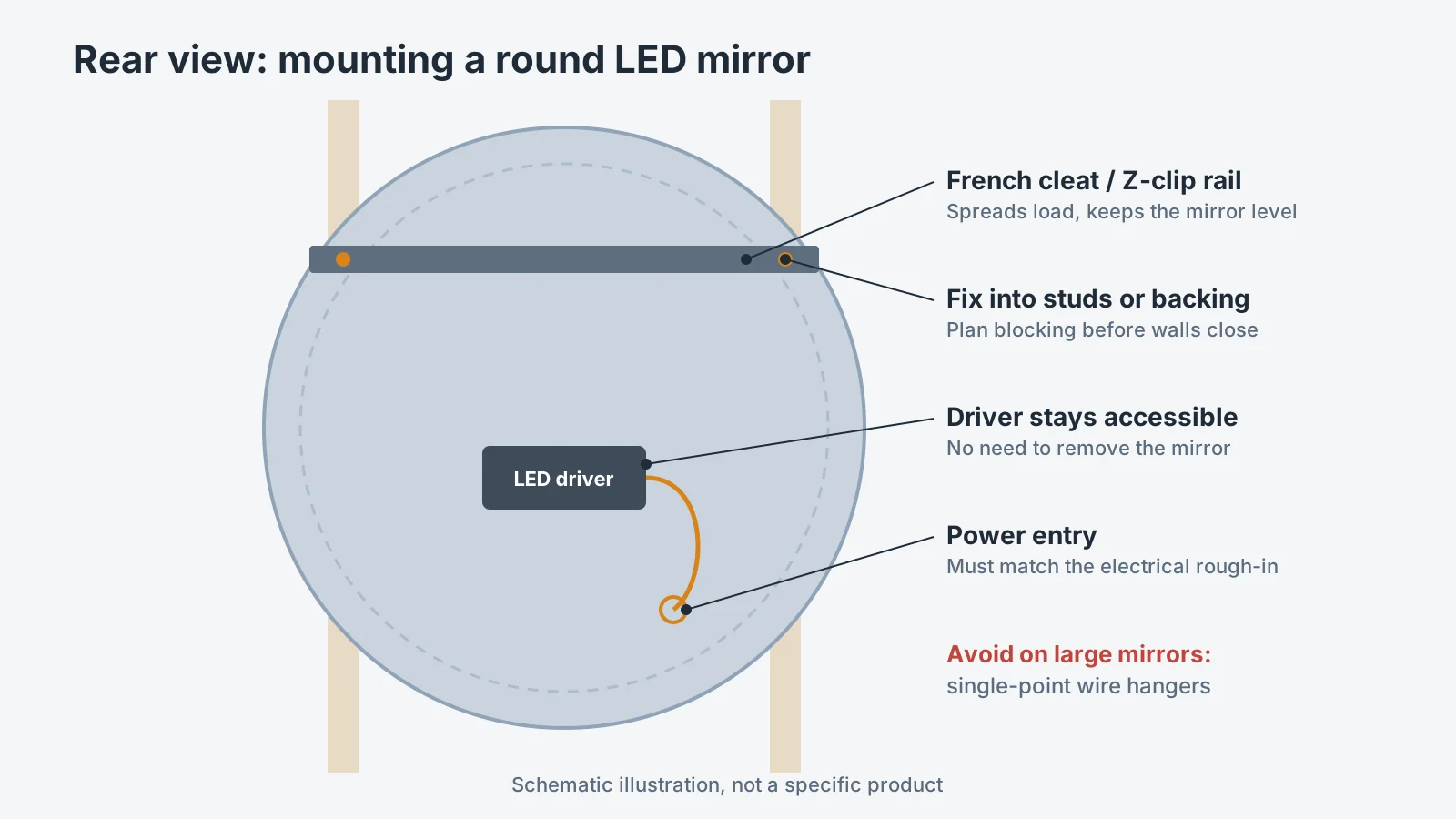
- French cleat or Z-clip: the most reliable option for heavier round mirrors. It spreads the load along a rail and keeps the mirror level, which a single hook cannot.
- Fixings into studs or solid backing: where a wall has no stud at the right spot, plan blocking or a backing plate before the wall is finished.
- No single-point wire hangers on large mirrors: a round mirror on one wire can rotate or tilt, and the wire concentrates the load.
- Security fixings in public areas: restaurants, restrooms and lobbies often use concealed or tamper-resistant clips so the mirror cannot be lifted off.
- LED mirrors: keep the driver accessible, and confirm the wire entry position matches the electrical rough-in.
Our complete guide to mounting a wall mirror walks through wall types and installation steps in more detail.
Ordering Circle Mirrors in Volume
Whether the order is 60 mirrors for a hotel refurbishment or a private-label range for online retail, the same few points decide whether the delivery matches the sample:
- Diameter and tolerance. State the diameter of the glass and the overall diameter with frame separately, and agree a tolerance. A difference of a few millimetres is invisible on one mirror and obvious in a row.
- Finish consistency. For metal frames, ask how finish colour is controlled between production batches, especially for brushed brass or bronze tones.
- Light colour. For LED mirrors, fix the colour temperature, the default power-on setting and the brightness in the specification.
- Sample approval. Approve a physical sample of each diameter and finish, and keep it as the reference for inspection.
- Packaging. Round glass has no corners to protect, so edge protection has to wrap the full circumference. For e-commerce, ask for packaging that survives parcel handling, not just pallet freight.
- Range planning for resellers. One design offered in several diameters lets a retailer cover different wall sizes with a single listing family.
LuckMirror manufactures round LED mirrors for OEM and ODM programs, from 50 pieces per model, with a 3-year warranty and moisture-resistant designs for bathroom use. Diameter, frame and finish, lighting, anti-fog, dimming, touch controls, logo and packaging can all be customized, and lead times are confirmed for each order. See our customization options or send us your project details.
FAQ
What is the MOQ for a custom-diameter round mirror?
At LuckMirror, the minimum order is 50 pieces per model. A different diameter or finish usually counts as a separate model, so confirm how your range will be counted when you request a quote.
Can one design be made in several diameters for a product range?
Yes. Offering one frame or lighting design in several diameters is a common way to build a range. Agree the size steps and approve a sample of each, because proportions such as frame width or light-band width may need adjusting at small and large diameters.
Can round mirrors be supplied with our logo and packaging?
Yes, logo and packaging customization is part of OEM/ODM orders. Provide your artwork, required languages and any care-instruction insert together with the order details.
What certifications should a round LED mirror have for my market?
That depends on the market and sales channel. For example, US retailers and marketplaces commonly ask for a safety listing of the finished lighted mirror, and the EU requires CE conformity for electrical products. A certified LED driver or strip does not make the complete mirror compliant, so ask any supplier for test reports that cover the finished product, and plan certification costs and timing into the program.
How long does production take?
Lead time depends on order quantity, the level of customization and whether new tooling is needed. LuckMirror confirms the lead time for each order at the quotation stage.