
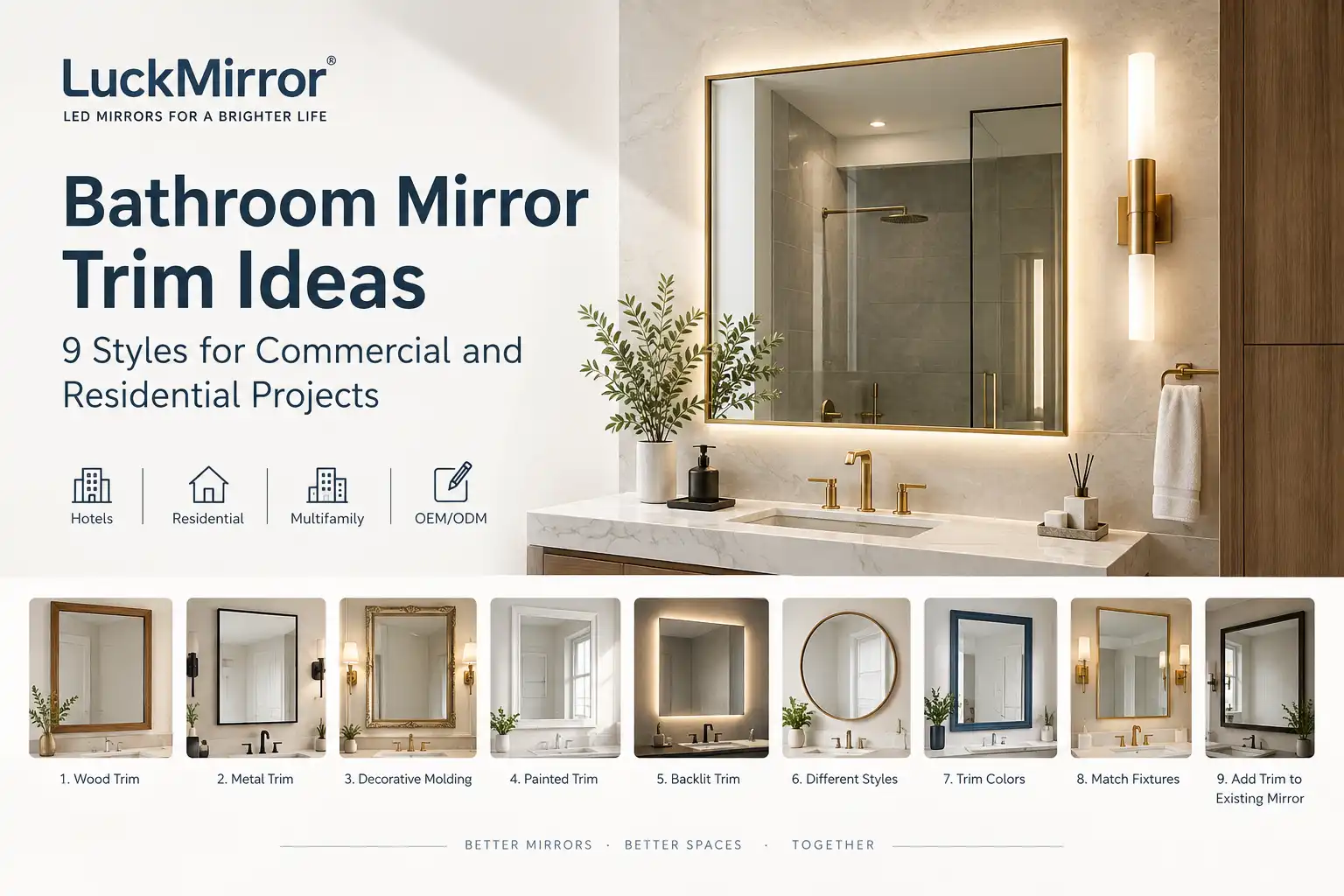
If you are selecting bathroom mirrors for a hotel, multifamily development, residential project, or retail product line, the right trim can change the entire look of the installation. The most useful bathroom mirror trim ideas usually fall into five material directions—wood, metal, decorative molding, painted finishes, and integrated lighting—but the best choice depends on the bathroom style, surrounding fixtures, mirror dimensions, and installation requirements.
For project buyers and designers, there is another consideration: a beautiful trim concept still has to survive production, shipping, installation, and repeated use. That makes material consistency, finish quality, moisture resistance, and customization capability just as important as appearance.
Here are nine practical directions to consider.
Wooden Bathroom Mirror Trim Ideas
Wood is still one of the easiest ways to make a bathroom mirror feel warmer and more architectural. It works particularly well when the vanity, cabinetry, or other wood elements already establish a natural material palette.
For commercial projects, however, the question is not simply which wood looks best. You also need to consider how the finish behaves in a humid environment and whether the supplier can reproduce the same finish across a large production run.
Natural Wood Trim
Light oak, maple, and similar finishes give a bathroom a softer appearance without making the mirror look overly decorative.
This approach works well for:
- Scandinavian-inspired bathrooms
- Japandi interiors
- Contemporary residential projects
- Boutique hotels
- Multifamily developments using warm neutral palettes
A relatively narrow wood profile can keep the mirror visually light, while a wider profile makes the mirror feel more like a piece of furniture.
Rustic and Reclaimed Wood
Reclaimed or distressed wood is a natural fit for farmhouse, rustic, and hospitality interiors where the mirror is intended to become part of the room’s character.
For a commercial specification, though, be careful with the word “reclaimed.” The visual effect can be reproduced with a controlled wood finish, which may be more practical when you need dozens or hundreds of mirrors to look consistent.
Dark-Stained Wood
Walnut tones and dark stains create stronger contrast against white tile, pale stone, or light-colored walls.
This is particularly useful when the bathroom already has black or dark hardware. The mirror becomes a visual bridge between the vanity and the wall rather than a separate decorative object.
Light Wood Trim
Light wood is often the safer choice when the bathroom is small or already contains several strong visual elements. It adds definition without carrying the visual weight of a thick black or dark metal frame.
If you are developing a private-label mirror collection, wood-look finishes can also give you the appearance of a custom frame while keeping the product family consistent across multiple sizes.
Metal Trim Ideas for Bathroom Mirrors
Metal trim gives a bathroom mirror a cleaner, more architectural appearance. It is particularly useful when the project already uses metal throughout the space.
Matte Black Mirror Trim
Matte black remains one of the easiest finishes to specify because it works with modern, industrial, contemporary, and transitional interiors.
A thin black edge can define a frameless-looking mirror without making the wall feel heavy. A wider black frame produces a stronger focal point.
For a hotel or multifamily project, black is also practical from a design-standardization standpoint: it can coordinate with faucets, shower frames, cabinet pulls, and lighting hardware across multiple room types.
Brass and Gold Trim
Brass and gold finishes move the mirror in a warmer, more decorative direction.
They work particularly well with:
- Luxury hospitality
- Boutique hotels
- High-end residential developments
- Traditional bathrooms
- Warm stone and marble palettes
Antique or brushed finishes tend to feel more architectural than highly polished gold, especially when the mirror is used repeatedly across a larger project.
Brushed Nickel and Chrome
Brushed nickel and chrome are useful when the bathroom already has cooler metal finishes.
Chrome gives a sharper, more reflective appearance, while brushed nickel is generally quieter visually. Either can work well in contemporary projects where the mirror should coordinate with the plumbing rather than compete with it.
Thin Metal Edge vs. Full Metal Frame
This distinction matters more than it first appears.
A thin metal edge keeps the reflective surface visually dominant. A full frame makes the mirror itself more prominent.
For compact bathrooms, narrow profiles are usually easier to work with. In larger hospitality bathrooms, a substantial metal frame can provide the visual weight needed to balance a large vanity wall.
Decorative Molding and Crown Molding for Bathroom Mirrors
If wood trim creates warmth, decorative molding creates architecture.
This approach is especially effective when the bathroom has traditional millwork, paneling, classic cabinetry, or other detailed elements.
Classic Crown Molding Frames
Crown molding can make a standard rectangular mirror look more substantial and custom-built.
It works best when the rest of the room already has traditional detailing. Putting an ornate mirror frame into an otherwise minimalist bathroom can look disconnected unless that contrast is intentional.
Picture-Frame Molding
Picture-frame molding is a more restrained option. It creates a defined border without the visual bulk of a heavily carved frame.
This is a useful direction for transitional projects where you want some traditional character without making the mirror look antique.
Ornate and Carved Molding
Carved details, decorative profiles, and vintage-inspired finishes can turn the mirror into a focal point.
These styles are most appropriate for:
- Boutique hospitality
- Luxury residential
- Historic-inspired interiors
- Traditional bathroom collections
They are less suited to projects where every unit needs a simple, highly repeatable installation.
Layered Molding for a Custom Look
A layered frame can combine a simple inner profile with a wider outer molding.
The result is more dimensional than a single flat trim piece. It can also create a useful visual transition between a large mirror and a detailed wall treatment.
For OEM development, layered construction is worth discussing at the sample stage because the frame depth, attachment method, packaging dimensions, and finished weight all become part of the product specification.
Painted Bathroom Mirror Trim Ideas
Painted trim gives designers more control over the relationship between the mirror and the rest of the bathroom.
Instead of treating the frame as a separate material, you can use it as another surface in the room’s color palette.
Classic White Trim
White trim works particularly well in small bathrooms and light-colored interiors.
It keeps the mirror visually clean and can blend with white cabinetry, wall paneling, or architectural trim.
Black Painted Trim
Black creates a sharper boundary around the mirror and works particularly well against white walls, pale stone, or light tile.
For contemporary projects, a black painted frame can provide the same visual contrast as black metal while allowing a different surface texture.
Matching Trim to the Vanity
Matching the mirror trim to the vanity is one of the simplest ways to make a bathroom feel intentionally designed.
For example:
- White vanity + white trim creates a quiet, integrated look.
- Dark vanity + dark trim creates a stronger architectural frame.
- Wood vanity + wood-toned trim creates material continuity.
The goal is not necessarily to make every surface identical. It is to repeat one or two key finishes so the bathroom feels coordinated.
Bold Accent Colors
In boutique hospitality or design-led residential projects, a colored frame can become part of the visual identity.
Deep green, navy, charcoal, and other saturated tones can work particularly well when they repeat a color already present in tile, cabinetry, or wall finishes.
For a private-label product, this can also become a product-line differentiator: the same mirror architecture can be offered in several controlled finishes rather than requiring a completely different design for every market.
Backlit Bathroom Mirror Trim Ideas
Backlighting changes the role of trim. Instead of simply surrounding the reflective surface, the frame can help create a controlled gap between the mirror and wall so light forms a halo around the perimeter.
This is particularly effective in modern hospitality and residential bathrooms.
LED Lighting Behind the Mirror Frame
A backlit mirror produces indirect light that reflects from the wall behind the mirror.
The result is softer than a direct front-facing light and can make the mirror appear to float.
For project specifications, do not treat the LED component as an afterthought. The lighting system, power connection, control method, and environmental protection all need to be considered as part of the mirror assembly.
Hidden LED Strip Trim
A hidden LED strip can create a clean perimeter glow without exposing the individual LEDs.
The distance between the light source, mirror, and wall affects the appearance of the halo. A poorly planned installation can produce uneven bright spots instead of the continuous glow designers usually want.
If you are developing this as an OEM product, request a physical sample rather than evaluating the lighting only from product photos.
Backlit Trim for Modern and Luxury Bathrooms
Backlighting is particularly useful when the design objective is a premium, contemporary appearance.
LuckMirror’s existing LED mirror range includes multiple shapes and finishes, including backlit round and oval configurations, and supports custom sizing for project applications.
For a commercial project, you should also confirm the required electrical and environmental specifications before approving the final design. A bathroom mirror with integrated electrical components is a different procurement item from a simple decorative framed mirror.
Mirror Trim Ideas for Different Bathroom Styles
The same trim material can look completely different depending on the rest of the bathroom. Instead of choosing a frame in isolation, start with the design language of the project.
| Bathroom Style | Trim Direction | Typical Finish |
|---|---|---|
| Modern | Thin metal or minimal painted trim | Black, white, brushed metal |
| Farmhouse | Rustic wood or simple molding | Natural, weathered, white |
| Traditional | Decorative molding | White, walnut, antique finishes |
| Industrial | Metal or dark wood | Matte black, dark brown |
| Coastal | Light wood or simple painted trim | White, natural wood |
| Scandinavian / Japandi | Minimal wood trim | Light oak, natural finish |
| Luxury | Brass, gold, layered molding, or backlighting | Brushed gold, brass, dark wood |
Modern Bathroom
Keep the profile narrow and the finish controlled. Matte black, brushed metal, or a minimal painted border usually works better than highly decorative molding.
Farmhouse Bathroom
Wood is the obvious starting point. Reclaimed-looking finishes, simple molding, and warm stains can connect the mirror to cabinetry and other natural materials.
Traditional Bathroom
Traditional bathrooms give you more room to use decorative profiles. Crown molding, carved wood, brass, and layered frames can all work when the surrounding architecture supports them.
Industrial Bathroom
Black metal and dark wood are natural choices. Simple geometric profiles tend to work better than ornate frames.
Coastal Bathroom
Light wood, white-painted trim, and natural textures keep the mirror relaxed without making it look overly themed.
Scandinavian or Japandi Bathroom
This is where restraint matters. Light wood, thin profiles, and simple geometry keep the mirror aligned with the rest of the space.
Luxury Bathroom
Luxury does not necessarily mean a thicker frame. Brass, layered molding, carefully controlled finishes, and integrated LED lighting can create a more premium result without making the mirror visually bulky.
How to Choose Mirror Trim Color
Once you have chosen a material and design direction, color becomes the next decision.
A useful rule for project work is to think in terms of coordination, contrast, and repetition rather than simply asking which color looks attractive on its own.
Match the Trim to Your Bathroom Hardware
If the faucets, shower hardware, and cabinet pulls are matte black, a black mirror frame creates an obvious visual connection.
The same principle applies to brass, gold, chrome, and brushed nickel.
You do not necessarily need an exact finish match, but large differences in sheen can be noticeable. A brushed brass mirror frame beside highly polished chrome plumbing, for example, creates a very different effect from a bathroom where the finishes have been deliberately coordinated.
Match the Trim to the Vanity
The vanity is usually one of the largest visual elements in the bathroom, so it is a logical reference point.
A wood vanity can support a wood-toned frame. A white vanity can work with white, black, or metallic trim depending on whether you want the mirror to blend in or stand out.
Create Contrast With the Wall
Contrast is useful when you want the mirror to act as a focal point.
Examples include:
- Black trim against white tile
- White trim against a darker wall
- Brass trim against green or blue tile
- Dark wood against light stone
When to Match vs. Contrast
There is no need for every finish in a bathroom to be identical.
A better approach is to establish a clear hierarchy. If the faucet, cabinet hardware, lighting, and mirror frame all have different finishes, the room can feel accidental. If two or three finishes repeat deliberately, mixed materials can look much more controlled.
How to Match Mirror Trim With Bathroom Fixtures
Trim selection becomes easier when you stop treating the mirror as an isolated product.
Look at the entire vanity wall.
Coordinate With Faucets and Shower Hardware
Start with the most visible permanent metal finishes.
If the project specification already calls for matte black faucets, black trim is an easy choice. If brushed nickel dominates the bathroom, a silver-toned frame will usually integrate more quietly.
For large projects, documenting the approved finish codes is worthwhile. “Gold” is not a sufficient specification when multiple suppliers are involved.
Coordinate With Cabinet Hardware
Cabinet pulls and knobs are smaller than the mirror, but they sit close enough to create a strong visual relationship.
Repeating the same finish on the mirror can make an otherwise standard vanity feel more considered.
Coordinate With Bathroom Lighting
The mirror frame should also work with the lighting.
For example, a brass-framed mirror can pair naturally with brass wall sconces. A black-framed mirror can reinforce a black linear vanity light or black sconces.
With integrated LED mirrors, the lighting is already part of the product. LuckMirror’s LED mirror products are designed with integrated illumination and are available in different styles, shapes, sizes, and colors for project applications.
Match the Mirror Trim to the Backsplash
The backsplash is another useful reference.
You can:
- Match the trim to the backsplash
- Use a contrasting frame
- Repeat one backsplash color in the frame
- Keep the frame neutral while allowing the tile to remain the focal point
The best choice depends on which element you want people to notice first.
Should Everything Match?
No.
A bathroom can comfortably use mixed finishes. The important part is intentional repetition.
For example, black mirror trim + black cabinet hardware + warm brass faucet can work. Black mirror trim + chrome faucet + nickel sconces + bronze cabinet hardware + gold accessories starts to become much harder to control.
How to Add Trim to a Builder-Grade Bathroom Mirror
This is where design ideas become a practical project decision.
Builder-grade mirrors are often large, frameless sheets of glass installed above a vanity. If the mirror itself is still in good condition, adding a frame can change its appearance without replacing the entire mirror.
For a B2B project, however, this approach needs to be evaluated differently from a homeowner DIY project. You need to consider installation labor, repeatability, trim tolerances, packaging, and whether the finished appearance will remain consistent across every unit.
Can You Frame a Builder-Grade Mirror Without Removing It?
In many installations, yes.
If the existing mirror is securely mounted and the planned trim can accommodate its edges and mounting hardware, the frame can potentially be installed around the existing glass.
But first determine how the mirror is attached.
A mirror held by clips is a different problem from a mirror bonded directly to the wall. If you discover adhesive mounting, removing the glass just to add a frame can introduce unnecessary risk.
Measure the Existing Mirror
Take actual measurements before ordering or cutting trim.
At minimum, record:
- Overall mirror width
- Overall mirror height
- Glass thickness
- Wall clearance
- Location of clips or brackets
- Distance from the mirror to the backsplash
- Available space around lighting fixtures
Frame dimensions can also change the effective reflective area. LuckMirror’s bathroom mirror sizing guidance notes that framed mirrors have less visible glass than an equivalent-size frameless mirror because the frame occupies part of the outer dimensions.
That matters when you are replacing or standardizing mirrors across multiple bathroom layouts.
Choose the Right Trim Material
For a commercial bathroom, material selection should account for humidity, cleaning routines, durability, and repeatability.
Wood can provide the most natural appearance, but it needs an appropriate finish. Metal provides a clean, durable visual language. Painted trim offers more color flexibility.
If you are specifying an OEM product rather than modifying mirrors on site, ask the manufacturer which frame materials and finishes can be produced consistently at your required quantity.
Deal With Existing Mirror Clips
Mirror clips are easy to overlook until the frame reaches them.
Depending on the design, you may need to:
- Notch the trim around the clips
- Use a deeper profile
- Reposition compatible mounting hardware
- Design the frame to conceal the clips
This is one reason a production sample is useful before approving a large order.
Mitered Corners vs. Butt Joints
Mitered corners create a cleaner, more furniture-like appearance, but they require more accurate cutting and assembly.
Butt joints are simpler and can be more forgiving during installation.
For a factory-produced product, the choice is less about DIY difficulty and more about how the selected construction method affects:
- Corner consistency
- Production time
- Packaging
- Assembly
- Long-term durability
Attach the Trim
The attachment method should be selected for the actual mirror and wall construction.
Do not assume that a general-purpose adhesive is automatically suitable for use against mirror glass. For commercial projects, the manufacturer or installer should confirm compatibility between the adhesive, mirror backing, frame material, and substrate.
Seal and Protect the Finished Trim
Bathrooms are demanding environments. Water, steam, cleaning chemicals, and repeated temperature changes can expose weak finishes quickly.
Wood trim in particular should have all appropriate exposed surfaces protected, including edges and joints.
For OEM procurement, ask for the finish specification and environmental-use guidance rather than relying only on the product photograph.
Common DIY and Project Mistakes to Avoid
The most common problems are usually not dramatic. They are small measurement and coordination errors:
- Ordering the frame before measuring the existing mirror
- Ignoring mirror clips
- Choosing a trim that is visually too heavy for the vanity
- Forgetting that the frame reduces visible glass
- Mixing unrelated metal finishes
- Treating bathroom trim like ordinary dry-room millwork
- Approving a large production order without reviewing a physical sample
For commercial projects, the last point is particularly important. A sample is where you catch the details that drawings and product photos tend to hide.
Choosing the Right Bathroom Mirror Trim for Your Project
The best bathroom mirror trim ideas are not necessarily the most decorative ones. For a project, the right choice is the one that balances appearance with production, installation, durability, and repeatability.
If you are specifying mirrors for a hotel, multifamily development, retail product line, or residential project, start with four questions:
- What material fits the design language?
Wood, metal, molding, painted trim, or an integrated LED solution? - What finish needs to repeat elsewhere?
Vanity, faucets, cabinet hardware, lighting, and backsplash should be considered together. - Will the mirror be custom-produced or modified on site?
For repeated installations, a factory-developed frame can be more consistent than site-built trim. - What project specifications need to be locked before production?
Dimensions, glass, frame finish, lighting, electrical configuration, mounting method, packaging, and required certifications should all be documented before mass production.
LuckMirror provides OEM/ODM customization for LED mirror products, including custom sizing and different styles, finishes, and configurations. Its manufacturing operation includes 15 deep-processing production lines and annual LED mirror capacity of approximately 800,000 units, supporting larger project requirements as well as customized product development.
If you already have a target mirror size, frame style, finish, quantity, and installation environment, those details are enough to start a project discussion. Rather than choosing a trim from a photo alone, ask the manufacturer to develop or sample the complete mirror assembly so you can evaluate the frame, glass, lighting, finish, and mounting details together.
Frequently Asked Questions
Can bathroom mirror trim be customized for OEM projects?
Yes. For OEM projects, the trim can be developed around the required mirror dimensions, finish, shape, lighting configuration, and overall product design. The important step is to confirm which specifications can be standardized across the production quantity before finalizing the design.
What is the best mirror trim material for hotel bathrooms?
There is no single best material for every hotel. Metal, properly finished wood, painted trim, and integrated framed LED mirrors can all work. The better choice depends on the hotel’s design standard, humidity exposure, cleaning requirements, budget, and the level of customization required.
Can I order custom-size bathroom mirrors with trim?
Custom sizing is commonly available for project-oriented mirror manufacturing. LuckMirror’s LED vanity mirror range, for example, supports customized sizing for different hotel and residential requirements.
What should I request from a bathroom mirror trim manufacturer before placing a bulk order?
Request a complete specification covering mirror dimensions and thickness, frame material and finish, lighting configuration if applicable, electrical requirements, mounting method, packaging, sample approval, production lead time, MOQ, and relevant compliance documentation.
Is backlit trim suitable for commercial bathroom projects?
Yes, but treat the LED system as part of the electrical product rather than simply as decorative trim. Confirm the required IP rating, electrical configuration, light output, color temperature, controls, installation method, and market-specific certification requirements before production.