
The safest way to clean a bathroom mirror is also the simplest: wipe it with a soft, lint-free cloth dampened with clean, warm water, apply any cleaner to the cloth rather than the glass, and dry the surface — especially the edges — straight away. On an LED mirror, add one step at the start: switch the lighting and demister off.
For one mirror in one home, that is the whole answer. For a hotel with 300 guest bathrooms, a developer handing over 80 units, or a reseller shipping mirrors into thousands of homes, the details matter more. The cleaner a housekeeping team picks up every day decides whether the mirror edges stay clean for years or start turning dark, and dark edges are rarely covered once the cause traces back to cleaning.
This guide covers the cleaning routine itself, why certain products damage mirrors, the extra rules for LED mirrors, and how to turn all of it into a written procedure your staff, tenants or end customers will actually follow.

The Cleaning Routine That Protects the Mirror Backing
The steps below follow the recommendations the Mirror Division of the Glass Association of North America (GANA) published in its bulletin Proper Procedures for Cleaning Flat Glass Mirrors (GANA MD 01-0105), with LED-specific steps added.
- Power down LED mirrors. Switch the mirror off at the touch control or wall switch so the light and demister are not running while you wipe (details in the LED section below).
- Dry-dust first. Remove dust, hair and loose particles with a dry microfiber cloth so grit isn’t dragged across the glass.
- Dampen the cloth, not the mirror. Use clean, warm water. Wring the cloth out until it’s barely damp. If you need a cleaner, apply it to the cloth.
- Wipe the face, staying off the edges. Work top to bottom across the glass. Keep the wet cloth away from exposed edges, the frame line and the gap between mirror and wall.
- Dry immediately. Follow with a second, dry lint-free cloth. Finish by checking that every edge and joint is dry.
- Treat stubborn marks separately. Dried hairspray or toothpaste usually lifts with a warm damp cloth held on the spot for a few seconds. Don’t escalate to solvents or abrasive pads (see the cleaner table below).
What this routine leaves out is as important as what it includes: no spraying the glass, no ammonia or vinegar cleaners, no letting liquid run down into the bottom edge.
Why Cleaning Is the Usual Cause of Black Edge
A standard bathroom mirror is not just glass. It’s a sheet of float glass with a thin reflective silver layer on the back, protected by one or more layers of backing paint. On the face of the mirror, the glass shields the silver. At a cut edge, all of those layers are exposed side by side.
When liquid reaches that edge and sits there — cleaner running down the face, spray drifting past the frame, water left after wiping — it can attack the silver from the side. The result is the dark, creeping band along the bottom or corners that the mirror industry calls black edge, also known as desilvering. It typically starts at the bottom edge, where gravity collects runoff, and once it has started, no amount of cleaning removes it, because the damage is behind the glass.
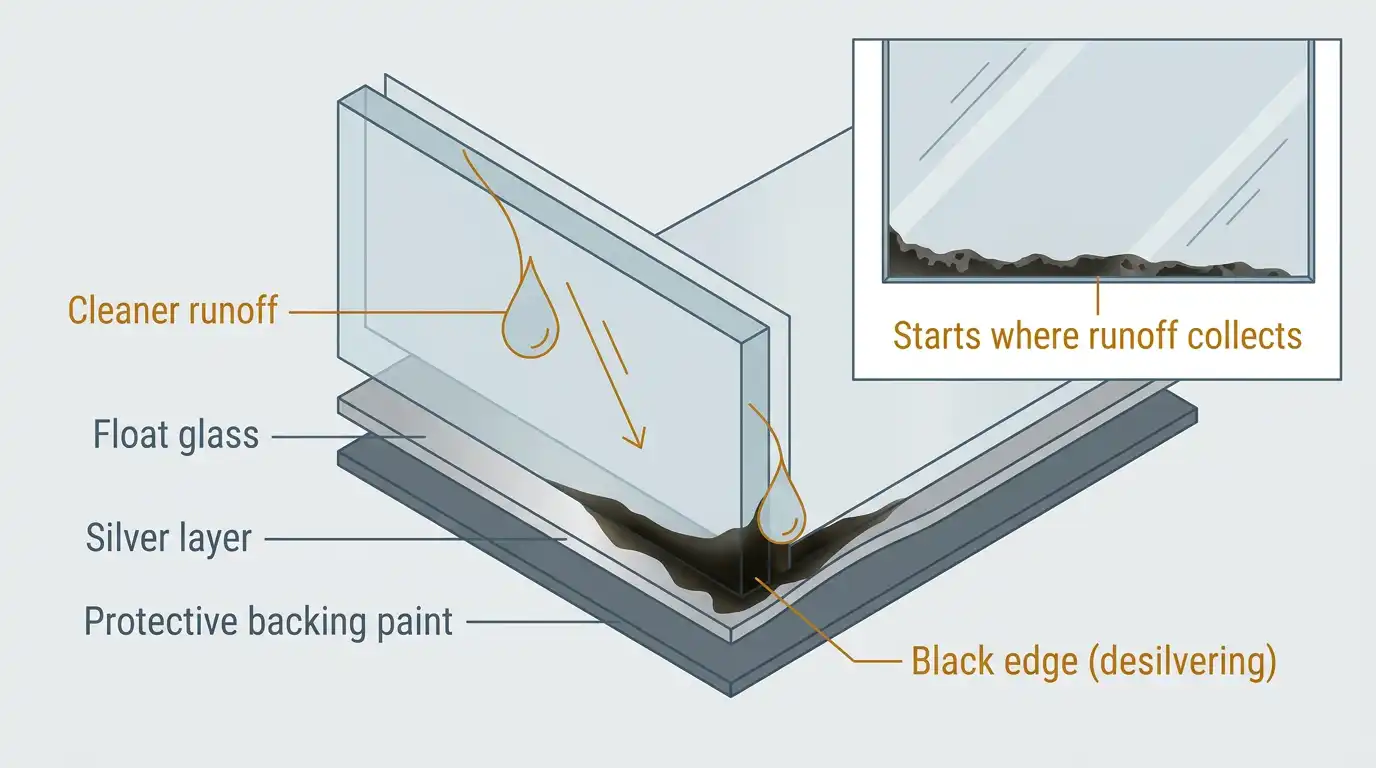
This is why the GANA bulletin advises against getting mirror edges wet with any liquid, and against commercial mirror cleaners containing ammonia or vinegar, as well as acid, alkali, abrasive and solvent products. It also explains why mirror warranties and commercial specifications often treat cleaning as a condition. One example: the University of Vermont’s Division 08 mirror design standard requires final cleaning to comply with GANA MD 01-0105 and limits the manufacturer’s special warranty to defects not caused by cleaning contrary to the recommended procedure.
For an owner or operator, the practical point is blunt: a housekeeping product choice can shorten the visible life of every mirror in the building, and that cost lands on the property, not the manufacturer.
Which Cleaners Are Safe on Mirrors
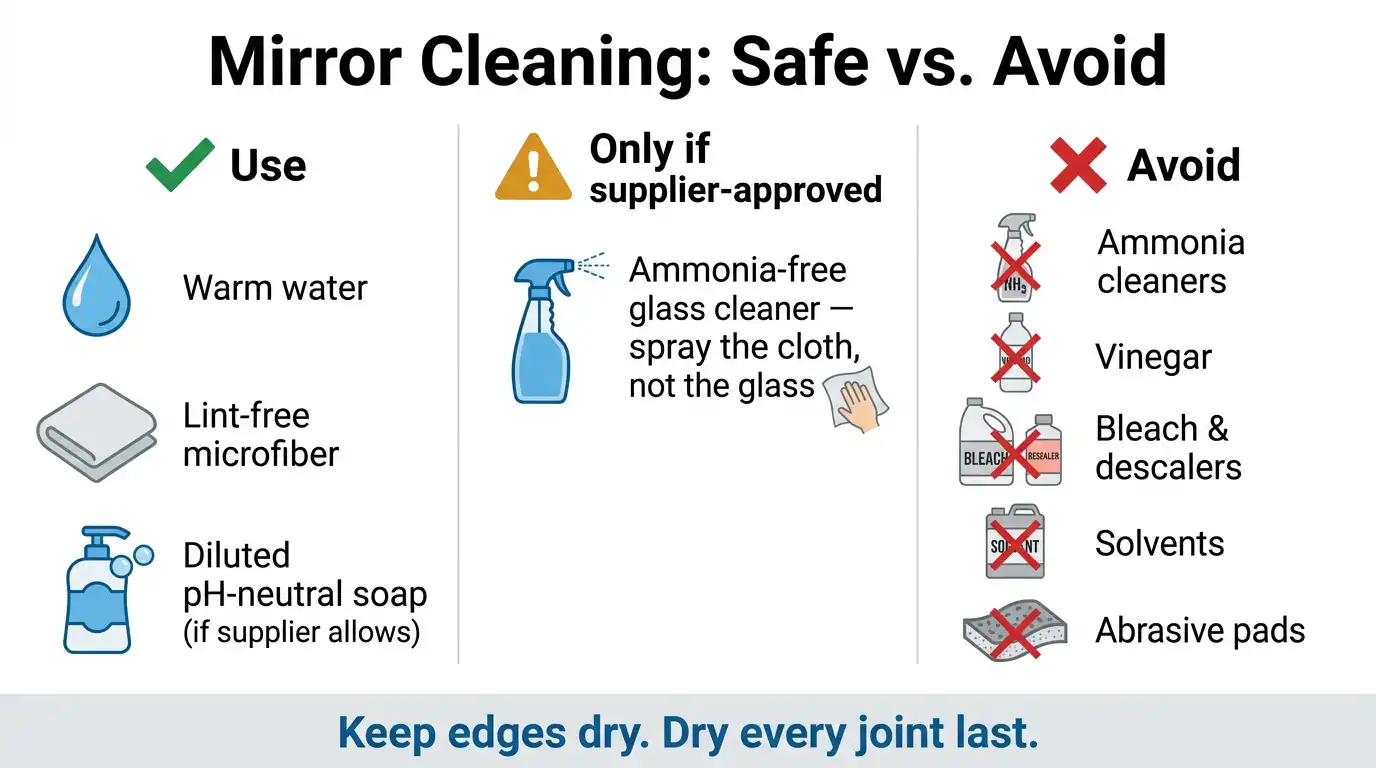
Consumer cleaning guides frequently recommend vinegar-and-water or ammonia-based glass sprays for streak-free results, and many households use them without visible damage in the short term. Mirror-industry guidance is more conservative because the damage shows up at the edges, slowly, and is permanent. For commercial properties where hundreds of mirrors are cleaned daily, the conservative rule is the one to write into your procedure.
| Cleaning product | Use on mirrors? | Why |
|---|---|---|
| Clean warm water + soft lint-free cloth | Yes — default | GANA describes this as the safest cleaner; nothing to attack the edge or backing |
| Mild pH-neutral soap, heavily diluted | Yes, if the mirror maker allows it | Some LED mirror instructions specify warm soapy water; wipe off and dry fully |
| Ammonia-free glass cleaner approved by the mirror maker | With care | Apply to the cloth, never sprayed on the glass; check it is on the supplier’s approved list |
| Ammonia-based glass cleaners | Avoid | Cited by mirror-industry guidance as a cause of edge damage |
| Vinegar or vinegar-based cleaners | Avoid | Listed by GANA alongside ammonia cleaners as not to be used |
| Acid or alkali cleaners (descalers, bleach, bathroom “power” sprays) | Avoid | Can attack the glass surface, edges and backing |
| Solvents (acetone, thinners) | Avoid | Can damage edges and backing paint |
| Abrasive powders, scouring pads, razor scrapers | Avoid | Scratch the surface; on LED mirrors can damage printed or frosted light zones |
A note on extra-fine steel wool: the GANA bulletin permits 0000 oil-free steel wool (instead of solvents) for removing stubborn surface marks on standard mirrors. We would keep it off LED mirrors’ touch-sensor areas, frosted or etched light bands, printed graphics and any coated or two-way mirror glass, and reserve it for maintenance staff rather than daily housekeeping.
Where your mirror supplier’s care sheet is stricter than this table, follow the supplier’s sheet. GANA itself notes that the mirror supplier’s cleaning procedure is the one the user is responsible for following.
Extra Steps for LED Bathroom Mirrors
An LED mirror adds electronics, a light-emitting zone and often a heated demister pad behind the glass. The glass face cleans the same way; what changes is everything around it.
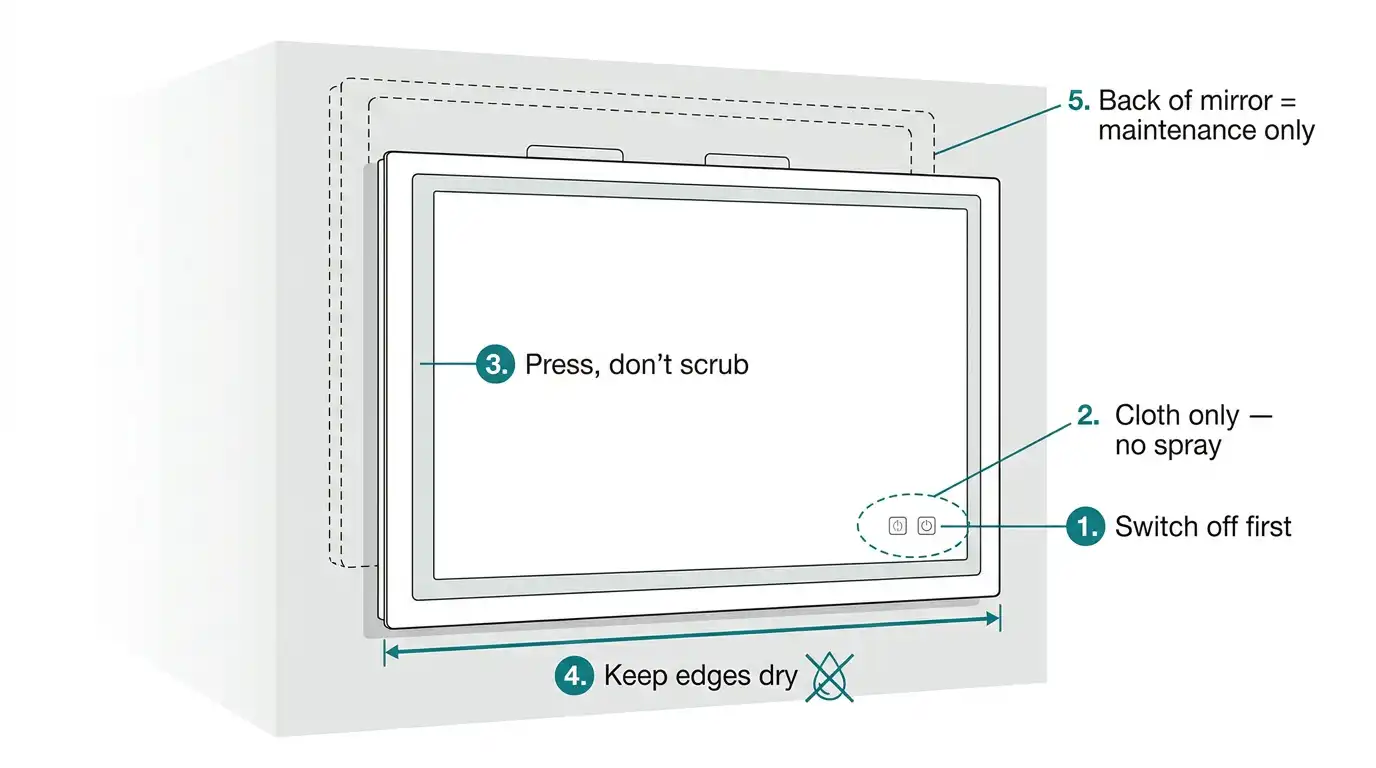
Switch it off before wiping. Most LED bathroom mirrors use capacitive touch buttons on the glass face. Wiping across them toggles the light, the demister or the color temperature, which confuses guests and housekeeping alike. Turning the mirror off first, by its own control or the wall switch where it is wired to one, also stops the demister from warming the glass while you clean. Cleaner on warm glass dries faster and streaks more.
Never spray at the controls or the light band. Spray mist travels. Around a touch sensor, a frosted light window or the gap where a backlit mirror stands off the wall, it can reach places a cloth never dries. The cloth-first rule matters more on an LED mirror than on any other.
Wipe frosted and etched light zones gently. Sandblasted or acid-etched windows that let the LED light through have a textured surface that holds residue. A barely damp cloth and a dry cloth, pressed rather than scrubbed, work better than cleaner, which tends to leave a cloudy film in the texture.
Leave the back alone. Housekeeping should not reach behind a backlit mirror, wipe the LED strip or touch the driver housing. Any cleaning behind the glass is a maintenance task with power isolated.
Read the IP rating correctly. Many bathroom LED mirrors are rated IP44 or IP54. Under IEC 60529, the second digit “4” means protection against water splashing from any direction. It does not mean the mirror can be hosed, steam-cleaned or drenched with spray, and it says nothing about the silver backing at the glass edges. A splash rating is protection against normal bathroom use, not a cleaning method. Our guide to lighted bathroom mirror specs, including IP ratings covers how to choose the right rating for each bathroom zone.
Large Panels and Multi-Mirror Walls
Gyms, dance studios, salons and some hotel bathrooms use large panels or several mirrors butted together. Two points from the GANA guidance matter here:
- Clean one mirror at a time. Don’t wipe across the face of several mirrors in one pass.
- Wipe joints in the same direction as the joint. On a vertical seam, wipe vertically along it. This stops cleaner collecting in the gap between panels, where it reaches two edges at once.
With large panels, also be clear about what the cleaning procedure can and can’t do. Edge care keeps the reflection clean; it says nothing about breakage safety. Questions about safety glazing for full-height panels in gyms and studios belong in the specification stage, separately from the mirror-quality specification for the glass itself.
Turning This Into a Housekeeping SOP
A routine only works if it’s written down where staff see it. A one-page care card mounted in the housekeeping closet or included in the room-attendant training pack is usually enough. Here is a sample you can adapt:
Mirror care — guest bathrooms
- Switch the LED mirror off.
- Dry-dust with cloth A (dry microfiber).
- Dampen cloth B with warm water. Wring out well.
- Wipe the glass top to bottom. Keep away from edges and touch buttons.
- Dry with cloth A. Check bottom edge and corners are dry.
- Do not use: ammonia sprays, vinegar, bleach, descaler, scouring pads.
- Hairspray or toothpaste spots: hold a warm damp cloth on the spot, then wipe and dry. Still there? Report to maintenance.
- Dark spots on edges, flickering light, or buttons not responding: report to maintenance, don’t clean harder.
A few operational details make the difference between a card on the wall and a habit:
- Control the chemical, not just the instruction. If the all-purpose bathroom spray on the cart contains ammonia or acid, it will end up on the mirror. Give mirrors their own labeled bottle or no bottle at all.
- Separate cloths. A cloth that has just wiped a toilet or a scale-crusted shower screen carries grit and chemical residue to the mirror.
- Write the escalation path. Black edge, touch-sensor faults and moisture inside the light zone are maintenance or warranty issues. Staff who don’t know that tend to scrub.
For developers and contractors: GANA’s installation bulletin for mirrors also recommends providing cleaning instructions to the new owner or the housekeeping staff at handover, and its cleaning bulletin advises installing mirrors as one of the last materials, after sprayed wall textures and wall-covering adhesives have cured. Construction debris that survives normal cleaning is a question for the mirror supplier, not for stronger chemicals. If you’re standardizing mirrors across many units, our guide to pairing vanities and mirrors across multi-unit projects covers the specification side.
For distributors and online sellers: the care card above is just as useful in the box. A clear, printed care insert is one of the cheapest ways to prevent the “mirror is turning black at the bottom” complaint months after delivery.
What to Settle With Your Mirror Supplier Before You Order
Cleaning starts at the specification stage. When you request quotes for a hotel, residential or private-label LED mirror program, these questions save arguments later:
- What cleaning products does your warranty allow — and exclude? Get it in writing, then match your housekeeping chemicals to it.
- How are the cut edges finished and protected? Ask what edge treatment or sealing the mirror receives and what backing paint system is used.
- Will you supply a care card we can brand and translate? For OEM programs, the insert can carry your logo, language and SKU.
- Is the IP rating for the whole mirror or a component? An IP-rated driver or LED strip does not make the complete mirror IP44. The same goes for certifications: a certified driver is not a certified finished mirror. Ask for the rating and test reports that apply to the finished product.
- Where are the touch sensors, and can they be relocated or replaced with a wall switch? For high-turnover rooms, some operators prefer controls positioned away from the main wiping area.
For hospitality projects specifically, our procurement guide to specifying wall-mounted LED makeup mirrors for hotel guest bathrooms covers lighting, mechanism and room-tier choices.
LuckMirror manufactures LED bathroom mirrors for OEM and ODM programs, with orders starting at 50 pieces, finished-product options rated IP44 or IP54, and CE, RoHS and ETL/UL certifications available by market. If you’re building a mirror program and want care instructions, packaging inserts and specifications settled together, see our customization options or send us your project details.
FAQ
Can you supply branded care cards with OEM or private-label mirrors?
Ask for this at the quotation stage. A printed care insert can usually be produced alongside custom packaging in OEM/ODM orders, so it’s best to supply your logo, languages and approved cleaner list together with the packaging artwork.
Does an IP44 rating mean housekeeping can spray cleaner directly on an LED mirror?
No. IP44 under IEC 60529 covers splashing water from any direction during normal use. Spraying the glass still sends liquid toward the edges, touch controls and the gap behind a backlit mirror. Apply cleaner to the cloth.
Is an LED mirror IP44 if its driver is IP44?
Not necessarily. A rating on the driver or LED strip applies to that component only. For a bathroom installation, ask for the IP rating and test documentation of the complete, finished mirror.
Will improper cleaning affect the mirror warranty?
It often does. Commercial mirror specifications and manufacturers’ care documents commonly exclude damage caused by cleaning outside the recommended procedure. Confirm the exact exclusions with your supplier before choosing housekeeping chemicals.
Can black edge be repaired on an installed LED mirror?
Desilvering is damage behind the glass, so it can’t be cleaned away. A frame or trim can hide minor edge damage on a plain mirror, but on an LED mirror a frame may cover light zones or controls, so replacement is often the practical fix. Prevention through cleaning practice is far cheaper.