
Most people spend real time picking the right mirror — the shape, the frame, the finish — then hang it wherever feels roughly right and call it done. That’s how you end up bending at the knees every morning just to see your chin, or stretching on your toes to check your hair. Getting the bathroom mirror height right costs nothing extra and fixes all of it. This guide covers every variable: standard measurements, faucet clearance, lighting coordination, ADA rules, frame types, and the quirks of LED and anti-fog mirrors. Work through it once and you won’t need to re-hang anything.
Why Bathroom Mirror Height Matters More Than You Think
A mirror hung at the wrong height creates friction you barely notice until it’s gone. You tilt your head, you lean forward, you step back — small adjustments that compound into real discomfort over thousands of mornings.
The problems run deeper than posture:
- Lighting shadows. When a mirror sits too low, overhead light or wall sconces hit the top of your head instead of your face. The result is a shadowed reflection that makes grooming harder than it needs to be.
- Water damage. A mirror hung too close to the faucet catches constant splash. The mineral deposits build up on the glass edge and the wall behind it.
- Visual imbalance. A mirror that floats too high leaves a dead gap between it and the vanity. One hung too low looks cramped and heavy. Either way, the proportions feel off even if you can’t name exactly why.
The bathroom mirror is the vertical anchor of the whole vanity wall. Its height sets the visual rhythm that everything else — lights, faucets, tile lines — follows. It’s worth doing carefully.
Standard Bathroom Mirror Height
There are three measurements worth knowing before you touch a drill.
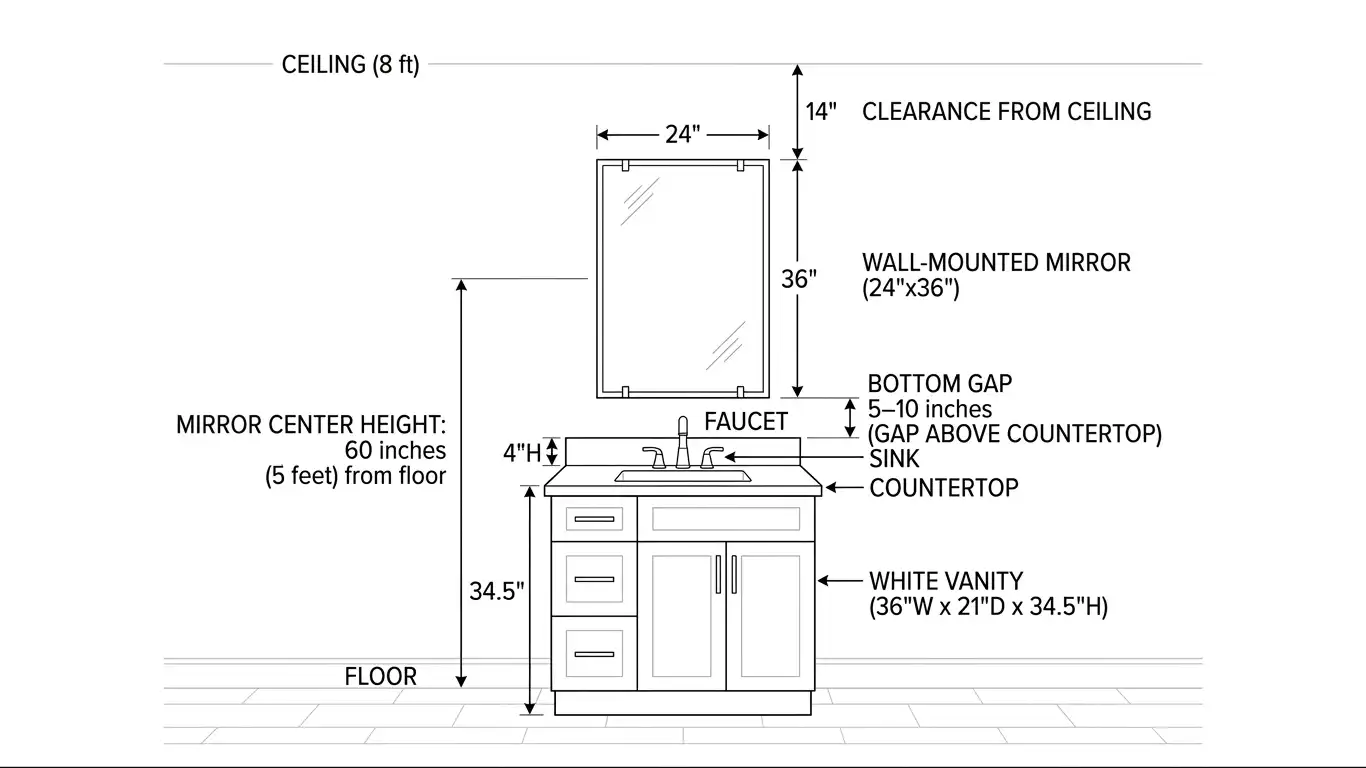
Mirror center from the floor: Aim for 57–65 inches. If you’re not sure where to start, 60 inches works for most households and most vanity configurations.
Mirror bottom above the countertop or sink rim: 5–10 inches. This gap keeps the glass out of splash range and leaves visual breathing room between the mirror and the vanity surface.
Mirror top from the ceiling: Leave at least 4–6 inches. Less than that and the mirror starts to feel boxed in, especially under standard 8-foot ceilings.
These three points work together. If your vanity is a standard 32–36 inches tall and you apply a 5–8 inch gap, the mirror bottom lands around 38–44 inches from the floor — which puts the center right in that 57–65 inch sweet spot for most adults.
| Vanity Height | Mirror Bottom from Floor | Mirror Center from Floor |
|---|---|---|
| 30–32 in | 37–42 in | 49–58 in |
| 32–34 in | 39–44 in | 55–62 in |
| 34–36 in | 40–46 in | 57–65 in |
| 36–40 in (comfort height) | 42–50 in | 58–66 in |
ADA Compliance
In accessible bathrooms — whether commercial, hospitality, or residential aging-in-place — mirror placement is regulated, not just recommended.
The core rule: the bottom edge of the reflective surface must sit no higher than 40 inches from the finished floor. This allows someone in a wheelchair to use the mirror without angling uncomfortably upward. For standing users to also use the same mirror comfortably, the top edge should reach at least 74 inches from the floor.
The simplest way to satisfy both conditions at once is a full-length or full-height mirror. It clears the 40-inch lower limit and extends high enough for standing users without requiring two separate installations.
A few practical notes:
- Measurements apply to the reflective surface, not the outer frame. A thick decorative frame can push the glass edge inward — measure from where the reflection actually starts.
- Medicine cabinets with mirrors face the same requirements. The reflective door face must meet the 40-inch rule.
- In children’s bathrooms (ages 6–12), some guidelines lower the maximum height to 31 inches for the sink surface, which may call for a lower mirror position as well.
How to Set Mirror Height Based on User Height
Standard measurements assume average adult proportions. They’re a starting point, not a final answer.
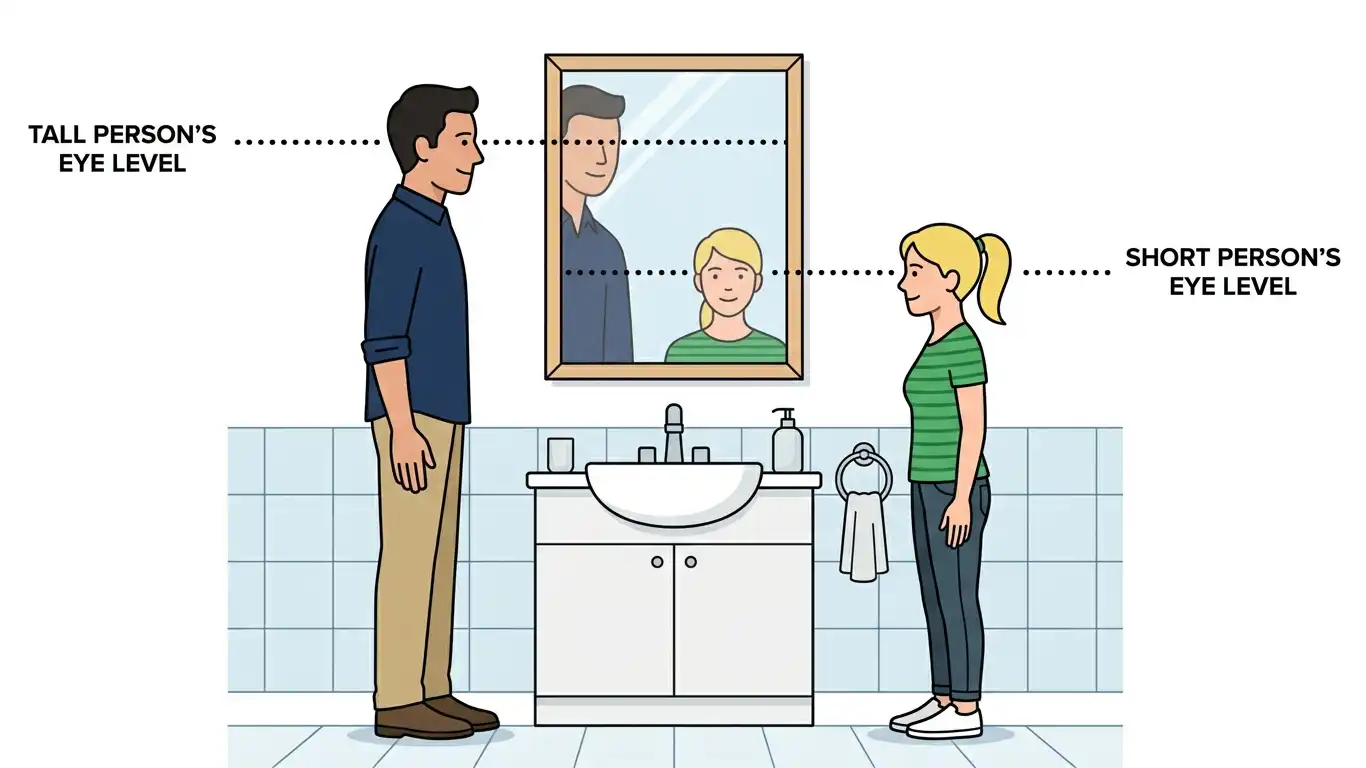
Eye level for most adults falls between 57 and 65 inches from the floor — roughly 5 to 5.5 inches below standing height. The goal is to position the mirror so the center of the glass lines up with, or sits just below, the eye level of whoever uses it most.
For a shared bathroom with users of different heights: Add the eye-level heights of the tallest and shortest regular users, divide by two, and use that as your mirror center target. A vertically taller mirror will cover more range, which helps in family bathrooms.
Practical steps:
- Measure your own eye level from the floor while standing in normal shoes.
- Mark it lightly on the wall with painter’s tape.
- Hold a piece of cardboard the size of your mirror against the wall, centered on that mark.
- Step back and check that your face lands in the upper-middle portion of the reflection.
- Repeat with other household members before committing.
The cardboard test costs nothing and saves a second round of holes in the wall.
Mirror Height Above the Faucet
The gap between the top of your faucet and the bottom of your mirror is one of the most specific decisions you’ll make in this process, because faucets vary so much.
Standard deck-mount faucet: Keep 5–8 inches between the highest part of the spout and the mirror bottom. This clears splash without creating an awkward dead zone on the wall.
High-arc or gooseneck faucet: Don’t measure from the spout tip — measure from the faucet handles instead. The arc reaches higher than the handles, but it’s the static height of the trim that dictates how close the mirror can sit. In practice, you may only get 1–2 inches between the mirror bottom and the top of the arc, which is fine as long as the glass isn’t in the direct splash path.
Wall-mount faucet: The faucet comes out of the wall rather than the deck, so the gap shrinks naturally. 3–5 inches between the spout outlet and the mirror bottom is workable here.
Vessel sink: This is the most common source of mistakes. The sink bowl itself adds 5–7 inches above the countertop. Measure your gap from the rim of the bowl, not the counter surface. Otherwise you’ll hang the mirror 5 inches above the counter, which is actually only an inch or two above the vessel rim — and that’s too close.
| Faucet Type | Measure Gap From | Recommended Gap |
|---|---|---|
| Standard deck-mount | Top of spout | 5–8 in |
| High-arc gooseneck | Faucet handles | 5–10 in (arc may be closer) |
| Wall-mount | Spout outlet | 3–5 in |
| Vessel sink (any faucet) | Vessel rim | 5–8 in |
Factors That Affect the Right Mirror Height for Your Bathroom
The standard measurements work in a generic bathroom. Yours probably has at least one variable that shifts things.
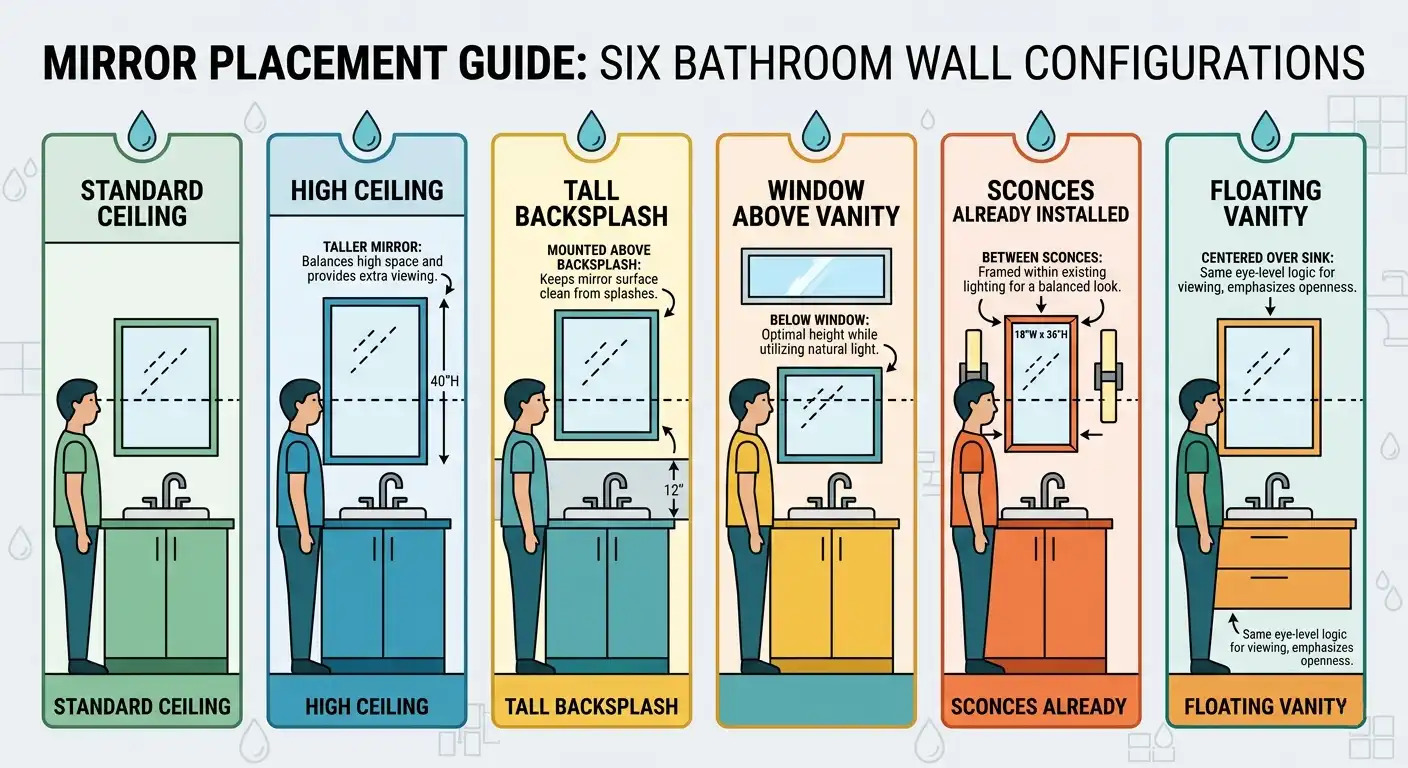
Ceiling height. Standard 8-foot ceilings don’t leave much room above a 60-inch center mirror. Nine or 10-foot ceilings give you more flexibility — and more reason to go taller with the mirror to fill the proportional gap. Don’t just hang the same 24-inch mirror higher; choose a taller mirror to match the increased wall space.
Tile and backsplash. A tall decorative backsplash pushes the lower mirror boundary up. In some bathrooms, the tile runs to 48 or 54 inches, which means the mirror needs to start above that line. This can conflict with the ideal center height — when it does, prioritize clearing the tile over hitting the standard center.
Windows above the vanity. If a window sits in the same wall as the mirror, fit the mirror between the countertop and the windowsill. Don’t fight the window for wall space. A narrower, taller mirror sometimes works better here than a wide, short one.
Lighting fixtures. If you’ve already roughed in lighting, the mirror height is constrained by where the boxes were placed. Work backward: if your light box is at 78 inches, your mirror top should sit 2–3 inches below that, which means a 30-inch-tall mirror would center around 63 inches — still within range.
Floating vs. floor-mounted vanity. Floating vanities can be installed at a custom height. If your household skews tall or short, adjust the vanity height first, then set the mirror relative to it. This is easier than compensating with mirror position alone.
Coordinating Mirror Height with Vanity Lighting
Mirror height and lighting height are not independent decisions. Get them out of sync and the result is either harsh shadows on your face or a well-lit mirror that nobody can see into properly.
Overhead bar light: Center it 75–80 inches from the floor. The mirror top should sit roughly 2–3 inches below the fixture’s bottom edge. If your mirror center is at 60 inches and your mirror is 30 inches tall, the top lands at 75 inches — which puts the light at 78 inches, right in range.
Side sconces: Mount them with the center at 60–65 inches from the floor, which places them at or near eye level. They should sit 2–4 inches away from the mirror’s side edge — close enough to cast light toward the face, far enough that the bulb isn’t in the reflection.
The right sequence: Set the mirror height first, mark the wall. Then position the lights relative to the mirror. Never work the other direction — lights are harder to move than mirrors.
Double vanity: Each mirror typically gets its own light. Center each fixture over its corresponding mirror, not the full vanity width.
If you’re installing an LED bathroom mirror with integrated lighting, this coordination is built in. The light source travels with the mirror, so you only need to find the right center height once.
| Lighting Type | Center Height from Floor | Position Relative to Mirror |
|---|---|---|
| Overhead bar light | 75–80 in | 2–3 in above mirror top |
| Side sconces | 60–65 in | 2–4 in from mirror side edge |
| Integrated LED mirror | Follows mirror center | No separate fixture needed |
Does Mirror Shape Change Where You Should Hang It?
The shape of a mirror doesn’t change the rule — eye level stays at the center — but it changes how you calculate where the center is and how much the visual weight sits.
Rectangular mirrors are the most straightforward. The center is easy to find, the proportions are predictable, and height calculations are direct.
Round and oval mirrors have their center clearly defined by geometry, but they read visually heavier in the upper half. Hanging a round mirror so the mathematical center hits 60 inches often feels slightly high. Dropping the center by an inch or two — to 58–59 inches — usually balances the visual weight better, especially with smaller-diameter mirrors.
Arched mirrors have an irregular vertical profile. Use the center of the reflective area, not the peak of the arch, as your reference point. The arch adds visual height above the reflection zone, which means the actual usable center sits lower than the geometric center of the whole frame.
Full-length mirrors: The bottom edge should start 3–5 inches from the floor. The top should reach at least 74 inches to provide full-body reflection for most adults. If you’re mounting a round LED mirror or an unusual shape over a vanity, prioritize getting the face-level reflection right — the rest follows from there.
Framed vs Frameless Mirrors
The short answer is yes — but only because frames change where the reflective surface actually starts.
A mirror with a 2-inch wooden frame on all sides has 4 inches of non-reflective material to account for. If you measure 60 inches to the outer frame center, the glass center is still 60 inches — but if you measure to the outer frame bottom, the glass bottom is 2 inches higher than that. In tight spaces, those inches matter.
Practical rule: Always measure to the edge of the glass, not the edge of the frame, when checking the 5–10 inch gap above the faucet. ADA compliance also measures from the reflective surface, not the frame.
Thick frames and visual size: A mirror with a 3–4 inch ornate frame reads visually smaller than the same glass dimension in a thin frame. If you’re choosing between sizes, size up when the frame is substantial.
Frameless mirrors eliminate the calculation entirely. The edge is the glass edge, so measurements are direct. They also tend to work better in small bathrooms because they don’t add visual mass to the walls. An LED vanity mirror with a minimal or no frame is a practical choice here — the integrated light ring or backlight defines the visual boundary without adding bulk.
Visual height effects:
- A tall, narrow framed mirror draws the eye upward and makes low ceilings feel higher.
- A wide, short mirror widens the vanity zone visually — better for long double-sink vanities with adequate ceiling height.
LED Mirrors and Anti-Fog Models
A standard mirror and an LED mirror hang at the same height. The difference is in the preparation before the mirror goes up.
Electrical rough-in placement: Before hanging an LED bathroom mirror, the junction box or outlet needs to be positioned where the mirror will cover it — or immediately outside the mirror footprint if the power cord will be exposed. The most common mistake is placing the box before finalizing the mirror size, then discovering it lands outside the mirror edge. Decide on the mirror first, then rough in the power.
For a mirror centered at 60 inches with a height of 30 inches, the back panel of the mirror spans from 45 to 75 inches off the floor. The power connection point should fall somewhere in that zone, near the center or one side, depending on the mirror’s connection location.
Anti-fog mirrors contain a heating element bonded to the back of the glass. It doesn’t change height placement, but it adds a low-voltage wire that needs a nearby outlet or hardwired connection. Plan this alongside the junction box position.
All-in-one LED mirrors — where the light source is integrated into the mirror body — simplify lighting coordination significantly. You’re setting one height instead of coordinating mirror and light separately. The face-level rule still applies: center at 57–65 inches from the floor. For more on choosing the right LED model for your bathroom, see our LED mirror selection guide or explore how backlighting changes the installation approach.
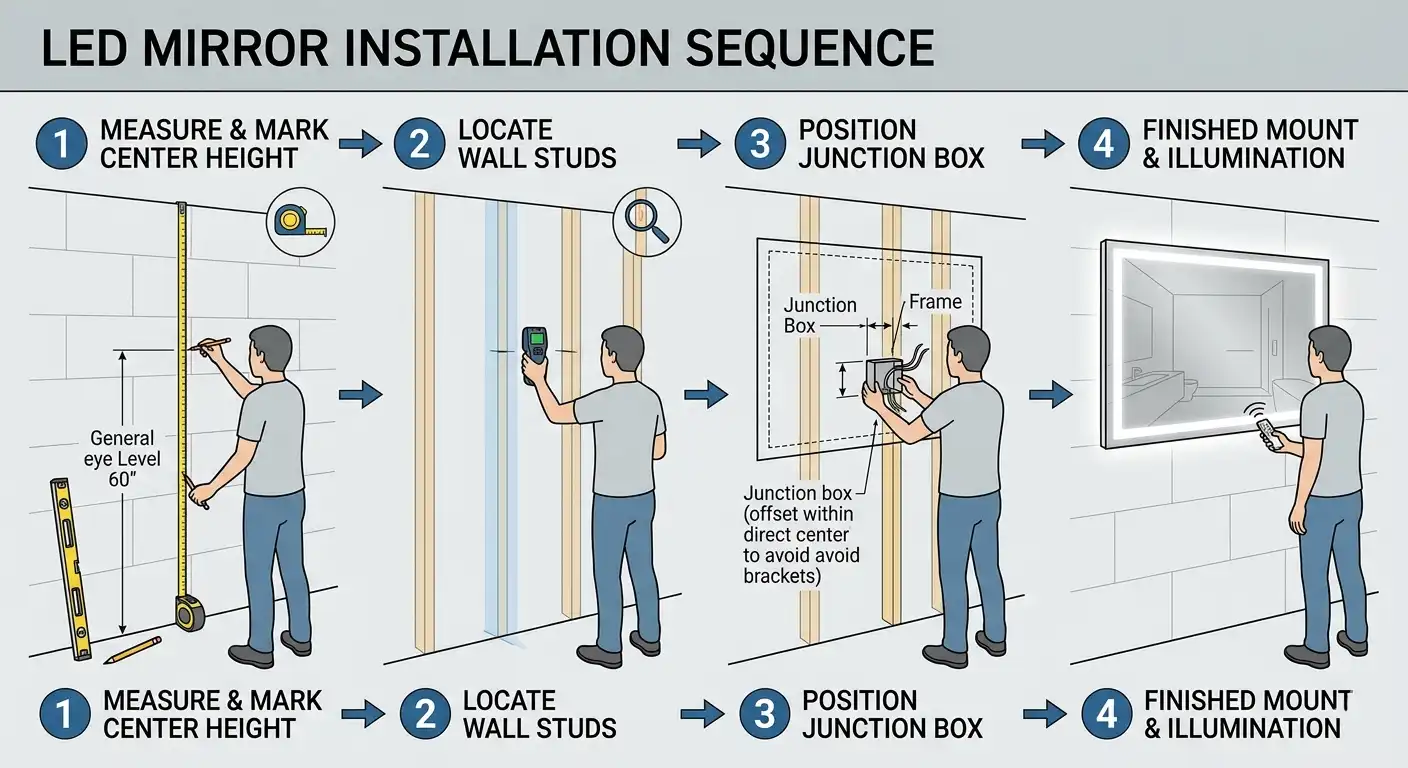
Recommended installation sequence for LED mirrors:
- Confirm mirror dimensions and center height.
- Mark the center point on the wall.
- Locate stud positions within the mirror footprint.
- Position the junction box or outlet within the mirror’s back panel area.
- Complete electrical rough-in.
- Hang the mirror and make the electrical connection.
Quick Reference: Bathroom Mirror Height Checklist
Before drilling, run through this list:
- Mirror center is 57–65 inches from the finished floor (start at 60 inches)
- Mirror bottom sits 5–10 inches above the countertop or vessel rim
- Mirror top clears the ceiling by at least 4–6 inches
- Gap accounts for faucet type (standard / high-arc / wall-mount / vessel)
- Mirror center aligns with eye level of primary users
- Light fixtures positioned after mirror height is confirmed
- If ADA: reflective surface bottom ≤ 40 inches from floor
- Frame measurements use reflective glass edge, not outer frame
- For LED mirrors: junction box roughed in behind mirror footprint
Summary
Bathroom mirror height comes down to a few clear principles: center the glass between 57 and 65 inches from the floor, leave 5–10 inches above the faucet or vessel rim, and always calibrate to the actual eye levels of people who use the space. Lighting, ceiling height, faucet style, mirror shape, and frame type all shift the ideal position slightly — but they adjust around the core measurements rather than replace them. For LED and anti-fog mirrors, the height rule is identical; the extra work is on the electrical side, not the measurement side. Get the numbers right before you drill, mock the position with tape or cardboard, and you’ll have a mirror that works as well as it looks.
FAQ
What is the standard bathroom mirror height from the floor?
The center of a bathroom mirror typically sits 57–65 inches from the finished floor. A starting point of 60 inches works for most standard vanities and average-height adults. The bottom edge usually lands around 40–46 inches from the floor, depending on the mirror’s height and the vanity configuration.
How high should a bathroom mirror be above a vessel sink?
Measure the gap from the rim of the vessel bowl, not the countertop. Keep the mirror bottom 5–8 inches above the bowl rim. Because vessel sinks add 5–7 inches above the counter, the mirror will hang noticeably higher overall than it would over a standard undermount sink — which is expected and correct.
What height should a bathroom mirror be for a tall person?
For a 6-foot-tall user, eye level falls around 67–69 inches from the floor. Center the mirror at 65–68 inches, or choose a taller mirror that covers a wider vertical range. A mirror that’s 36 inches tall centered at 66 inches reflects from 48 to 84 inches — covering most of the face and upper body regardless of height.
How high should vanity lights be above a bathroom mirror?
An overhead bar light should center at 75–80 inches from the floor, placing it roughly 2–4 inches above the mirror top in most setups. Side sconces should center at 60–65 inches — approximately at eye level — and sit 2–4 inches away from the mirror’s side edge. Set the mirror height first, then position the lights relative to it.
What is the ADA compliant height for a bathroom mirror?
In accessible bathrooms, the bottom edge of the reflective surface must be no more than 40 inches from the finished floor. The top edge should reach at least 74 inches so standing users can also see themselves. A full-height mirror is the most straightforward way to meet both requirements simultaneously. Note that measurements apply to the glass surface, not the outer frame.