
Most bathroom renovations stall at the mirror. You have the vanity picked out, the tile sorted, even the faucet sitting in a box — but the mirror feels like a gamble. Too wide and it crowds the wall. Too small and it floats there like an afterthought. The stakes feel low until you live with the wrong choice every morning for years. This guide cuts through the guesswork. Whether you’re working with a 24-inch powder room vanity or a 72-inch double sink, you’ll find the exact measurements, the trade-offs between styles, and a quick-reference chart to nail your decision before you buy.
How Mirror Size Shapes the Way Your Bathroom Feels
A mirror does more than show your reflection. It bounces light around the room, creates a visual anchor above the vanity, and can make a tight bathroom feel noticeably bigger — or smaller, if the sizing is off.
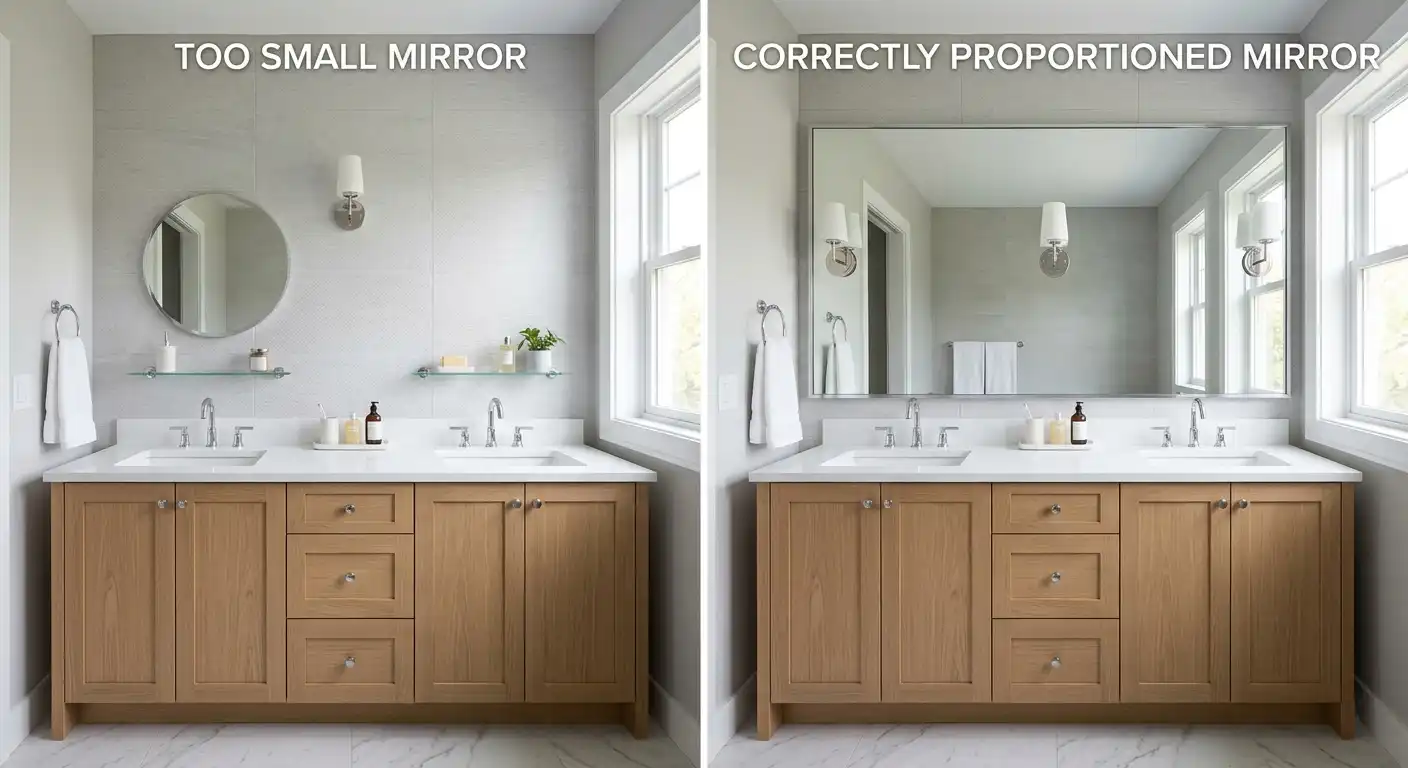
A mirror that’s too small looks like it was chosen for a different bathroom and left behind. It draws attention to the empty wall around it and tends to make the vanity look squat. A mirror that runs wider than the vanity flips the visual hierarchy: the wall suddenly feels top-heavy, and the cabinetry beneath looks like a support act rather than the main piece.
The sweet spot is a mirror that feels like it belongs to the vanity. When the proportions are right, the whole wall reads as one composed unit, and the room feels larger because your eye has somewhere intentional to land.
Mirror Width and Vanity Proportion
Every sizing discussion starts here. The mirror should be narrower than the vanity, not wider. That single rule eliminates most bad choices.
The standard approach is to subtract 2 to 4 inches from the total vanity width. If your vanity is 36 inches wide, a mirror between 32 and 34 inches fits cleanly. This leaves 1 to 2 inches of visible wall on each side — enough to frame the mirror without leaving a distracting gap.
A slightly more generous guideline used by many designers is the 70–80% rule: the mirror’s width should fall between 70% and 100% of the vanity width. So a 48-inch vanity can support a mirror anywhere from about 34 to 48 inches wide, with the wider end reserved for frameless mirrors that visually recede into the wall.
What happens at the extremes:
- Mirror equals vanity width exactly → works for frameless mirrors; looks crowded with a thick frame
- Mirror wider than vanity → visual imbalance, especially with wall sconces that now have nowhere to go
- Mirror less than 70% of vanity width → looks deliberately undersized; works as a design statement, but can feel impractical for daily use
For height, a common starting point is two-thirds of the vanity cabinet height. On a standard 36-inch tall vanity, that puts the mirror around 24 inches tall — a clean, proportioned look. You can go taller if the ceiling allows and you want more vertical coverage, but stay at least 6 inches below the ceiling to avoid a cramped appearance.
| Vanity Width | Recommended Mirror Width | Mirror Height Range |
|---|---|---|
| 24″ | 18″–22″ | 24″–30″ |
| 30″ | 24″–28″ | 28″–34″ |
| 36″ | 30″–34″ | 30″–36″ |
| 48″ | 42″–46″ | 34″–40″ |
| 60″ | 54″–58″ (single) or 2 × 26″–28″ | 36″–42″ |
| 72″ | 66″–70″ (single) or 2 × 30″–34″ | 38″–44″ |
For a deeper look at how placement works once you have the right size, see Bathroom Mirror Height: The Complete Guide to Perfect Placement.
How to Measure for a Bathroom Mirror
Before anything else, get the actual numbers from your wall. Guessing from memory — or trusting the measurements listed on a product page — leads to surprises on install day.
What you’ll need: a tape measure, a pencil, and painter’s tape to mark the target area on the wall.
Four measurements to take
1. Vanity width Measure the full cabinet from left edge to right edge. If the cabinet has a thick decorative side panel, measure only the main cabinet body — the mirror should align with the functional area, not the decorative trim.
2. Available wall height Measure from the vanity countertop up to either the ceiling, the underside of an overhead light fixture, or any cabinet that sits above. This tells you the maximum mirror height before you start crowding other elements.
3. Clearance above the faucet The bottom of the mirror should sit at least 5 to 10 inches above the faucet spout. Measure from the countertop to the top of the faucet, then add 5 inches minimum. That’s where the mirror’s bottom edge should start.
4. Horizontal space for lighting If you plan wall sconces on either side of the mirror, those lights need space too. Most sconces require at least 3 to 6 inches between the mirror edge and the fixture body. Measure how much wall remains on each side after accounting for the mirror width you’ve chosen.
One thing people miss: if you’re buying a framed mirror, the listed dimensions almost always refer to the outer frame, not the glass. A 30-inch mirror with a 2-inch frame on each side gives you 26 inches of actual reflection. If you need 30 inches of visible glass, buy a 34-inch mirror with that frame width.
Single Sink Vanity Mirror Dimensions
Single-sink vanities run from 24 inches wide on the compact end to 48 inches in a standard full-size bathroom. One centered mirror is the default approach, and it works cleanly in almost every layout.
The key is that the mirror doesn’t need to span the full vanity width to look intentional. Something 2 to 4 inches narrower on total width looks more considered than a mirror that runs edge to edge.
| Vanity Width | Ideal Mirror Width | Common Mirror Height | Notes |
|---|---|---|---|
| 24″ | 18″–22″ | 24″–30″ | Small; frameless works best to avoid visual crowding |
| 30″ | 24″–28″ | 28″–34″ | Most versatile size range |
| 36″ | 30″–34″ | 30″–36″ | Standard single-sink sweet spot |
| 48″ | 42″–46″ | 34″–40″ | Can also use two mirrors (20″–22″ each) for a shared bathroom |
If your sink is offset — positioned to one side of the vanity rather than centered — center the mirror over the sink, not over the cabinet. The goal is a clear view of your face from the typical standing position, not geometric symmetry with the countertop.
Height mounting tip: Most people are comfortable with the mirror’s center at about 58 to 65 inches from the floor. Work backward from that target: if your mirror is 32 inches tall, the center lands at 64 inches when the bottom edge is at 48 inches from the floor.
One Wide Mirror or Two Separate Ones?
A double-sink vanity opens up two distinct approaches, and neither is wrong — they just produce different looks.
Option A: One wide mirror
A single mirror that spans most of the vanity gives the bathroom a hotel-style, seamless feel. It reads as a continuous surface and tends to make the room look larger by eliminating the wall space between two mirrors.
For a 60-inch double vanity, a single mirror running 54 to 58 inches wide works well. For a 72-inch vanity, 66 to 70 inches.
This approach works best when the bathroom is on the smaller side (so you want to maximize the reflective surface), when the design is modern or minimalist, and when the lighting comes from overhead rather than side sconces.
Option B: Two separate mirrors
Two individual mirrors, one centered over each sink, feel more personal and symmetrical. They’re easier to replace or update independently, and they leave wall space in the center that’s useful for a wall light, a niche, or just breathing room.
Typical sizing for a 60-inch double vanity: two mirrors around 24 to 28 inches wide each, with a 4 to 8-inch gap between them. For a 72-inch vanity, 28 to 32 inches each with a similar gap.
The rule that matters here: both mirrors must be exactly the same size and mounted at exactly the same height. Even a half-inch difference in position reads as an error from across the room.
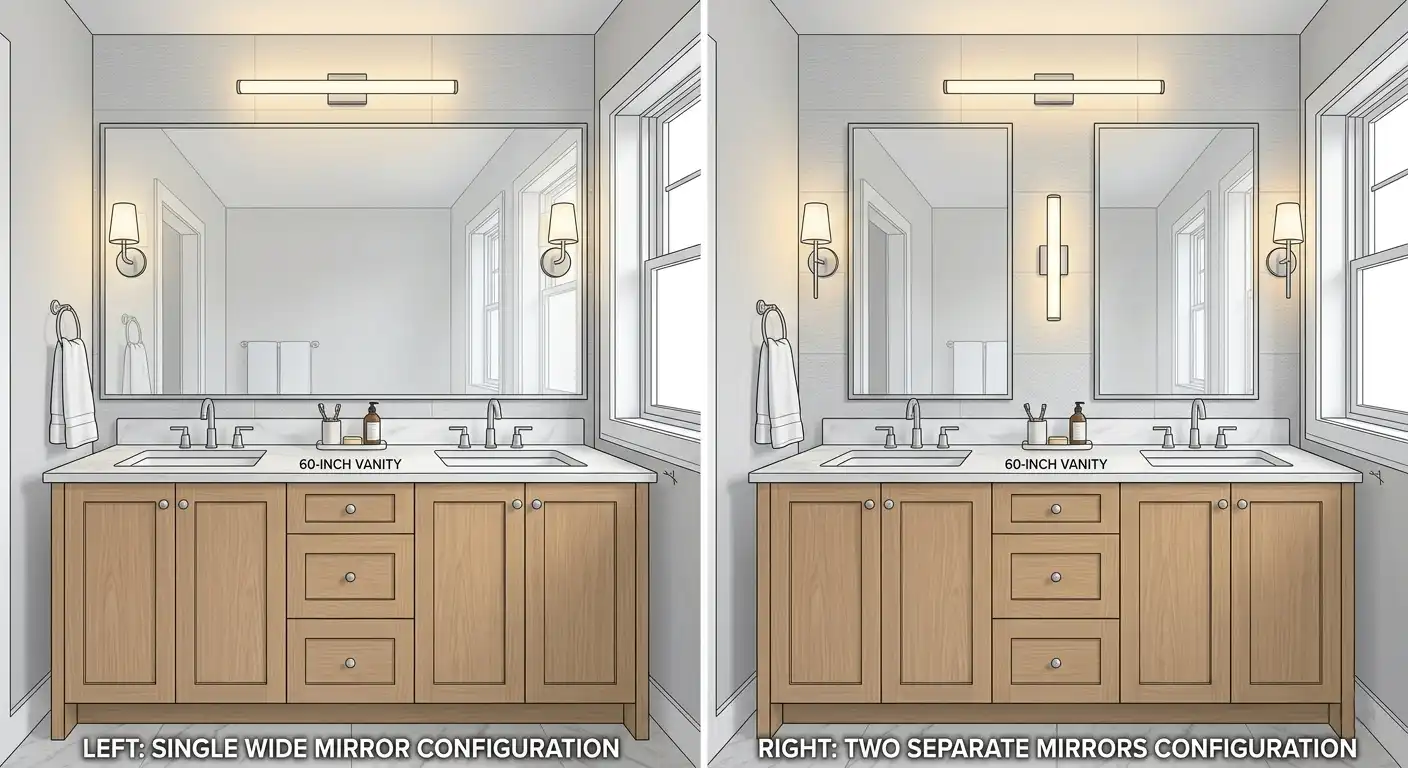
| Vanity Width | Single Mirror Option | Double Mirror Option |
|---|---|---|
| 60″ | 54″–58″ wide | 2 × 24″–28″ with 4″–8″ gap |
| 72″ | 66″–70″ wide | 2 × 28″–32″ with 4″–8″ gap |
| 84″ | 76″–80″ wide | 2 × 32″–36″ with 4″–8″ gap |
Mirror Shape and Size
Shape isn’t just a design choice — it affects how you size the mirror and where you hang it.
Rectangular mirrors
Rectangular mirrors follow the width and height guidelines laid out above without adjustment. They’re the most versatile choice and work in every bathroom style. The main decision is orientation: landscape (wider than tall) gives a broad, open feel; portrait (taller than wide) adds vertical emphasis and works particularly well in bathrooms with lower ceilings.
Round mirrors
Round mirrors soften a bathroom that’s heavy on straight lines — the tile grids, the cabinet hardware, the door frames. When sizing a round mirror, use the diameter as your reference measurement.
A common starting point: the diameter should be 60–80% of the vanity width. For a 36-inch vanity, a round mirror between 22 and 28 inches in diameter is the typical range.
One thing to watch: round mirrors are centered on the mirror’s middle, not its edge. Always measure from the center of the vanity to position it correctly, then mark where the hanging hardware falls. If you start from the edge, the mirror ends up slightly off-center.
Our Round LED Mirror collection shows some common diameter options in use if you want a visual reference.
Oval mirrors
Vertical ovals work especially well above a single sink in a narrow bathroom or powder room. They draw the eye upward, making a low-ceilinged space feel less compressed. Horizontal ovals behave more like a standard rectangular mirror and follow the same width rules.
Arched mirrors
An arched mirror — flat on the bottom, curved at the top — follows the same width guidance as a rectangular mirror. The curved top is decorative; the bottom edge is the one you measure from for mounting height.
| Mirror Shape | Key Sizing Reference | Typical Size Range |
|---|---|---|
| Rectangle | Outer width vs. vanity width | Width: −2″ to −4″ from vanity |
| Round | Diameter vs. vanity width | Diameter: 60–80% of vanity width |
| Vertical oval | Widest point vs. vanity width | Width: 60–75% of vanity width |
| Arch | Bottom width vs. vanity width | Same as rectangle |
How the Frame Affects Dimensions
The physical size of the mirror you order and the visual footprint it creates on the wall are two different things. That gap matters most when you’re working with a frame.
Frameless mirrors
Frameless mirrors visually blend into the wall. Because there’s no border to create visual weight, the glass itself is the boundary — and the eye doesn’t perceive it as an imposing object. You can often go slightly larger than the standard formula and it still won’t feel crowded.
They’re also easier to measure: the listed dimensions are the glass dimensions.
Framed mirrors
Frames add visual weight and presence, which is a good thing in a bathroom that needs a focal point. But they require a small adjustment to your sizing math.
If you’re buying a mirror with a 1.5-inch frame all around, a 32-inch-wide mirror has only 29 inches of actual reflective surface. Make sure you’re shopping based on the outer frame dimensions, and mentally subtract the frame width when checking whether the glass covers what you need.
Thick ornate frames (3 inches or more) narrow the mirror more substantially. On a smaller vanity, this can make a 30-inch mirror feel more like a 24-inch one for practical purposes.
Practical comparison:
| Frame Style | Visual Weight | Effective Glass Area | Best With |
|---|---|---|---|
| Frameless | Low | Full listed width | Modern, minimalist, small bathrooms |
| Thin metal frame (0.5″–1″) | Low-medium | Near full width | Transitional styles, any bathroom |
| Standard frame (1″–2″) | Medium | Listed width minus 2″–4″ | Traditional, farmhouse, eclectic |
| Thick decorative frame (3″+) | High | Significantly reduced | Statement piece in larger bathrooms |
For specific frame styles, materials, and how they interact with size choices, Bathroom Mirrors Framed: The Complete Guide to Styles, Materials & Sizes covers the material options in detail.
Small Bathroom Mirror Sizing
In a small bathroom, the instinct is to choose a smaller mirror. That instinct is usually wrong.
A mirror that runs close to the full width of the wall — rather than just matching the vanity — doubles the visual space on that wall by reflecting the room back at you. Light bounces further, the far wall appears to recede, and the bathroom feels less enclosed.
Strategies that work:
Go wide, not just vanity-wide. If there’s 40 inches of open wall above a 30-inch vanity, a 36 to 38-inch frameless mirror uses that wall space better than a 26-inch mirror. The mirror now spans more of the wall, and the bathroom reads as wider.
Go tall if the ceiling is low. A mirror that runs from near the countertop to near the ceiling uses vertical space to create an illusion of height. Portrait-orientation mirrors and vertical ovals both work well for this.
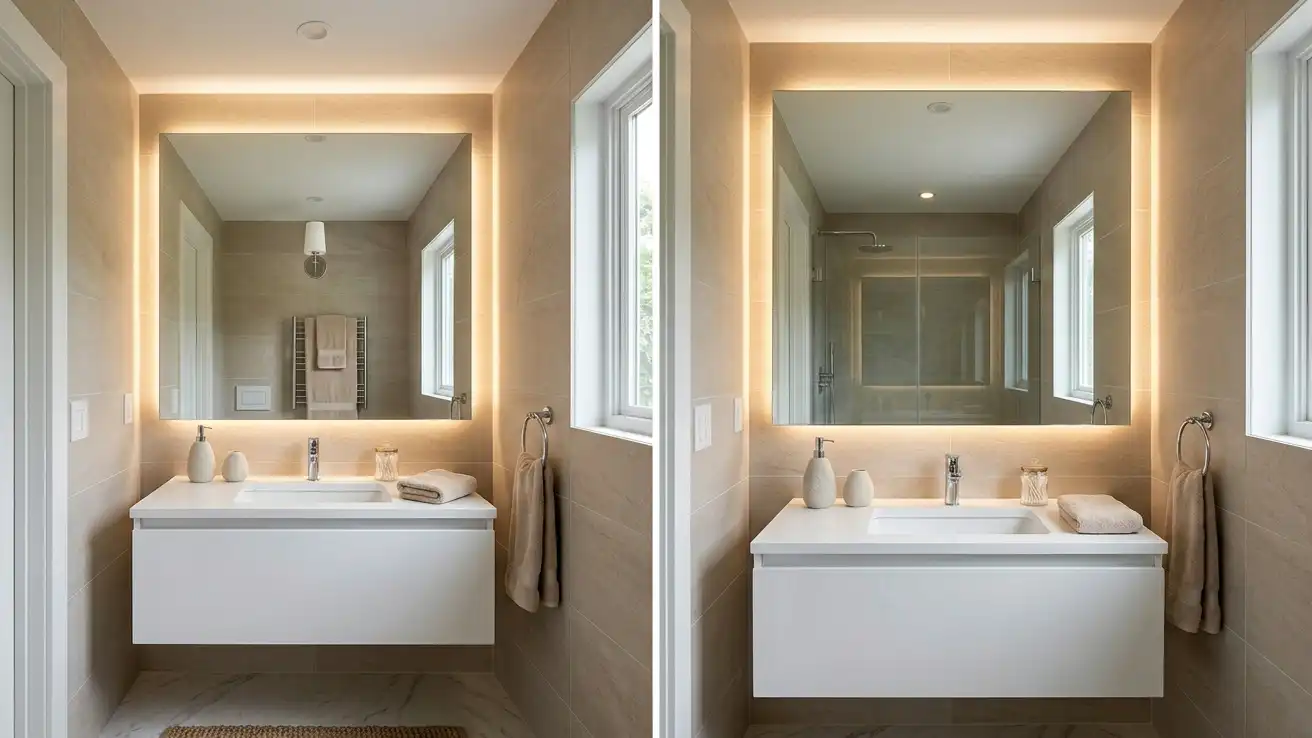
Use backlit options for small rooms. An LED bathroom mirror that glows from behind creates the impression that the wall itself is lit, which softens shadows and makes corners appear less defined. The room reads as larger not because of the mirror’s size but because of how the light spreads.
Powder rooms are the exception. A powder room is a half-bath used briefly by guests, not a daily grooming station. Here, you can prioritize aesthetics over function — an eye-catching round or organic-shaped mirror becomes a focal point rather than a practical tool.
LED and Smart Mirror Dimensions
LED mirrors and smart mirrors follow the same core sizing rules as standard flat mirrors. The width-to-vanity relationship doesn’t change. What does change are a few practical installation details.
Power source clearance. Hardwired LED mirrors need access to an electrical box inside the wall, typically behind the mirror. If you’re retrofitting rather than building new, confirm the outlet location before you finalize the mirror size — you may need to adjust the center point slightly.
Frame-to-glass ratio. Many LED mirrors use the frame housing to contain the LED strips and driver. This frame is usually 1 to 2 inches wide, so size the mirror using the outer dimensions but expect a slightly narrower effective glass area than a frameless mirror of the same listed width.
Smart mirror features and wall clearance. Mirrors with integrated displays, cameras, or speakers sit slightly further from the wall to accommodate the depth of the components. For most models this is less than 2 inches, but confirm the mounting depth in the product specs so you know how far the mirror protrudes.
Anti-fog options. Anti-fog mirrors use a heating pad laminated to the back of the glass. This doesn’t change the mirror’s dimensions, but it does add slight weight — factor this into your hanging hardware selection.
If you’re choosing between the many LED mirror types currently available, Best LED Mirror Selection Guide for Bathroom Upgrades breaks down the options by feature set.
Mirror Size Chart and Sizing Formula
If you want to skip straight to numbers, here’s a consolidated reference.
Sizing formula
| Measurement | Formula |
|---|---|
| Mirror width | Vanity width − 4″ (total); or 70–100% of vanity width |
| Mirror height | Ceiling height to countertop × 0.50–0.65; or vanity cabinet height × 0.66 |
| Bottom edge height from floor | 40″–48″ (typical range); 5″–10″ above faucet spout |
| Top edge to ceiling | Leave at least 6″ of clearance |
| Side clearance for sconces | 3″–6″ on each side between mirror edge and sconce body |
Full size chart by vanity width
| Vanity Width | Mirror Width Range | Mirror Height Range | Typical Setup |
|---|---|---|---|
| 18″–24″ | 14″–22″ | 20″–28″ | Powder room; small guest bath |
| 24″–30″ | 20″–28″ | 24″–32″ | Compact single sink |
| 30″–36″ | 26″–34″ | 28″–36″ | Standard single sink |
| 36″–48″ | 32″–44″ | 30″–40″ | Wide single or shared single |
| 60″ double | 54″–58″ single OR 2 × 24″–28″ | 36″–42″ | Double vanity |
| 72″ double | 66″–70″ single OR 2 × 28″–34″ | 38″–44″ | Large double vanity |
Round mirror diameter by vanity width
| Vanity Width | Round Mirror Diameter |
|---|---|
| 24″ | 16″–20″ |
| 30″ | 20″–24″ |
| 36″ | 22″–28″ |
| 48″ | 28″–36″ |
Online calculator: Omnicalculator’s bathroom mirror size tool takes your vanity width and ceiling height and gives you a calculated mirror size. It’s a useful cross-check once you have your wall measurements.
If you plan to hang the mirror yourself, How to Hang a Mirror on a Wall: A Complete Guide to Getting It Right the First Time covers the mounting process step by step.
Conclusion
Bathroom mirror dimensions come down to a few reliable principles: stay narrower than the vanity, choose a height that works for the ceiling and the people using the room, and adjust for shape and frame weight. The size chart and formula in this guide apply whether you’re working with a compact apartment bathroom or a large primary suite. Get those measurements off the wall before you shop, decide early whether you’re going framed or frameless (since it affects how the numbers translate to visible glass), and the rest of the decision — round vs. rectangular, single vs. double mirror — becomes a matter of personal taste rather than guesswork.
Frequently Asked Questions
What is the standard size for a bathroom mirror?
There isn’t one universal standard, but the most common bathroom mirrors fall between 24 and 48 inches wide and 28 to 36 inches tall. The “right” standard for your bathroom is determined by your vanity width: the mirror should be 2 to 4 inches narrower than the vanity and tall enough to comfortably see your face and shoulders.
What size mirror for a 36-inch vanity?
For a 36-inch vanity, a mirror between 30 and 34 inches wide is the typical range. A 32-inch wide, 32-inch tall mirror is a common match that leaves even spacing on both sides and provides enough reflection for a single user.
Can a bathroom mirror be the same width as the vanity?
Yes, but it works better with frameless mirrors than framed ones. A frameless mirror flush with the vanity width looks intentional. A framed mirror at the same width tends to look like it was sized accidentally rather than by design. If you go edge-to-edge, frameless is the cleaner choice.
How do I size a round mirror for a bathroom vanity?
Use the diameter as your guide. The diameter should be 60–80% of the vanity width. Center the mirror over the sink, not over the cabinet edge, and measure the hanging point from the center of the vanity rather than the side. For a 36-inch vanity, a 22- to 28-inch diameter round mirror is a practical starting range.
How high should a bathroom mirror be above the sink?
The bottom edge of the mirror should sit 5 to 10 inches above the faucet spout or backsplash. This keeps splash water off the mirror and puts the reflective surface at a practical height. Most people are comfortable when the mirror’s center falls between 58 and 65 inches from the floor.