
Stare into a well-made infinity mirror for more than a few seconds and something strange happens — your brain stops registering it as a flat object on the wall. It reads as a hole. A tunnel of light that keeps going long after the frame should have stopped it. That gap between what you know (it’s a few inches deep) and what you see (it looks endless) is the entire appeal, and it comes down to a surprisingly simple trick with two mirrors and a string of LEDs.
This guide breaks down what an infinity mirror actually is, why the illusion works, what goes into building or buying one, and where people typically put them.
What Is an Infinity Mirror?
An infinity mirror (sometimes called an endless mirror) is a light fixture built from two mirrors facing each other, with LED lights placed in the gap between them. One mirror is fully reflective. The other lets some light pass through while reflecting the rest. That second mirror is what makes the whole thing work — without it, you’d just be looking at a regular mirror with some lights stuck on it.
It’s not a digital effect or a screen. It’s pure optics — the same physics behind a barbershop’s double mirrors, just engineered on purpose instead of by accident.
How an Infinity Mirror Actually Works
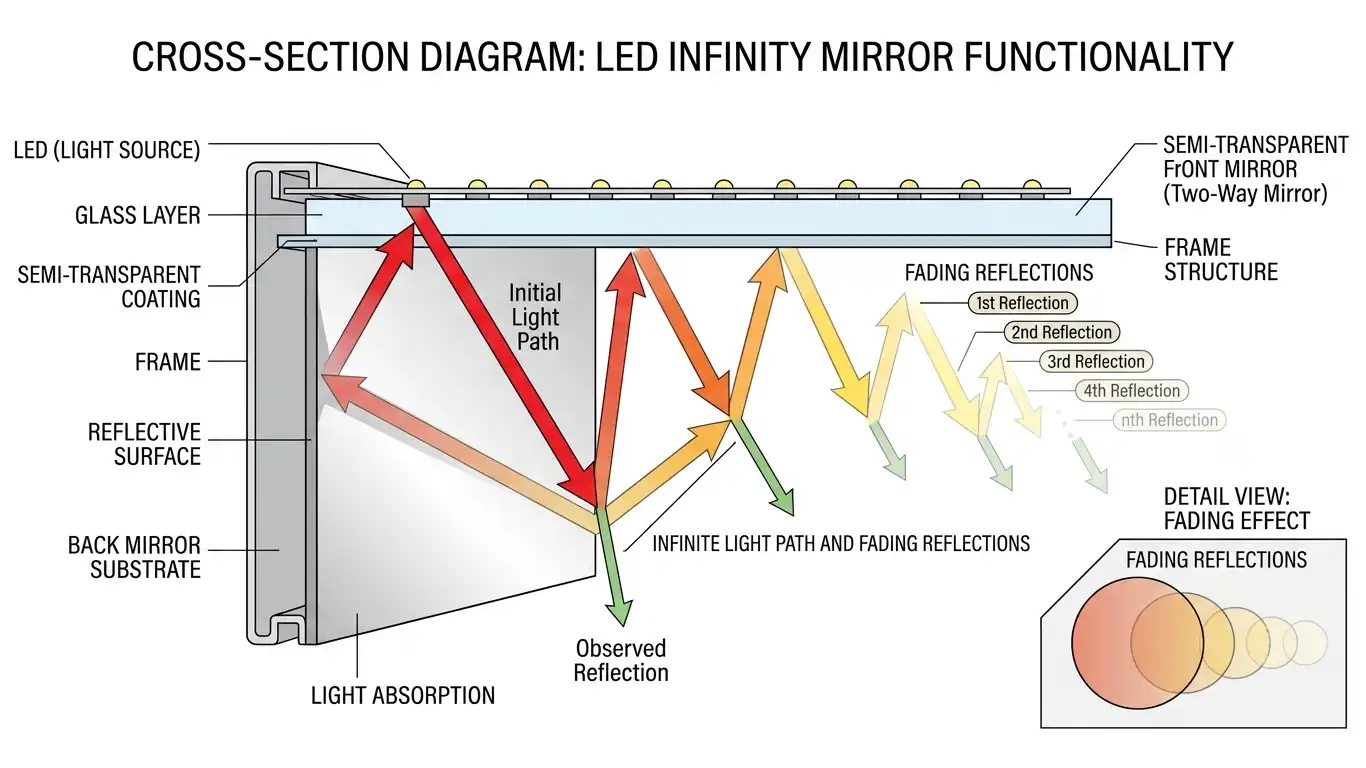
The mechanism is easier to picture as a sequence than as an explanation. Light starts at the LED strip, bounces between the two mirror layers, and loses a bit of strength with every pass.
| Stage | What happens | What you see |
|---|---|---|
| 1. Light emission | The LED strip lights up inside the gap between the two mirrors | A bright ring or shape close to the front |
| 2. First bounce | The back mirror reflects almost all the light forward | A second, slightly dimmer copy of the shape |
| 3. Partial pass-through | The front mirror reflects most of the light back, but lets a portion escape toward your eyes | The reflection you actually perceive |
| 4. Repeat | The remaining light keeps bouncing, losing a little intensity each time | A row of fading, shrinking copies |
| 5. Fade-out | Eventually the light gets too dim to register | The “vanishing point” that makes it look infinite |
This back-and-forth bouncing between two parallel reflective surfaces is the basic mechanism Wikipedia describes for the infinity mirror effect, and it’s why the front mirror is typically half-silvered, often called a one-way mirror, though this isn’t strictly required to produce the effect. Your eyes don’t see “two mirrors and some LEDs” — they see a pattern of shrinking, darkening copies, and the brain automatically reads that pattern as distance, the same way it reads a hallway or a row of telephone poles as receding into the distance.
What Changes the Effect
Two infinity mirrors built with identical parts can still look completely different depending on three variables:
- Mirror reflectivity — A back mirror with very high reflectivity keeps more light bouncing, so you see more visible layers before it fades out. A duller mirror cuts that number down fast.
- Gap between the mirrors — A narrow gap (around an inch) packs the reflections close together. A wider gap spreads them out and can make the tunnel look deeper, though too wide and the pattern gets messy.
- Viewing angle — Looking straight on gives the cleanest, most symmetrical tunnel. Off to the side, the illusion starts to break down and you can see where the “tunnel” actually ends.
There’s no single “correct” setting — it’s closer to a dial you tune depending on whether you want a tight, dense glow or a deep, dramatic tunnel.
Infinity Mirrors vs Similar Optical Effects
People often mix up infinity mirrors with two other tricks that look similar but work on completely different principles.
| Effect | How it’s created | Key difference from an infinity mirror |
|---|---|---|
| Infinity mirror | One fully reflective mirror + one semi-transparent mirror, with light bouncing between them | Built specifically with a half-silvered mirror so the effect fades and is one-directional |
| Droste effect | A printed or digital image that contains a smaller copy of itself, repeated | Pure graphic design trick — no mirrors, no light bouncing, just recursive imagery |
| House of mirrors / facing mirrors | Two fully reflective mirrors placed directly opposite each other | Both mirrors are 100% reflective, so you (and everything around you) get reflected endlessly in both directions, not just one |
The short version: an infinity mirror needs one mirror that lets light through. A regular mirror room doesn’t — that’s what makes it a “house of mirrors” instead of an “infinity mirror.”
What You Need to Build One
Most infinity mirror builds use the same short list of parts:
- A fully reflective mirror (glass or acrylic) for the back panel
- A semi-transparent (“two-way”) mirror, in glass, acrylic, or adhesive film, for the front panel
- An LED strip to sit in the gap between them
- A frame or shadowbox deep enough to hold both mirrors with a gap in between
- A power supply, and optionally a remote or app controller
The quality of the two mirrors has more influence on the final look than almost anything else on this list — a cheap, foggy two-way film will give you a noticeably blurrier tunnel than glass or acrylic.
Build Your Own or Use a Ready-Made Shadowbox
There are two practical routes here, and the right one depends on how much you want to customize.
Building your own frame makes sense if you want a specific size, shape, or depth that nothing off the shelf offers. The main requirement is depth — the frame needs enough internal space to fit both mirror panels with a clear gap for the LED strip, and the inside should be painted matte black to stop stray light from leaking out and softening the illusion.
Using a ready-made shadowbox (an IKEA Ribba frame is a common starting point) saves time and guesswork. You skip the woodworking and just cut a small slot for the power cable. The trade-off is that you’re limited to standard sizes and depths.
If backlighting an existing mirror sounds easier than building a frame from scratch, the step-by-step process for adding LED lights to the back of a mirror covers strip selection, corner connections, and waterproofing in more detail, and applies to most DIY lighting projects, not just infinity mirrors.
Choosing the Right LED Lighting
Not every LED strip behaves the same way once it’s sealed between two mirrors.
- Single-color strips are the simplest and cheapest option, and they’re a safe choice for a first build.
- RGB strips let you change color with a remote — useful if you want the mirror to match different rooms or moods.
- Addressable strips (sometimes called pixel LEDs) let each individual light show a different color, which opens up animated or chasing patterns rather than one flat color across the whole loop.
- Music-reactive controllers sync brightness or color changes to sound, which shows up often in gaming setups and party pieces.
Brightness and color also affect how many reflection layers you can actually see — brighter, cooler-toned LEDs tend to stay visible for more bounces than dim, warm ones. If you’re choosing a strip type or figuring out how to join sections around corners, the LED strip selection and installation steps for backlit mirrors apply directly here as well.
Which Infinity Mirror Style Fits Your Space
Infinity mirrors come in a handful of common shapes, and each one changes how the effect reads.
| Shape | Visual character | Best suited for |
|---|---|---|
| Round / circle | Smooth, symmetrical tunnel with no hard edges | Bedrooms, minimalist decor |
| Hexagon / octagon | Geometric, slightly more structured tunnel | Gaming rooms, modern interiors |
| Square / rectangle | Straightforward tunnel, easiest to DIY | First-time builders, tabletop projects |
| Cube (Hypercube) | Tunnel effect visible from multiple faces at once | Statement pieces, sci-fi-themed rooms |
| Custom shapes (letters, logos) | Tunnel effect follows a specific outline | Branding, signage, personalized gifts |
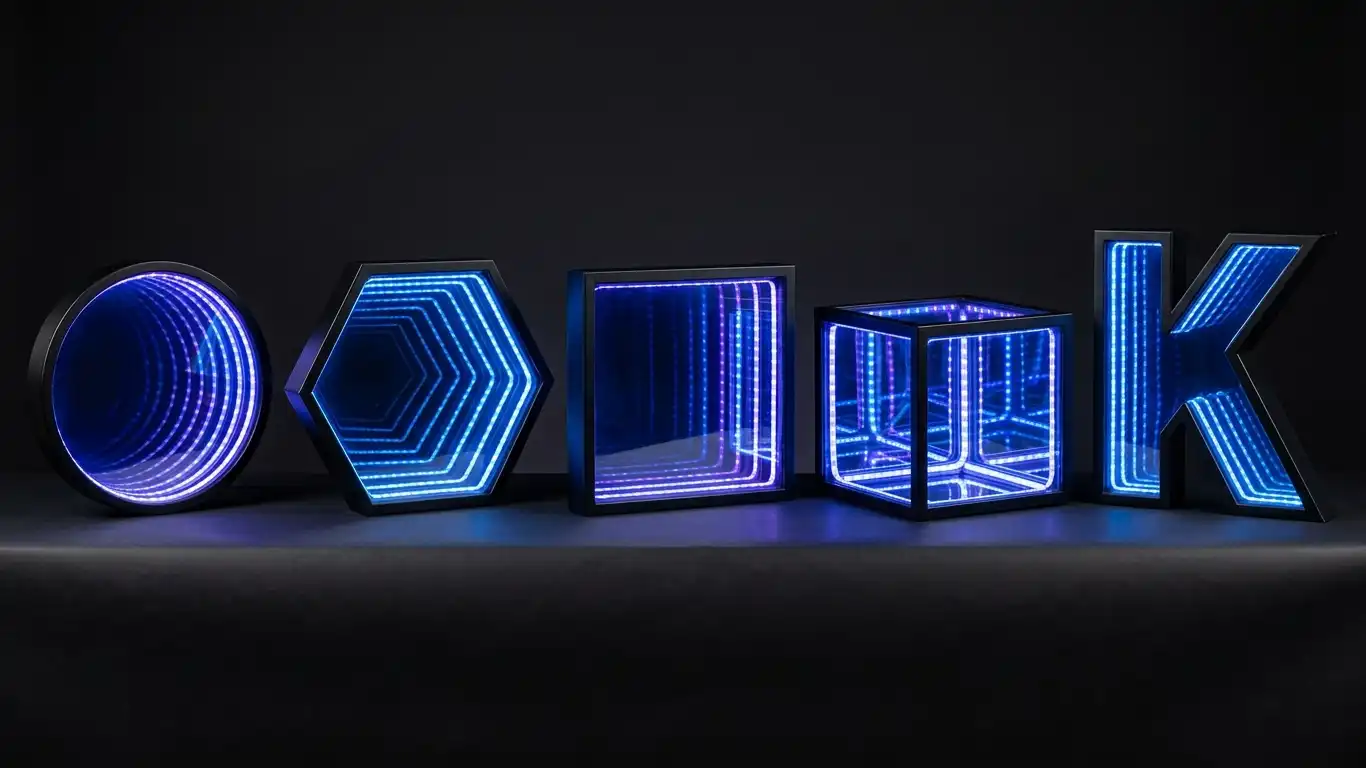
Round and square shapes are the most forgiving for a first DIY attempt because the mirror cuts are simple straight lines or a single curve. Cubes and custom shapes require more precise cutting and alignment, since any mismatch between panels is easier to spot.
Where People Use Infinity Mirrors
The same light tunnel effect shows up in a surprising range of settings:
- Home decor — wall art, accent lighting in bedrooms and living rooms, statement pieces above a console table
- Retail and store displays — jewelry counters and boutique windows, where the depth effect draws attention to a single product
- Bars and nightclubs — bottle shelving, stage backdrops, and dance floor lighting
- Art installations and galleries — large-scale, walk-around pieces (Yayoi Kusama’s mirror rooms are the best-known example)
- Gaming rooms and desk setups — panel inserts in PC cases or as standalone desk lighting
For anyone weighing a backlit mirror specifically for a bathroom or vanity setup rather than a wall art piece, browsing a range of finished LED mirror styles is a useful way to compare frame shapes and lighting placement before deciding whether to build or buy.
Summary
An LED infinity mirror gets its “endless tunnel” look from a fairly simple setup — one fully reflective mirror, one semi-transparent mirror, and an LED strip sandwiched between them, with light bouncing back and forth and fading a little more with each pass. How convincing the illusion looks depends on a handful of variables you can control: mirror reflectivity, the gap between the panels, and the angle you’re viewing it from. Building one means sourcing the right mirror pair, choosing LEDs that suit the look you want, and either building a frame or repurposing a ready-made shadowbox. Once that groundwork is in place, the same basic technique scales from a small bedroom wall piece to a full art installation, which is why the effect shows up everywhere from home decor to nightclub bars to gallery walls.
FAQs
How wide should the gap be between infinity mirror panels?
Most builds use a gap somewhere between one and a few inches. Narrower gaps create tightly packed reflections; wider gaps create a deeper but more spread-out tunnel. There’s no fixed rule — it’s worth testing with your specific LED strip before sealing the frame permanently.
Can you make an infinity mirror with two regular mirrors instead of a two-way mirror?
No. Two fully reflective mirrors facing each other create a different effect (closer to a house-of-mirrors look), not the fading tunnel of an infinity mirror. You need one mirror that’s semi-transparent so light can pass through toward your eyes.
Why does my infinity mirror look curved or off-center instead of straight?
This usually means the two mirror panels aren’t perfectly parallel. Even a slight tilt will cause the reflections to drift toward one side instead of receding straight back.
What’s the difference between an infinity mirror and a two-way mirror?
A two-way mirror is one component — the semi-transparent panel. An infinity mirror is the full assembly: a two-way mirror paired with a fully reflective mirror and a light source, arranged to create the tunnel illusion.
Is it safe to leave an LED infinity mirror running all day?
LED strips run cool compared to incandescent bulbs and use very little power, so leaving one on for extended periods is generally fine. The main thing to watch is heat buildup in fully enclosed frames — some airflow or a small gap helps the strip last longer.