
For most guest bathroom vanities, the configuration that holds up best across a full property is a fixed or lightly adjustable wall-mounted mirror on a metal arm, CRI 90 or higher with an R9 above 50, 3000K–4000K, and front-lit or dual-lit rather than back-lit alone. Suction-mount and door-hook mirrors don’t belong on a procurement spec — they’re built for a single consumer, not two hundred rooms and a housekeeping turnover schedule. The sections below walk through why, how the mechanism and lighting choices map to room category, and what a spec comparison across tiers actually looks like.
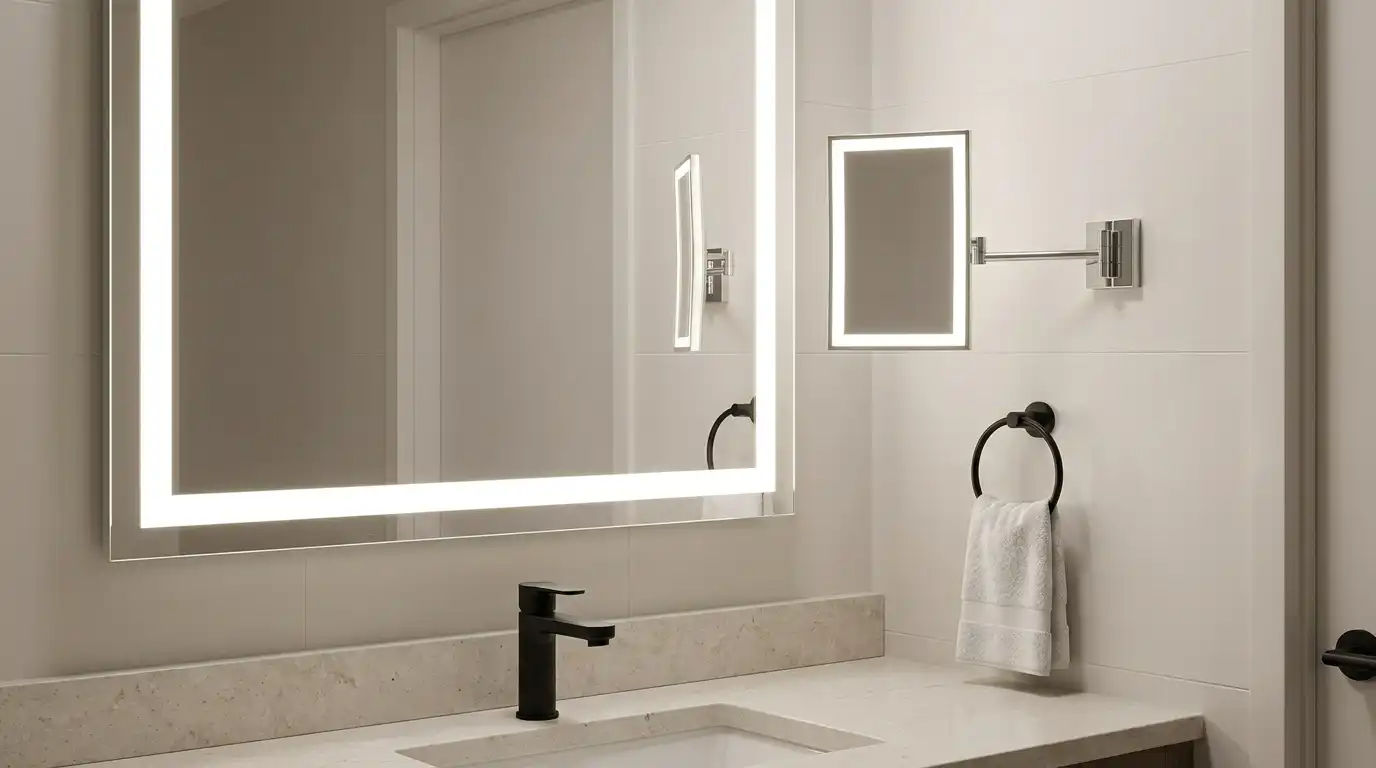
Why Wall-Mounted Beats Freestanding for Guest Bathrooms
A freestanding or tabletop mirror is one more object housekeeping has to reposition, one more thing a guest can knock into the sink, and — on a countertop that’s already tight in a standard guest bath — one more thing eating into usable space. A wall-mounted unit stays where it’s installed, holds up under daily cleaning, and reads as a fixture rather than an amenity that can walk off with a guest. The tradeoff is real, though: it’s a one-time install decision. Once fifty or two hundred of them are on the wall, swapping the mechanism or the finish means a maintenance ticket, not a housekeeping note. That’s exactly why the mounting choice below matters more here than it would for a single home bathroom.
Mounting Mechanisms You Can Spec
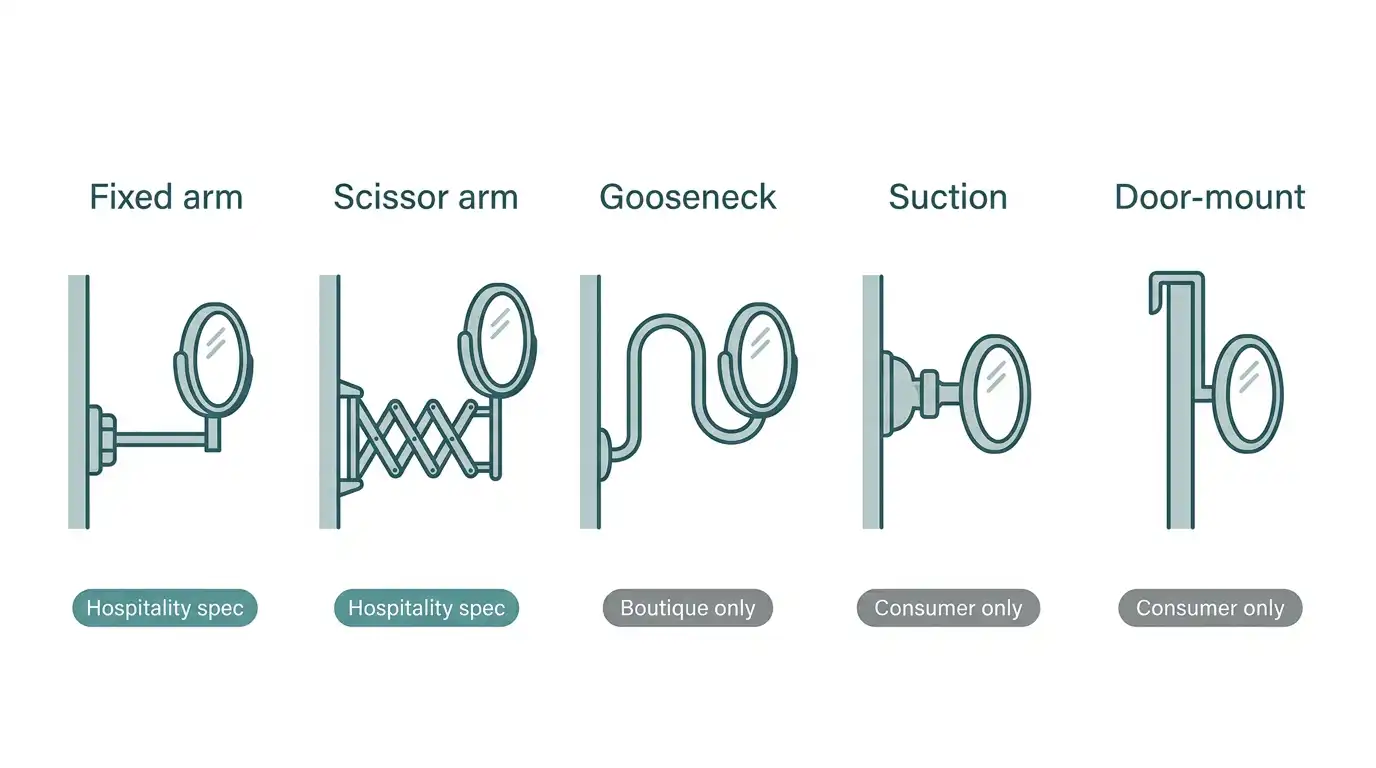
Five mechanisms show up across the market, but only two of them show up reliably in hospitality specs:
- Fixed arm — bolted to a stud or a solid backing plate, no moving joints. Lowest failure rate, lowest cost, and the default for economy and select-service properties.
- Scissor/accordion arm — folds flat against the wall and extends toward the guest. More moving parts than a fixed arm, but it’s held up well enough in mid-scale hospitality use that several manufacturers now spec it as standard for guest-facing vanity mirrors.
- Gooseneck arm — flexible tube, easy to angle, more common in boutique or residential-feeling properties where the aesthetic matters as much as the function.
- Suction mount — no wall penetration, but suction cups fail over time in a humid bathroom and aren’t rated for a fixture housekeeping will bump repeatedly. Fine for a consumer travel mirror, not for a 200-room property.
- Door-mount — hangs on a door or cabinet edge. Essentially a retail/DTC product, not something you’d put on a commercial spec sheet.
If a distributor client is asking about the last two, that’s a signal they’re stocking for the consumer channel, not a hospitality project — worth confirming before you quote.
Fixed-Face vs Adjustable Heads: Matching the Mechanism to the Room
A fixed-face mirror head has no pivot, no swivel, nothing that can loosen after a thousand guest interactions. That’s the case for economy and limited-service properties, where per-room cost and low warranty-claim rates matter more than guest customization. An adjustable head — one that tilts or swivels on the arm — gives guests some control over the angle, which shows up in guest-satisfaction scores at the mid-scale and above. It’s also the piece most likely to generate a maintenance call three years in, so factor that into total cost of ownership, not just the unit price.
Single-Sided vs Double-Sided Heads
A double-sided head — standard mirror on one face, magnifying on the reverse — adds real functionality for guests doing detailed grooming, and it’s a natural upsell for boutique and luxury properties. It also adds a swivel point and a second reflective surface to manufacture and align, which shows up in the unit cost. For standard guest rooms across a mid-scale or economy property, a single-sided head keeps the spec simple and the failure points to a minimum; save the double-sided configuration for suites, spa properties, or wherever the brand standard specifically calls for it.
Frontlit vs Backlit: Which Actually Helps Guests Get Ready
Backlit alone looks good in a rendering and photographs well for the brand’s Instagram, but it throws light around the mirror rather than onto the guest’s face — for a shave or foundation application, that’s the wrong light. Front-lit and dual-lit configurations put the light where the task actually happens.
The number that matters more than color temperature is CRI. Hospitality lighting specs commonly call for a CRI of 90 or higher, and for a mirror specifically, the R9 value — how well it renders saturated reds — is arguably the more useful number, since human skin tone leans heavily on the red end of the spectrum. A wholesale mirror engineering brief recommends an R9 of 50 or above alongside CRI 90+, with CCT typically specified between 3000K and 4000K for a warm-to-neutral guest bathroom feel, and a lumen density in the 600–1,000 lumens-per-linear-foot range for even coverage without hot-spotting. If your project spans multiple room categories, ask your supplier about SDCM consistency (≤3 is the common hospitality benchmark) so guest rooms on different floors don’t show visibly different white points side by side — a mismatch guests notice even if they can’t name what’s wrong. For more on how frontlit and backlit setups actually differ in practice, see our breakdown of lights over mirrors versus lighted mirrors.
Spec Comparison at a Glance
| Feature | Economy/Select-Service | Mid-Scale | Boutique/Luxury |
|---|---|---|---|
| Mounting mechanism | Fixed arm | Fixed or scissor arm | Scissor or gooseneck arm |
| Head adjustability | Fixed | Adjustable tilt/swivel | Adjustable, often with magnifying flip |
| Mirror sides | Single-sided | Single-sided | Double-sided (mirror + magnifying) |
| Lighting type | Frontlit | Frontlit or dual-lit | Dual-lit, tunable CCT |
| CRI / R9 target | 90+ / R9 40+ | 90+ / R9 50+ | 95+ / R9 50+ |
Wholesale Cost Tiers: What Actually Drives the Difference
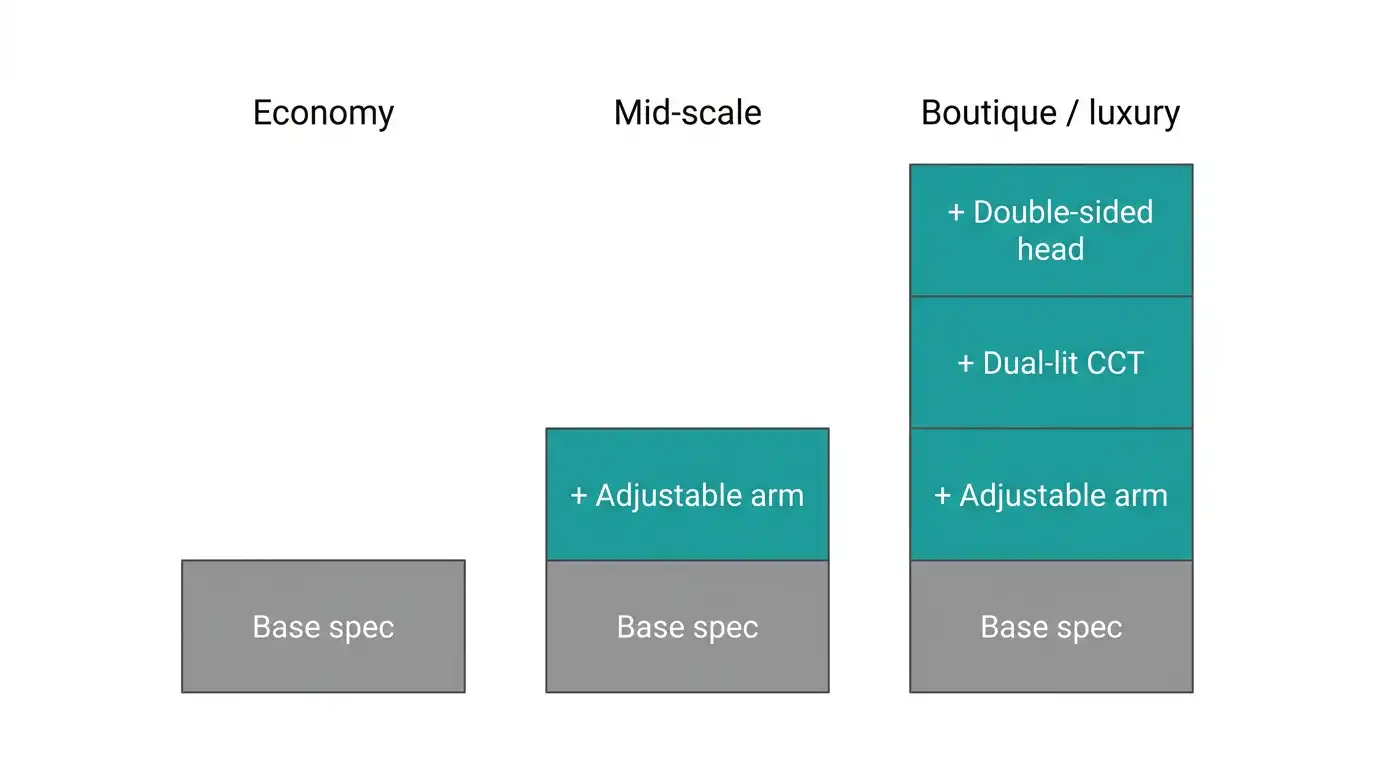
The per-unit cost gap between tiers isn’t really about the glass — it’s the moving parts and the electronics. A fixed-arm, single-sided, frontlit mirror is the simplest thing to manufacture and the cheapest to warranty, which is why it anchors the economy tier. Moving to an adjustable arm adds a mechanical joint; moving to dual-lit with tunable CCT adds a second LED circuit and a driver that supports it; moving to double-sided adds a second mirror face and a pivot. None of those are dramatic cost jumps individually, but stack three or four of them onto a luxury-tier spec and the difference between your economy and premium configuration compounds fast. If budget is fixed, it’s usually worth spending on CRI and R9 before spending on mechanical features — guests notice bad light immediately; they rarely notice that the arm has one fewer joint than the room next door.
Matching the Configuration to the Project
- Limited-service / economy: Fixed arm, single-sided, frontlit, CRI 90+. Lowest cost, lowest maintenance burden across a large room count.
- Mid-scale / select-service: Fixed or scissor arm, single-sided, frontlit or dual-lit, CRI 90+ with attention to SDCM consistency across floors.
- Boutique / luxury / spa: Scissor or gooseneck arm, double-sided with magnifying flip, dual-lit with tunable CCT, CRI 95+.
- Serviced apartments / multifamily: Similar to mid-scale, but weight installation simplicity more heavily since these units often go in without a dedicated hospitality install crew.
None of this is a fixed rulebook — a brand standard or a specific PIP requirement can override any line above — but it’s the starting matrix most procurement teams land on before customizing further. LuckMirror produces all of the mechanism, lighting, and sizing combinations described here as OEM/ODM configurations, so the spec above can be adjusted per project rather than forced into a fixed catalog SKU.
FAQs
Does a wall-mounted LED makeup mirror need to be hardwired in a hotel bathroom?
Most permanent hospitality installs are hardwired rather than plug-in, both for a cleaner look and to avoid a guest-accessible cord in a wet area. Confirm damp- or wet-location fixture ratings with your electrical contractor based on the mirror’s distance from the tub or shower.
What CRI should a hospitality-grade LED mirror have?
CRI 90 or higher is the common baseline across hospitality lighting specs, with an R9 of 50+ recommended specifically for mirrors, since skin tone rendering depends heavily on red-spectrum accuracy.
Can the same mirror configuration be used across different room categories on one property?
It can, but many properties differentiate by tier — fixed-arm single-sided mirrors in standard rooms, adjustable double-sided units in suites — rather than standardizing on one SKU property-wide.
Is a scissor arm less durable than a fixed arm for high-turnover guest rooms?
It has more moving parts, so it carries a somewhat higher warranty-claim rate than a fixed arm, but properties that spec it at mid-scale and above generally accept that tradeoff for the guest-facing adjustability.
Do these mirrors need an IP rating if they’re mounted away from the shower?
Most guest bathroom vanity locations only need a splash-rated fixture (commonly IP44), well below what’s required inside a shower enclosure. Confirm the exact zone requirement with your electrical contractor before finalizing the spec.