
Most bathrooms are lit by a single overhead fixture. It fills the room well enough, but the moment you stand in front of the mirror to shave or apply makeup, your face drops into shadow. That is the central problem with bathroom lighting — general illumination and task illumination are two different things, and confusing one for the other is the reason so many people look fine at home but step into daylight and realize something went wrong. This guide covers the fixtures, sizing rules, installation heights, and bulb choices that make lights over mirrors in bathrooms actually work, along with an honest comparison of traditional vanity fixtures versus the increasingly popular LED mirror.
What Bathroom Mirror Lighting Is Really For
Before choosing a fixture, it helps to be clear about what mirror lighting needs to do. The goal is even, shadow-free illumination across your face — not across the wall, not across the ceiling, across your face. That matters for shaving, applying makeup, checking skin, and any other task where you need to see details clearly.
Three things determine whether a fixture delivers on that:
- Evenness. Light coming from a single overhead point casts shadows under the nose, chin, and eyes. Light from multiple directions — or from a source wide enough to span the mirror — flattens those shadows.
- Color accuracy (CRI). A bulb with a high Color Rendering Index shows colors closer to how they appear in natural light. For makeup in particular, a CRI below 80 can make it genuinely difficult to match shades correctly.
- Glare control. Bare exposed bulbs pointing directly at the mirror bounce light into your eyes. Frosted glass, diffusers, or opaque shades distribute light more evenly without the harsh glare.
Everything else — style, finish, number of bulbs — is secondary to getting these three right.
5 Types of Lights Over Mirrors in Bathrooms
| Fixture Type | Best For | Shadow Control | Installation | Average Cost |
|---|---|---|---|---|
| Vanity bar light | Most bathrooms | Good | Simple | $30–$200 |
| Recessed downlights | Large bathrooms (as supplement) | Poor alone | Requires ceiling work | $20–$80 per unit |
| Hollywood globe lights | Glamour / makeup-focused bathrooms | Excellent | Moderate | $80–$400 |
| Backlit / LED mirror | Small bathrooms, minimalist design | Good at surface | Plug-in or hardwired | $100–$600 |
| Pendant lights | Decorative / double vanity | Moderate | Ceiling wiring needed | $60–$500 |
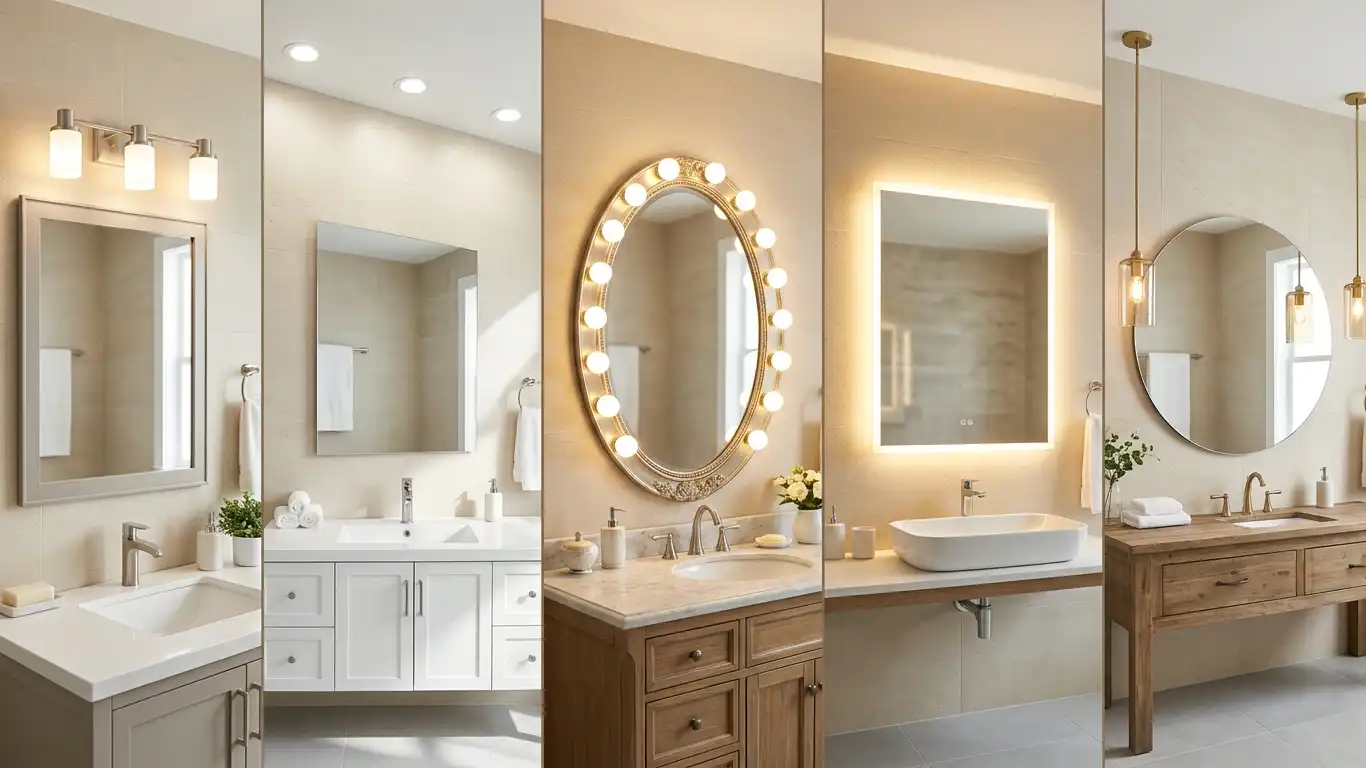
Vanity Bar Lights
A vanity bar light — sometimes called a bath bar or strip light — is a horizontal fixture mounted directly above the mirror. It is the most widely installed option for a reason: it is straightforward to fit, comes in standard widths that work with most mirrors, and delivers consistent illumination across the vanity area.
Most collections offer 2-light, 3-light, 4-light, and 5-light configurations. The number of bulbs matters less than the overall fixture width and total lumen output. A 3-light bar in the right width will outperform a 5-light bar that is too narrow.
One thing worth checking before you buy: whether the fixture can be mounted with bulbs facing up or facing down. Bulbs pointing down push more light toward the face but increase glare. Bulbs pointing up bounce light off the ceiling for a softer effect that works well in powder rooms or guest baths where intense task lighting is not the priority.
Bar lights work across most design styles — brushed nickel suits modern and transitional bathrooms, aged brass works in vintage and farmhouse spaces, and matte black reads as contemporary or industrial depending on the rest of the room.
Recessed Lights and Downlights
Recessed lighting over a mirror is a common choice in newly built or renovated bathrooms, and it looks clean. The problem is physics: a light source directly above your head casts downward shadows. Stand under a single recessed light and look in the mirror — your eyes, nose, and chin will all have dark areas underneath them.
That does not mean recessed lights have no role. In larger bathrooms, they work well as an ambient layer when combined with wall sconces or a vanity bar. Recessed fixtures at the shower, near the toilet, or toward the ceiling’s center add general brightness without competing with the task lighting at the mirror.
If you have recessed lights over the vanity and no other fixtures, consider adding a bar light or sconces rather than replacing what is already there.
Hollywood Globe Lights
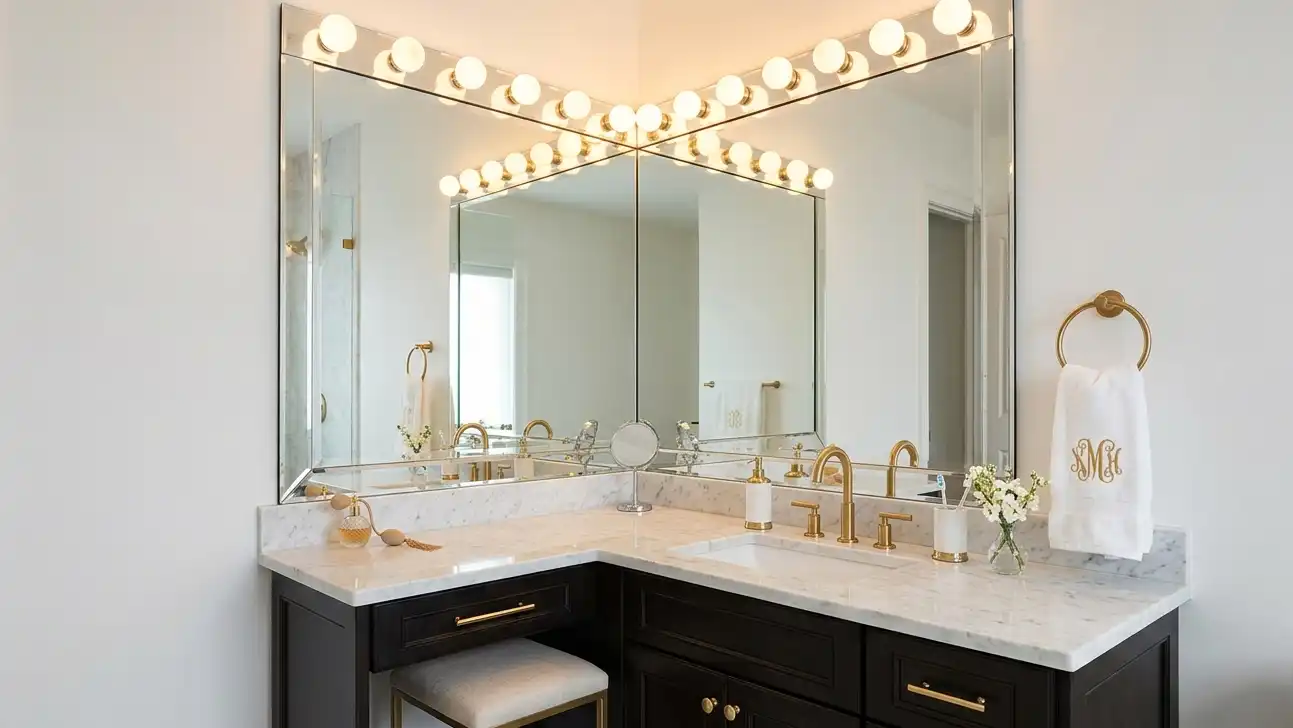
Hollywood-style vanity lighting — a row of round globe bulbs arranged horizontally above or around a mirror — became popular in dressing rooms because it genuinely solves the shadow problem. Light comes from multiple bulbs spread across a wide span, which means it hits the face from slightly different angles simultaneously. The result is flatter, more even illumination than a single bar fixture can achieve.
The trade-off is visual weight. A full Hollywood bar with eight or ten exposed bulbs is a statement piece. It works well in bathrooms with enough wall space to carry it, and in spaces designed around a glamorous or retro aesthetic. Pair it with a frameless mirror for a clean look, or a beveled mirror for something more ornate.
For bulb choice, frosted globe bulbs reduce glare compared to clear ones and still provide the spread of light that makes the style functional.
Backlit Mirrors and Lighted Mirrors
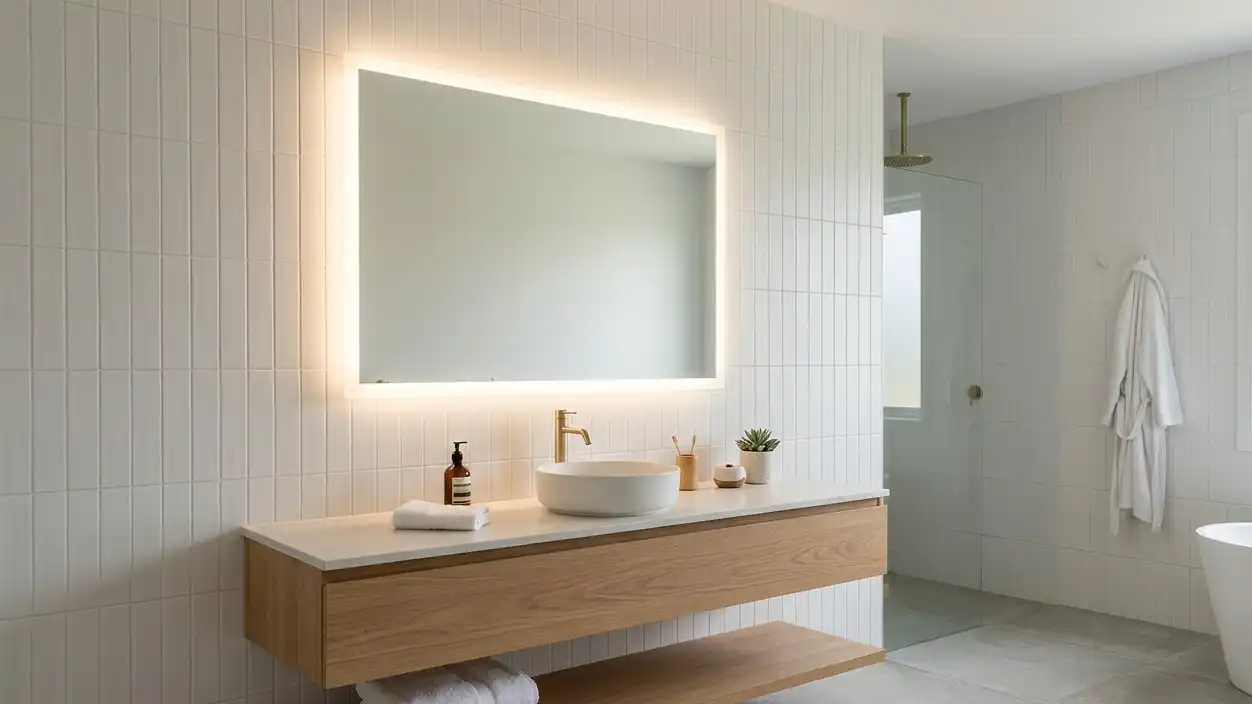
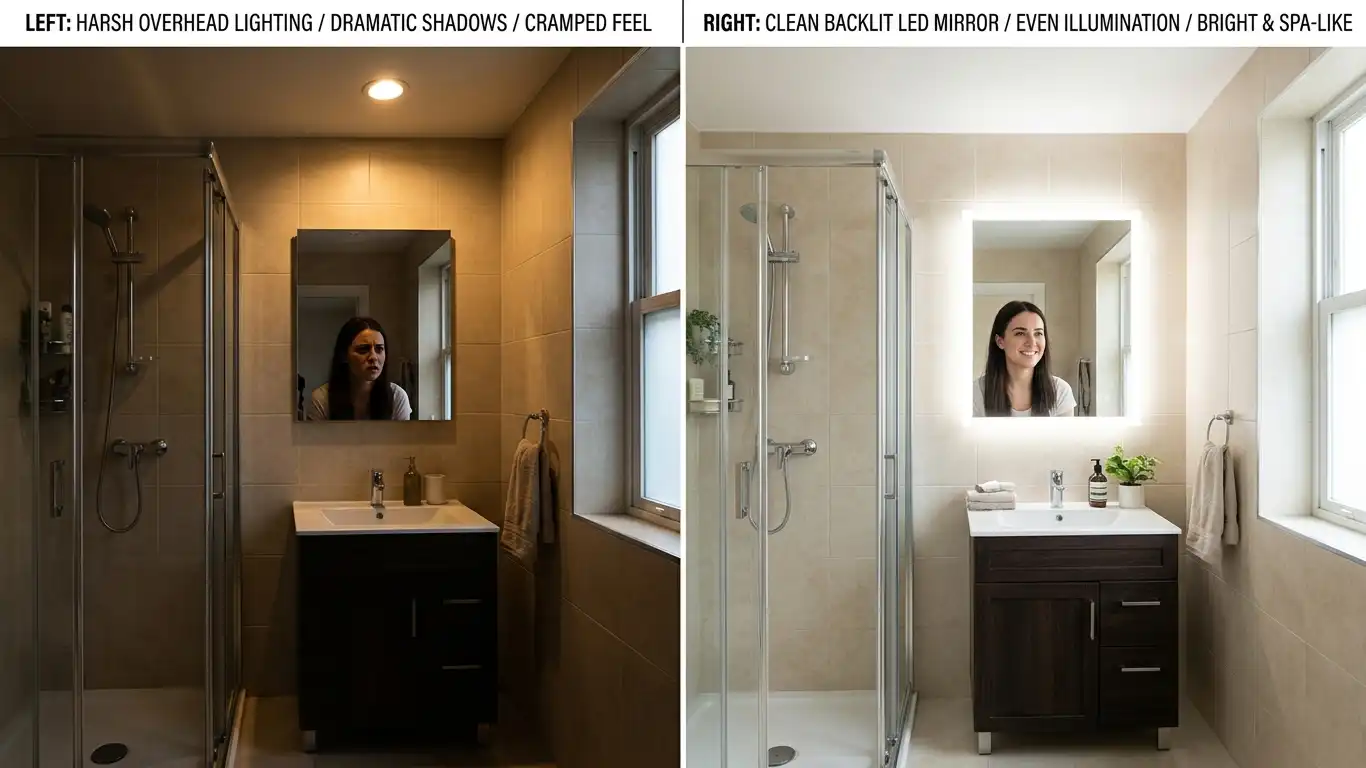
A backlit mirror has LED strips mounted behind the glass panel. The light glows around the mirror’s perimeter, producing a halo effect that reads as sophisticated and modern. An edge-lit or front-lit mirror has LEDs embedded at the edge or in the frame, projecting light forward across the mirror surface.
Both types are increasingly common in newly renovated bathrooms. The reasons are practical: they eliminate the need to coordinate a separate mirror and light fixture, they free up wall space, and most include built-in color temperature adjustment and dimming. Many also include anti-fog heating, which is genuinely useful in a steamy bathroom.
The honest limitation is output. A backlit LED bathroom mirror produces excellent close-range task light at the glass, but it does not throw enough ambient light to fill a large bathroom. In a compact powder room or a secondary bathroom, it can serve as the primary vanity light source. In a master bathroom or any room larger than roughly 50 square feet, it works best as the vanity layer within a broader lighting scheme that includes ceiling fixtures elsewhere.
See also: The Best Rated Lighted Makeup Mirror: Tested, Reviewed, and Ranked for a full comparison of current models.
LED Mirror vs Traditional Vanity Lights
This is the question that comes up most often in bathroom renovations, and the answer depends on the size of the bathroom, how the vanity is used, and how much wall space is available.
| Factor | LED Mirror | Traditional Vanity Light |
|---|---|---|
| Task lighting quality | Good at close range | Good to excellent depending on placement |
| Ambient room fill | Limited | Strong |
| Installation | Plug-in or hardwired | Hardwired (wall box required) |
| Color temperature control | Built-in (most models) | Depends on bulb choice |
| Space required | Mirror only, no extra wall space | Needs wall space above or beside mirror |
| Style flexibility | Modern / minimalist | Wide range of styles |
| Cost range | $100–$600 | $30–$400 |
| Best for | Small bathrooms, powder rooms, modern design | Most bathrooms, especially larger spaces |
The short version: an LED vanity mirror handles close-up task lighting well and works as a standalone solution in small bathrooms. Traditional fixtures provide more total light output and more design options. For larger bathrooms or double vanities, using both — a lighted mirror plus ambient ceiling fixtures — gives the most flexibility.
How to Size a Vanity Light
Fixture size is where a lot of installs go wrong. A light bar that is too wide overhangs the mirror and looks unintentional. One that is too narrow looks like it belongs on a smaller fixture somewhere else.
The standard guidance is to choose a fixture that is approximately 75% the width of the mirror. So if the mirror is 36 inches wide, the fixture should be around 27 inches. If the mirror is 48 inches, aim for 36 inches.
Single vanity sizing reference:
| Mirror Width | Recommended Fixture Width |
|---|---|
| 24 inches | ~18 inches |
| 30 inches | ~22 inches |
| 36 inches | ~27 inches |
| 42 inches | ~31 inches |
| 48 inches | ~36 inches |
One hard rule: the fixture width should never exceed the mirror width. A bar that extends past the mirror’s edges creates glare and bounces light in directions that are not useful.
For double vanities with two separate mirrors, use one bar above each mirror — sized to 75% of each individual mirror. For a double vanity with one large continuous mirror, use either two fixtures centered above each sink, or a single bar sized to 75% of the mirror’s total width. The two-fixture approach gives better light distribution; the single-fixture approach is cleaner visually.
How High Should Lights Be Above a Bathroom Mirror?
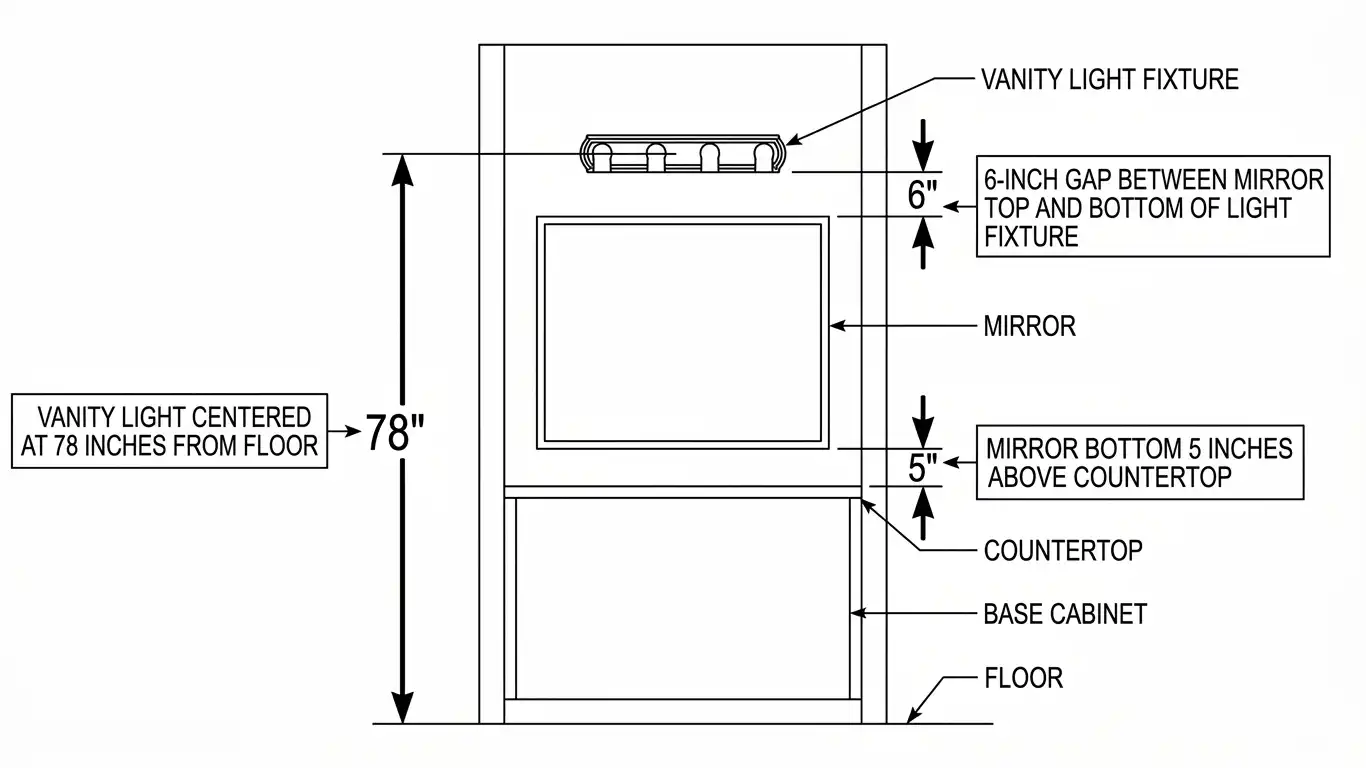
Mounting height affects both how well the fixture lights your face and how the wall proportions feel. The industry standard for a bar light mounted above a mirror is 75 to 80 inches from the finished floor to the center of the fixture.
In practical terms, that usually means the fixture sits 5 to 10 inches above the top edge of the mirror. That gap is important — if the fixture is installed flush against the mirror top, the light angle becomes too steep and shadows reappear underneath the features.
A few situations call for adjustment:
- Tall ceilings (9 ft or higher): The standard height may feel disconnected from the mirror. Consider a slightly larger fixture or mount slightly higher, up to 84 inches, to maintain visual proportion.
- Short ceilings (7 ft or less): There may not be room for the standard height. Work with what is available, prioritizing the 5-inch gap above the mirror over the floor measurement.
- Taller household members: Raising to 80 inches from the floor is reasonable if the primary users are above average height.
For more on coordinating light placement with mirror position, see Bathroom Mirror Height: The Complete Guide to Perfect Placement.
Color Temperature and Bulb Type
Color temperature is measured in Kelvin (K). The number tells you how warm or cool the light appears.
| Color Temperature | Appearance | Best Use |
|---|---|---|
| 2700K | Warm yellow-white | Ambient / relaxation lighting |
| 3000K | Warm white | General bathroom lighting |
| 3000–3500K | Natural white | Recommended for vanity tasks |
| 4000K | Cool white | Bright task lighting, clinical feel |
| 5000K+ | Daylight | Not recommended for bathrooms |
For a mirror used for makeup or detailed grooming, 3000–3500K is the sweet spot. It is close enough to natural daylight to show colors accurately without the harshness of a 4000K or higher bulb.
CRI (Color Rendering Index) matters as much as temperature. A bulb with a CRI of 90 or above will render skin tones and makeup shades more accurately than an 80 CRI bulb. This is the metric most often ignored at point of purchase and most often regretted afterward.
For bulb type: LED is the practical choice in almost every case. The lifespan is far longer than incandescent or CFL, they reach full brightness instantly, they work with most dimmer switches, and they run cool — relevant in a small, sometimes humid room.
One technical note for bathrooms: fixtures near the shower or in enclosed wet areas need a damp or wet location rating. Most vanity lights above a mirror are in a damp location zone (Zone 2) and require at minimum a damp-rated fixture. Check the product specification before installing.
Double Vanities and Small Bathrooms
Double vanities
The most common mistake with double vanity lighting is treating the two mirrors as one continuous surface and hanging a single fixture that does not span both. The result is bright in the middle and dim at the edges — the opposite of what you want.
The cleanest solution is one fixture per mirror, sized to 75% of each individual mirror, centered above each sink. This creates symmetry that reads as intentional and ensures both users get adequate light without competing.
If you have a single large mirror spanning both sinks, either use two fixtures centered over each sink, or use a single bar wide enough to light the full span (still sized to 75% of the total mirror width). The round LED mirror is worth considering for single-sink setups in double vanity arrangements — it provides uniform illumination without requiring additional wall fixtures.
Small bathrooms
In a compact bathroom, the priority shifts. You want enough light to see clearly without making the room feel smaller or cluttered with hardware.
A few approaches that work well:
- LED lighted mirror as the primary source. Eliminates a separate fixture entirely and keeps the wall clean. Works well when the bathroom is under about 45 square feet.
- Single narrow bar light. A 2-light or 3-light fixture in a compact width keeps the wall proportions from feeling crowded.
- White or light finishes. Light reflects more from pale surfaces, which means the same lumen output goes further in a light-colored small bathroom than in a dark one.
- Avoid recessed lighting as the only source. It creates the worst shadows in the smallest spaces.
For framed mirror options that complement smaller vanity setups, see Bathroom Mirrors Framed: The Complete Guide to Styles, Materials & Sizes.
Summary
Choosing lights over mirrors in bathrooms comes down to three decisions: what type of fixture suits the space, what size works with the mirror, and at what height to install it. A vanity bar light mounted at 75–80 inches from the floor, sized to roughly 75% of the mirror width, and fitted with a 3000–3500K LED bulb at CRI 90 or above covers the majority of bathrooms without overcomplicating things. For modern bathrooms with limited wall space, a backlit LED mirror eliminates the separate fixture entirely and handles task lighting well in smaller rooms. In either case, the goal is the same: even, shadow-free light at face level — and that is worth getting right.
Frequently Asked Questions
What is the best color temperature for bathroom vanity lights over a mirror?
The most practical range is 3000–3500K. This produces a neutral white light that renders skin tones and makeup colors accurately without the harshness of cooler daylight bulbs. Warm white bulbs below 2700K create a flattering glow but can make it difficult to judge whether foundation or concealer is the right shade.
Can you use recessed lights as the only lighting above a bathroom mirror?
Recessed lights alone are not recommended over a vanity mirror. A downlight mounted directly above the head casts shadows under the eyes, nose, and chin, making grooming tasks harder. They work well as a secondary ambient layer when combined with a wall-mounted bar light or sconces at or near mirror level.
How do you light a bathroom mirror without a junction box?
The easiest option is a plug-in LED mirror, which draws power from a standard outlet rather than requiring hardwired installation. Some plug-in vanity sconces are also available. Alternatively, a licensed electrician can add a junction box in the right position, which is typically a straightforward job during any renovation.
What size vanity light do I need for a 48-inch mirror?
Apply the 75% rule: 75% of 48 inches is 36 inches. Look for a fixture in the 34–38 inch range. The fixture should not exceed 48 inches — staying within the mirror width keeps the light properly directed and avoids visual imbalance.
Is a backlit LED mirror bright enough for applying makeup?
For a single-sink vanity in a bathroom up to roughly 45–50 square feet, a quality LED bathroom mirror with a front-lit or edge-lit design and a CRI of 90 or above is generally sufficient for makeup application. Backlit-only models (where light only glows behind the mirror, not in front of it) provide less useful task illumination and work better as ambient or accent lighting than as a standalone makeup light.