
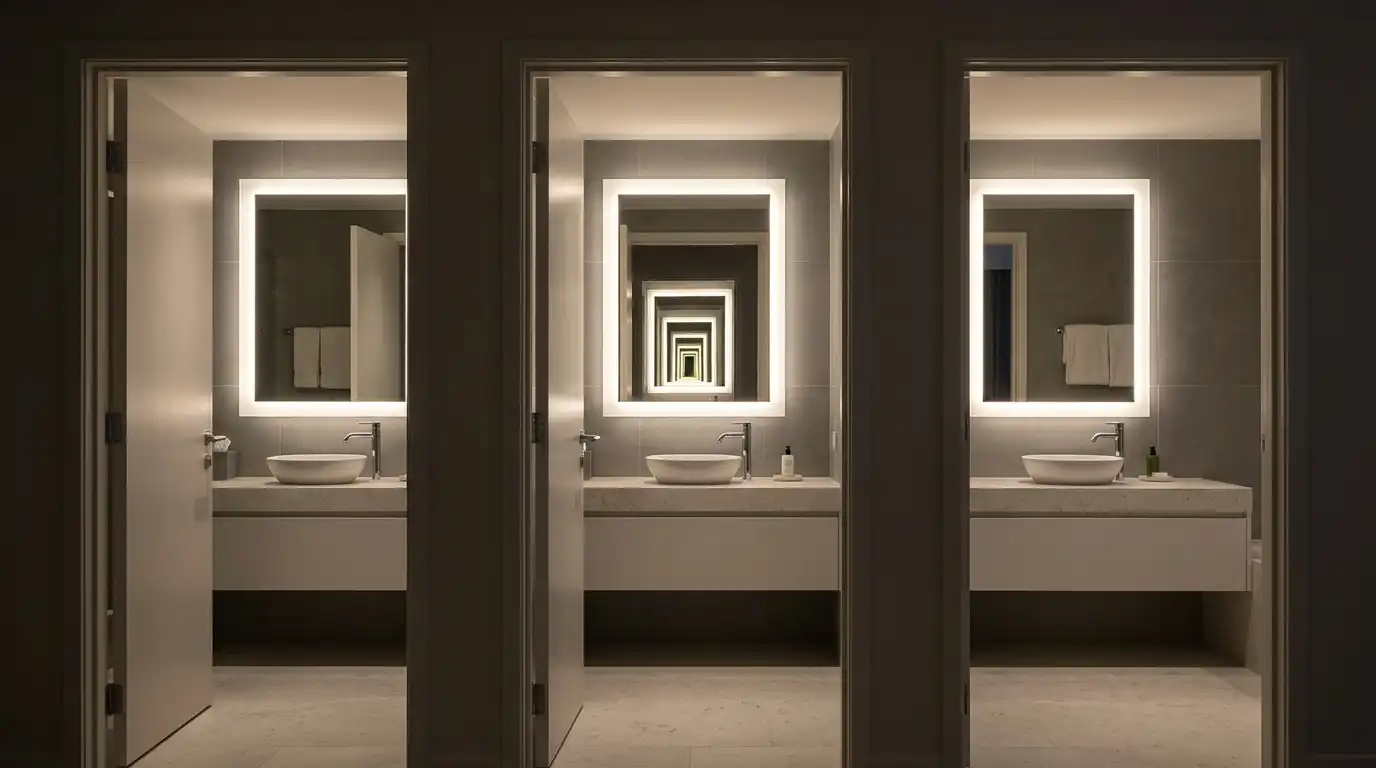
The LED lights in a mirror come down to six decisions: where the light sits (front, back, edge or both), which LED source is used, the colour quality and how tightly it is binned, the driver and its flicker behaviour, the controls, and the expected lifetime. For one retrofit, a self-adhesive strip and a plug-in adapter will do. For an order of 200 hotel mirrors or a private-label range, those six decisions belong on the specification sheet, because they decide whether mirror 1 and mirror 200 look the same.
Walk down a refurbished hotel corridor at night with the bathroom doors open and the problem is easy to see: one mirror glows slightly pink, the next slightly green, a third flickers on camera. Each mirror passed inspection on its own. Nobody had specified how closely they had to match. This guide explains each lighting decision in buyer’s terms and ends with a checklist you can send to a supplier with your RFQ. If you are adding a strip to a single existing mirror, our step-by-step guide to adding LED lights to the back of a mirror is the better starting point.
Where the Light Goes: Four Layouts
Layout decides what the light is for. Light that reaches the user’s face is task light; light that washes the wall is mostly decorative.
| Layout | How it works | Light on the face | Typical use |
|---|---|---|---|
| Front-lit | LEDs behind a frosted or etched band in the mirror glass | High | Guest bathroom vanities, salons |
| Backlit (halo) | LEDs on the back panel, light spills onto the wall | Low | Corridors, decor walls, ambient light |
| Edge-lit | LEDs in the frame or along one edge | Medium | Slim framed mirrors, retail ranges |
| Front-lit + backlit | Two LED circuits, often separately switched | High | Suites, premium units, makeup stations |
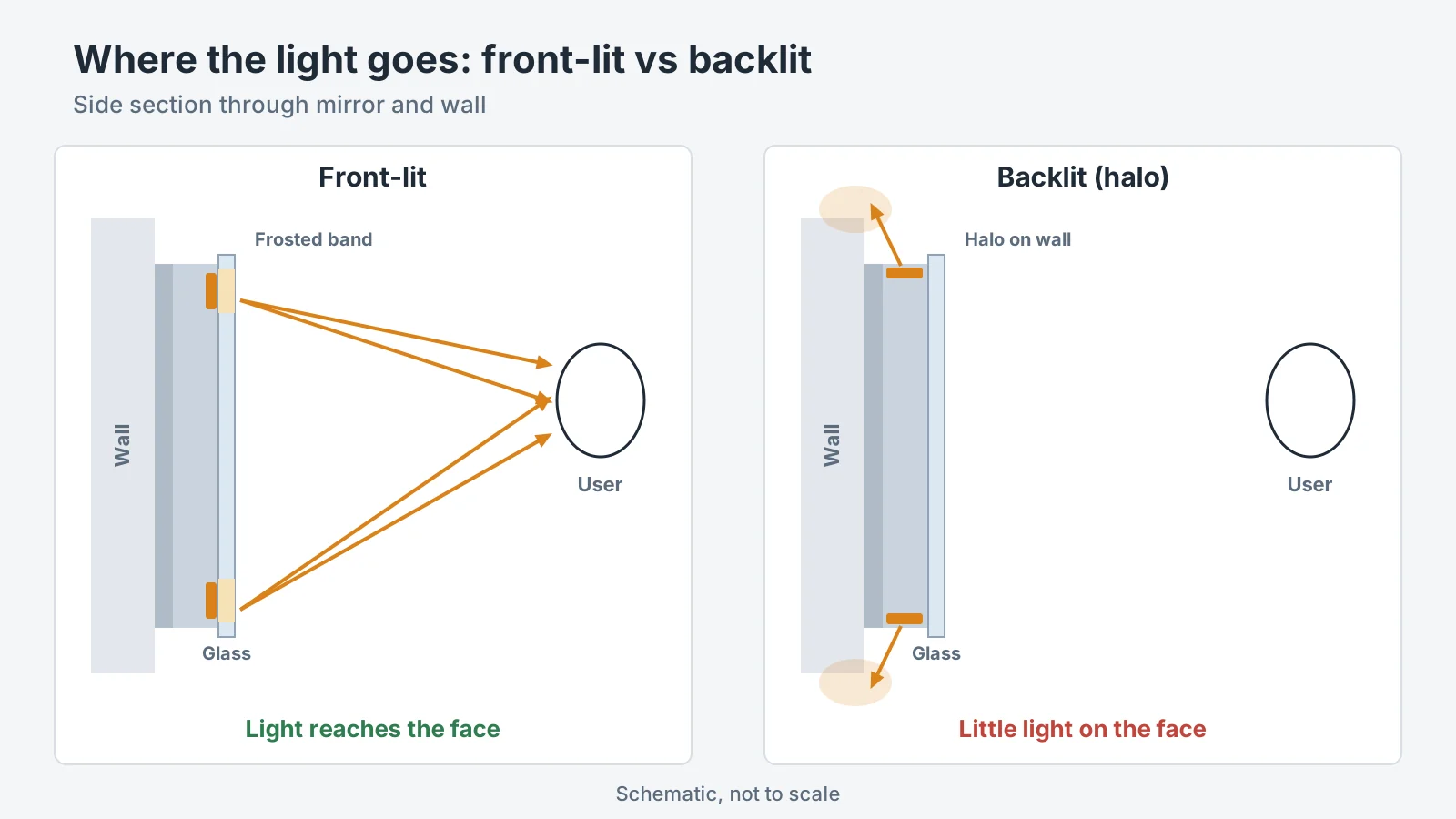
A backlit halo looks good in renderings but leaves shadows under the eyes and chin at a vanity. Where guests shave or apply make-up, specify front lighting or a dual layout. Our comparison of lights over mirrors versus lighted mirrors covers placement in more detail.
The LED Source: SMD Strip or COB
Most LED mirrors use flexible LED strip mounted on an aluminium channel or backplate. Two strip types dominate:
- SMD strip carries individual LED packages (commonly 2835 or 5050 sizes) at a set density per metre. Behind a narrow frosted band, low-density strip can show as a row of bright dots.
- COB (chip-on-board) strip places chips so closely that the line of light looks continuous, even with a short distance between strip and diffuser.
What matters to the buyer is the result on the finished mirror, not the strip datasheet. Ask for two things at sample stage:
- No visible hot spots through the frosted band or halo at full brightness, viewed from normal standing distance.
- Measured light output of the finished mirror, not the lumens-per-metre rating of the strip. A strip rating is measured bare; once it sits behind frosted glass or in a channel, the usable output is lower.
Colour: CCT, CRI, R9 and Binning
CCT (correlated colour temperature) sets how warm or cool the light looks. Bathroom mirrors usually offer 3000 K (warm), 4000 K (natural) and around 6000 K (cool), often switchable on one touch button.
CRI and R9 describe how accurately colours look under the light. For grooming, a CRI of 90 or higher is the common request, with R9 (saturated red, important for skin tones) stated separately, because a strip can reach CRI 90 with a weak R9.
Binning is the part most specifications leave out. Two LEDs both sold as “3000 K” can still look visibly different. The ANSI C78.377 standard defines each nominal CCT as a region roughly the size of a 7-step MacAdam ellipse, and differences of about 4 steps or more are generally noticeable side by side. Mirrors hung in a row are always seen side by side.
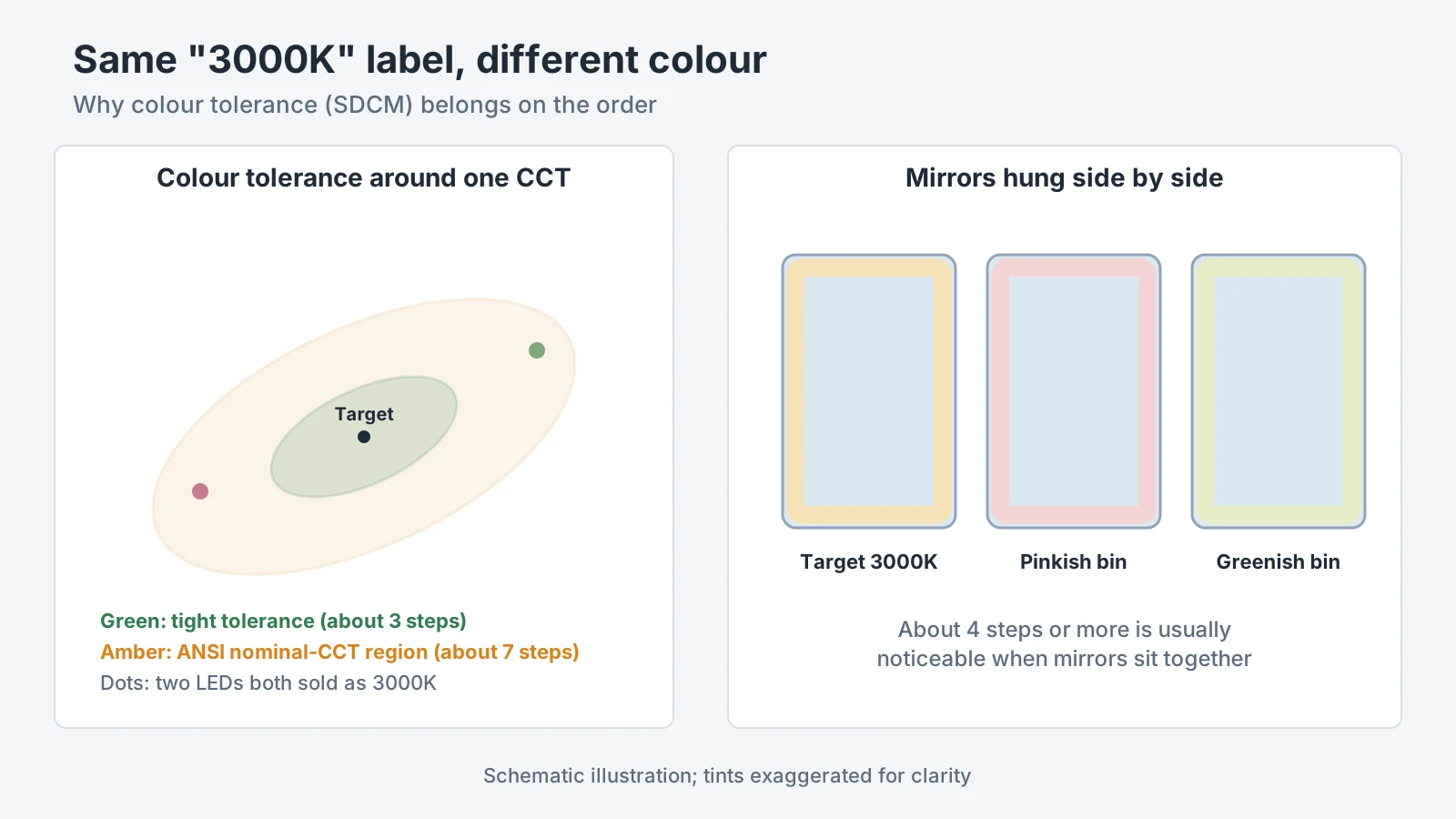
For any project where mirrors are installed next to each other, or for a retail range that customers compare on a shelf:
- Specify a tight colour tolerance (many projects ask for 3 SDCM or less) and ask the supplier which bin they buy.
- Ask for all mirrors in one order to come from the same LED batch where possible.
- For repeat orders, keep an approved sample as the colour reference, because LED bins change between production lots.
- For switchable-CCT mirrors, fix the default setting at power-on, so that every room starts at the same colour after housekeeping switches the circuit off and on.
Driver, Power and Flicker
The LED driver converts mains power to the low-voltage DC the strip runs on, typically 12 V or 24 V constant voltage. It is also the most common reason an LED mirror stops working before its LEDs wear out, so its quality and position matter.
- Flicker. Cheap drivers and some dimming methods produce flicker that people may not see directly but which shows on phone cameras and can cause discomfort. A US Department of Energy summary of the IEEE 1789 recommended practice puts the low-risk limit at a percent flicker no higher than 0.08 × the flicker frequency, which works out to about 10% at 120 Hz. Ask for flicker to be tested across the full dimming range, not only at full brightness.
- Access. Specify a driver that can be reached or replaced without taking the mirror off the wall, for example through a removable back cover or a driver mounted in the wall box.
- Load. Anti-fog pads draw power too. Confirm the driver and wiring are sized for lighting and demister running together.
- Certification. A certified driver or strip does not make the finished mirror certified. Markets and sales channels that require a safety listing require it for the complete lighted mirror, so ask for test reports that cover the finished product.
Controls and Behaviour After a Power Cut
Controls cause more complaints in hotels than light quality, mainly because nobody specified how the mirror behaves when power returns.
| Control | What to specify |
|---|---|
| Touch button on glass | Position (away from the main wiping area), long-press dimming, memory of last setting |
| Wall switch only | Mirror lights at a fixed default brightness and CCT every time |
| Motion sensor | Detection range, switch-off delay, whether it can be disabled |
| Auto shut-off | Time-out for light and demister, so neither runs all night |
Most hotel rooms are switched off at a master key card. Decide whether each mirror should come back on at its last setting or at a fixed default, and put that in writing.
Lifetime: What L70 Claims Mean
LED lifetime is usually stated as L70: the operating hours until light output falls to 70% of its initial level. The figure comes from IES LM-80 tests on the LED package, projected forward with the IES TM-21 method. TM-21 limits how far the data can be stretched: with 20 or more samples, the projection may not exceed six times the test duration, according to ENERGY STAR’s TM-21 summary. A 6,000-hour test therefore supports a projection of no more than 36,000 hours.
Two cautions for buyers:
- LM-80 data describes the LED package at a set temperature. Inside a mirror, the strip runs warmer or cooler depending on the aluminium channel and ventilation, so the lifetime of the finished mirror can differ.
- A lifetime claim for the LEDs says nothing about the driver, touch sensor or demister, which often fail first. The warranty terms, not the L70 figure, show what the supplier will actually stand behind.
Lighting Specification Checklist for Your RFQ
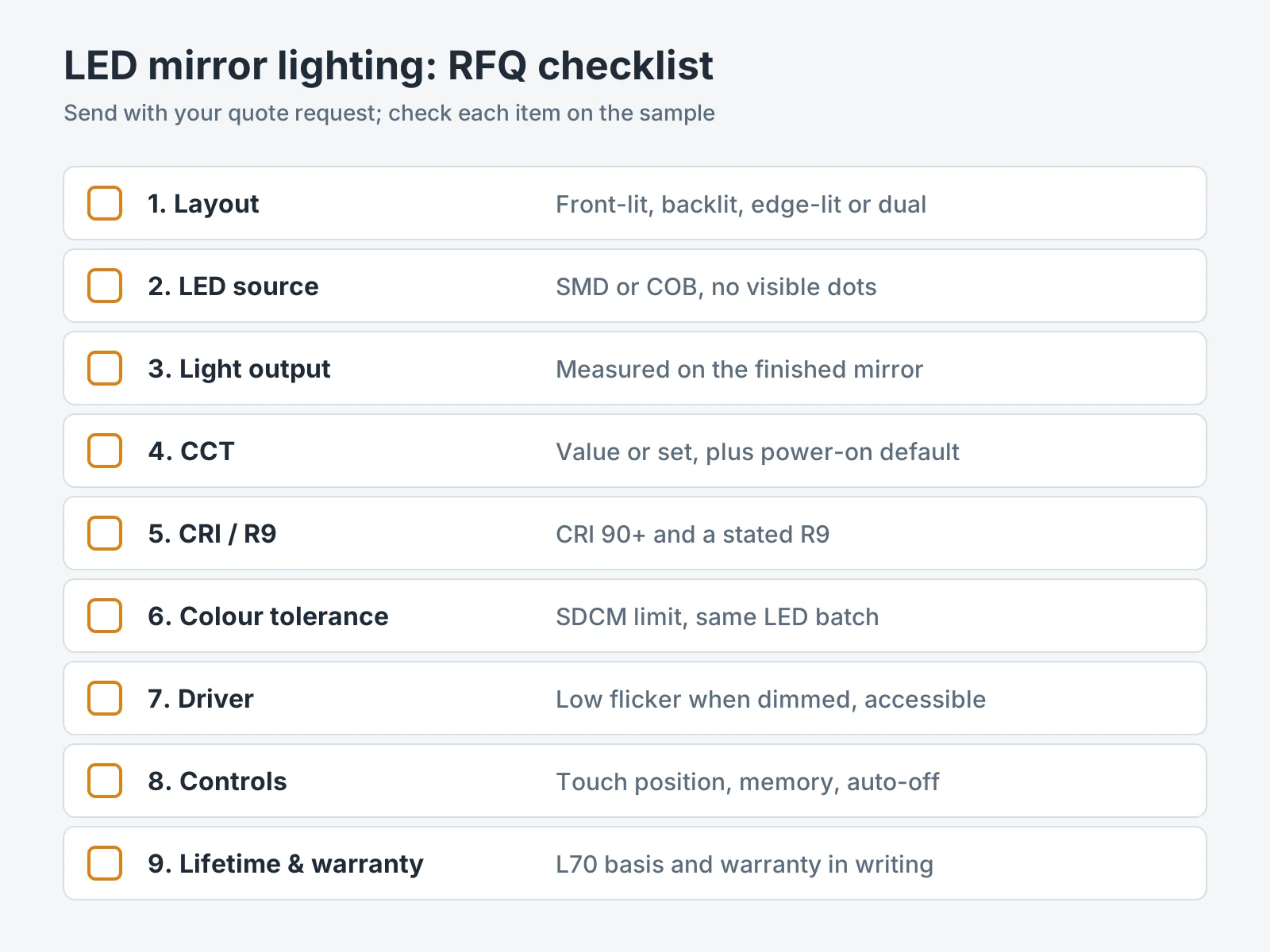
| Item | What to specify | How to check at sample stage |
|---|---|---|
| Layout | Front-lit, backlit, edge-lit or dual | Light on the face at the vanity |
| LED source | SMD or COB; no visible dots | View at full brightness from standing distance |
| Light output | Measured output of the finished mirror | Supplier measurement or side-by-side comparison |
| CCT | Fixed value or switchable set, plus power-on default | Check after switching power off and on |
| CRI / R9 | CRI 90+ and a stated R9 value | Supplier test report |
| Colour tolerance | SDCM limit and same-batch LEDs | Compare several samples side by side |
| Driver | Voltage, flicker across dimming range, access | Phone-camera check; remove the access cover |
| Controls | Touch position, memory, sensor, auto-off | Operate every function on the sample |
| Lifetime and warranty | L70 basis and warranty terms in writing | Request LM-80/TM-21 data and the warranty document |
LuckMirror builds LED bathroom mirrors for OEM and ODM orders, from 50 pieces per model, with moisture-resistant designs and a 3-year warranty. Lighting layout, colour temperature, dimming, anti-fog, touch controls, size, frame, logo and packaging can all be specified for your project, and lead times are confirmed for each order. See our customization options or send us your lighting specification for a quote.
FAQ
Can the lighting configuration be customised for one project without a large order?
At LuckMirror, the minimum is 50 pieces per model. A change of lighting layout, CCT set or control type usually counts as a separate model, so confirm how your mix will be counted when you request a quote.
How do we keep the light colour the same on a repeat order?
Keep an approved sample as the colour reference, state the CCT, CRI and SDCM tolerance on the purchase order, and ask the supplier to compare the new production against the reference before shipping. LED bins vary between lots, so a written tolerance matters more than the CCT label.
Is the LED driver replaceable after installation?
It depends on the design. Specify driver access at the order stage, through a removable back cover or a driver mounted in the wall box, so maintenance staff can replace it without removing the mirror.
Which certifications does a lighted mirror need for our market?
That depends on the destination market and sales channel. Whatever the requirement, it applies to the complete lighted mirror. Certificates for the driver or the LED strip alone do not cover the finished product, so plan certification costs and timing into the program.
Can we get a sample before placing the order?
Ask for a sample of each lighting configuration and check it against the checklist above. The sample then becomes the reference for colour, brightness and control behaviour in production.