
For most bathrooms, the best lighted mirror combines dual-sided or front-lit LED lighting in the 4000K–5000K range, a CRI of 90 or higher, a built-in anti-fog pad, and at least an IP44 rating. Beyond that baseline, the right pick depends on how the mirror gets used: anyone doing detailed makeup or tweezing wants a 3x–5x magnification insert, while a mirror going up near a shower or tub needs its rating matched to the wiring code for that specific zone. The sections below walk through each factor individually, with manufacturer spec data and the codes and standards behind it.
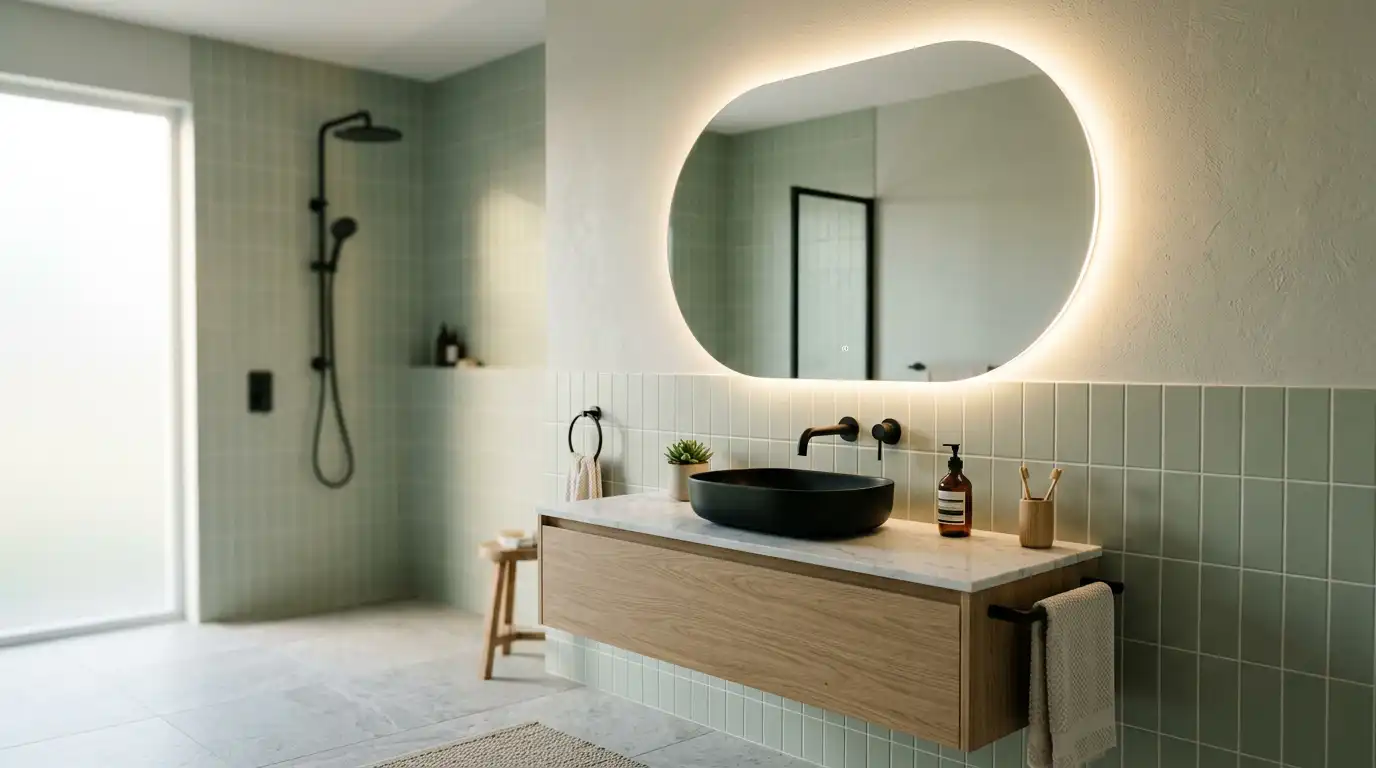
How to Choose a Lighted Mirror
Brightness is the easiest spec to compare and the least useful one on its own. Two mirrors can list similar lumen output and feel completely different in use, because the number doesn’t say where the light is coming from, what temperature it is, or how faithfully it renders skin tone. A better shortlist works through five questions in order: where does the light sit relative to your face (lighting type), what color is it (color temperature and CRI), do you need a magnified section, will steam be an issue, and what safety rating does the installation location require. Answer those, and the rest — frame style, touch controls — comes down to taste and budget.
Front-Lit vs Back-Lit vs Edge-Lit vs Dual-Lit
The position of the LEDs changes how your face actually looks in the mirror, which matters more than most spec sheets suggest.
- Front-lit mirrors put LEDs directly behind the glass, facing you. This gives the most even, shadow-free light for tasks like shaving or applying eyeliner.
- Back-lit mirrors position LEDs around the perimeter, shining outward against the wall. It creates a soft halo effect that’s flattering for ambiance but throws light past your face rather than onto it.
- Edge-lit mirrors run a thin LED strip along the border, visible as a glowing outline. It’s a middle ground — more style than task lighting.
- Dual-lit designs combine front and rear LEDs in one fixture. One current-production example, the dual-lit LED bathroom mirror line, pairs both light sources behind a single touch switch so brightness adjusts across front and back together.
| Lighting type | Where the light sits | Best for | Shadow risk |
|---|---|---|---|
| Front-lit | Behind the glass, facing outward | Shaving, makeup, skincare | Low |
| Back-lit | Around the perimeter, facing the wall | Ambient/night lighting | High on the face |
| Edge-lit | Thin strip along the frame edge | Style accent, mild task use | Moderate |
| Dual-lit | Front and rear combined | Task use with adjustable ambiance | Low |
If the bathroom already has a separate vanity fixture, it’s worth comparing that setup against a built-in mirror light before buying either — this breakdown of lights over mirrors versus lighted mirrors covers when a fixture-based approach still makes sense.
Color Temperature: Warm, Natural, or Cool White
Color temperature is measured in Kelvin (K), and it has nothing to do with brightness — a dim bulb and a bright one can share the same color temperature. Lower numbers look amber and warm; higher numbers look blue-white and clinical.
| Kelvin | Appearance | Typical use |
|---|---|---|
| 3000K | Warm white, amber tone | Relaxing, evening ambiance |
| 4000K | Natural white | General grooming |
| 5000K | Neutral daylight | Makeup, color-critical tasks |
| 6000K+ | Cool white, blue-toned | Maximum clarity, detailed shaving |
For a task mirror specifically, most lighting guidance lands in a narrower band than the full range suggests. One lighting overview focused on vanity mirrors puts the ideal range around 4000K to 5000K, balanced and daylight-like without the harshness of higher Kelvin settings. Several current mirror lines sidestep the choice entirely by offering all three — a common touch-control pattern cycles through 3000K, 4000K, and 6000K with a short press, so the same fixture covers evening routines and detailed morning tasks.
CRI: Why the Number Matters More Than Watts
Color Rendering Index (CRI) measures how accurately a light source reveals true color compared to natural daylight, on a scale of 0 to 100. It’s a separate spec from Kelvin — a light can be perfectly neutral in tone and still render skin badly if the CRI is low. According to Westinghouse Lighting’s lighting education material, sources in the 80–90 range are considered good, and anything above 90 is excellent, with incandescent and halogen bulbs sitting at a full 100. For a bathroom mirror specifically, that distinction is practical, not academic: a CRI below 80 can make foundation shades look mismatched under the mirror and correct once you step into daylight. Pair a 4000K–5000K color temperature with a CRI of 90+ and skin tones read close to true.
Choosing the Right Magnification (1x, 3x, 5x, 10x)
Magnification is the one spec that’s genuinely about distance, not just strength. A 10x insert isn’t a stronger version of the main mirror — it’s built for a specific working distance, typically 8–12 inches, and looks distorted if you lean in too close or sit too far back. Manufacturer FAQ data on magnifying inserts is consistent on this point: at the correct focal distance, 10x magnification shows pore-level detail without warping proportions, and the “distortion” people report is almost always a distance problem, not a glass defect.
As a rough guide: 1x–2x suits general grooming, 3x–5x covers most makeup and skincare tasks, and 8x–10x is for precision work like tweezing, blackhead removal, or contact lens insertion. Anyone who wears glasses or contacts arguably benefits from a magnifying section more, not less, since it compensates for the vision correction they’re not wearing during close-up tasks. For sizing an insert to a specific vanity, see this bathroom magnifying mirror guide.
Anti-Fog and Defogging Technology
Anti-fog mirrors use a thin heating element — usually a demister pad — bonded to the back of the glass, warming the surface just enough to prevent condensation from forming. It’s a passive system: switch it on before or during a shower, and the glass stays a few degrees above dew point the whole time. Response time varies by model; some current designs advertise clearing a fully steamed surface within a couple of minutes of activation. It’s worth checking whether the defog function runs on its own switch or is tied to the main light circuit, since a mirror that only defogs while lit isn’t much help to anyone who likes showering with the bathroom dim.
Touch Controls and Dimming
Capacitive touch switches have mostly replaced mechanical buttons on lighted mirrors, and the better ones pack two functions into one control. A pattern that shows up repeatedly across current product lines: a short press cycles through color temperature options, while a long press — often held for about three seconds — shifts into dimming mode, adjusting brightness from roughly 10% up to 100%. It’s a small detail, but it means one touch point handles both jobs instead of requiring separate switches, which matters in a wet environment where fewer exposed controls is generally safer.
Framed vs Frameless Design
A framed mirror has a visible border — wood, metal, or resin — that can hide wiring and mounting hardware but also blocks a portion of any edge- or back-lit glow. Frameless designs, sometimes finished with a beveled edge, create a cleaner, “floating” look and let edge lighting read as a continuous halo rather than a lit strip behind a rim. Neither is objectively better; it’s a tradeoff between concealment and visual lightness. Anyone weighing a beveled frameless mirror against a bordered one can compare styles in this guide to beveled bathroom mirror styles, and the round LED mirror line is a common frameless starting point for smaller powder rooms.
IP Ratings and Bathroom Zones
An IP (Ingress Protection) rating is a two-digit code — the first digit for solids, the second for liquids — defined by the international standard IEC 60529. For bathroom mirrors, only the second digit usually matters: IPX4 (or IP44, once dust protection is included) means protected against splashing water from any direction, which covers most sink-adjacent installations.
Where the rating actually needs to go higher is proximity to water, not just “somewhere in the bathroom.” UK and EU wiring regulations formalize this with numbered zones; a plain-language breakdown of the system explains that fixtures inside a shower or directly above a bath typically need a higher rating than ones mounted a meter or more away — see this overview of bathroom zones and IP ratings for specifics. The table below simplifies the general pattern; exact zone boundaries vary by country and code edition, so always check local regulations before installing.
| Zone | General description | Typical minimum IP rating |
|---|---|---|
| Inside shower/bath | Direct water contact | IP65–IP67 |
| Above sink / near shower edge | Splash exposure | IP44 |
| General wall space, away from water | Humidity, no direct splash | No formal minimum (IP20+ common) |
The US doesn’t use this exact zone system — the National Electrical Code instead classifies fixtures as “wet-location” or “damp-location” rated based on distance from a tub or shower rim, a related but not identical framework, covered next.
Wet-Location Safety and Certifications
In the US, a light fixture installed within roughly 3 feet horizontally and 8 feet vertically of a tub or shower generally needs a damp- or wet-location rating under the NEC, and GFCI protection applies to bathroom receptacles rather than fixed lighting circuits in most cases — though local amendments sometimes extend that requirement, so it’s worth confirming with a licensed electrician before a hardwired install.
Beyond wiring codes, product certifications indicate the fixture itself was independently tested. CE and RoHS cover electrical safety and restricted substances for the EU market; ETL and UL both indicate testing by a nationally recognized lab against the same safety standards, with the main practical difference being which lab did the testing rather than the rigor involved, as LEDVANCE’s comparison of the two marks lays out. A spec-sheet check across current bathroom mirror lines shows CE, RoHS, ETL/UL, and IP44 or IP54 listed as the standard certification set — a reasonable baseline to look for regardless of brand.
Matching the Mirror to the Scenario
Rather than a generic top-five list, it’s more useful to match mirror type to the room:
- Small powder room or guest bath: A compact frameless or round LED mirror with edge lighting keeps the wall visually light.
- Double vanity: Two front-lit or dual-lit mirrors with independent touch controls, so each person sets their own color temperature.
- Dedicated makeup station: A vanity mirror or bathroom mirror with a built-in magnifying insert, CRI 90+, adjustable Kelvin.
- Rental or no-drill install: A plug-in model, since hardwired mirrors generally need an existing junction box or an electrician in most bathroom wet zones.
FAQs
Do LED bathroom mirrors need to be hardwired by an electrician?
Hardwired models usually do, especially within the wet zones covered by local electrical code. Plug-in versions can typically be installed without an electrician as long as a grounded outlet is within safe reach of the cord.
What color temperature is best for applying makeup?
Most guidance points to 4000K–5000K paired with a CRI of 90 or higher, which renders skin tone close to natural daylight without the blue cast of higher Kelvin settings.
Can a lighted mirror be mounted directly above a shower or inside a wet zone?
Generally no, unless it carries a rating built for that zone — inside a shower typically calls for IP65 or higher, well above the IP44 rating most standard bathroom mirrors carry.
Is IP44 enough for a mirror mounted above a bathroom sink?
For most sink installations, yes — IP44 covers splash exposure from any direction, which is the typical risk level at a vanity that isn’t inside or directly beside a shower enclosure.
How long do LED bathroom mirror lights last before needing replacement?
LED arrays in quality fixtures commonly run 30,000–50,000 hours before noticeable dimming, which works out to several years of daily use — though the driver or touch switch can fail sooner than the LEDs themselves.